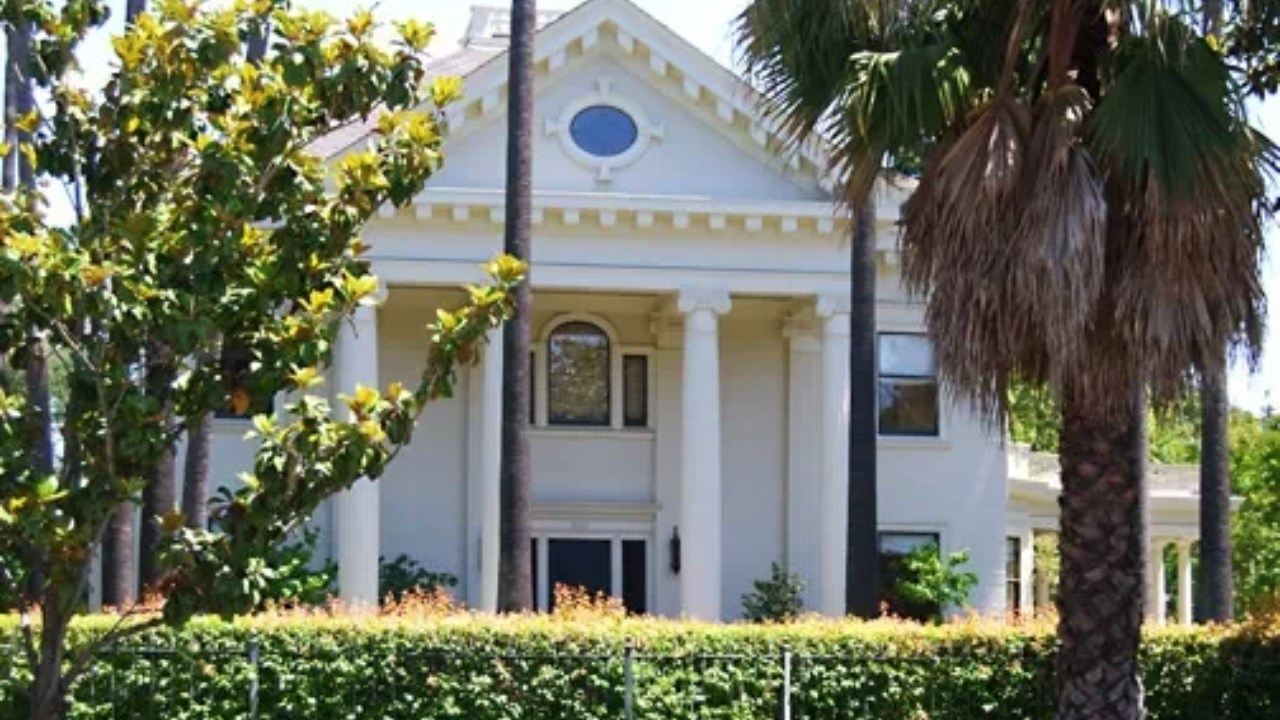
Historic trophy real estate in supply-constrained technology hubs does not trade on standard residential valuation metrics. The near-$20 million listing of Palo Alto’s Squire House—a 1904 Neoclassical estate originally constructed for Stanford University classics professor John Adams Squire—demonstrates how scarcity, regulatory friction, and cultural provenance decouple an asset’s price from traditional comparable sales. Evaluating this property requires dissecting the structural mechanisms that transform a century-old residential structure saved from demolition into an ultra-high-net-worth capital store.
The Structural Valuation Framework of Trophy Historic Assets
Standard residential real estate relies on the sales comparison approach, adjusting price per square foot based on recent local transactions, lot size, and bedroom count. At the upper tier of the Silicon Valley market, this methodology fails because asset uniqueness eliminates true comparables. Instead, institutional and ultra-high-net-worth buyers price properties like the Squire House using a three-part valuation model: Intrinsic Land Utility, Regulatory Scarcity Value, and Cultural Provenance Equity.
The first component, Intrinsic Land Utility, establishes the baseline floor price. Situated at 900 University Avenue in Palo Alto, the property occupies a prime parcel within walking distance of downtown Palo Alto and the Stanford University campus. In this micro-market, unimproved or teardown residential land routinely commands extreme premiums due to zoning restrictions that prevent high-density subdivision. The underlying dirt acts as a non-depreciating bond backed by the concentration of venture capital and technology equity within a five-mile radius.
The second component, Regulatory Scarcity Value, accounts for the cost and impossibility of replicating the structure under modern municipal codes. Built in 1904 by architect T. Paterson Ross, the Squire House features architectural elements—such as its towering Corinthian columns, grand portico, and expansive interior volumes—that face severe entitlement barriers today. Modern Palo Alto zoning ordinances, floor-area-ratio (FAR) caps, daylight plane restrictions, and historic preservation overlays make constructing a new residence of identical scale and setback virtually impossible. The buyer is not merely purchasing timber and plaster; the buyer is acquiring grandfathered developmental rights that bypass multi-year architectural review boards and environmental impact assessments.
The third component, Cultural Provenance Equity, functions identically to the art market’s valuation of blue-chip works. The Squire House is listed on the National Register of Historic Places and carries a documented narrative tied directly to the founding academic era of Stanford University. Unlike newly constructed modern estates, which suffer immediate functional and aesthetic obsolescence as architectural trends shift, a certified historic landmark appreciates through institutional validation. The narrative of its survival—having been rescued from demolition in the late twentieth century through preservationist intervention—adds a layer of irreproducibility that insulates the asset from broader market downturns.
The Economics of Adaptive Reuse and Preservation Friction
The survival of the Squire House highlights a critical inflection point in urban real estate economics: the battle between redevelopment yield and preservation cost. In high-appreciation corridors like University Avenue, the economic incentive to demolish older structures is driven by the Highest and Best Use (HBU) principle. When the land value exceeds the combined value of the land and the existing improvements, rational market actors seek demolition to maximize allowable square footage or convert single-family parcels into higher-yielding commercial or multi-family uses.
During the mid-to-late twentieth century, the Squire House faced this exact economic threat. Maintaining a massive 1904 Neoclassical residence requires capital expenditures that scale non-linearly compared to modern construction. The cost function of historic preservation includes specialized artisan labor, non-standard millwork replication, structural seismic retrofitting, and the complete replacement of obsolete mechanical, electrical, and plumbing (MEP) systems concealed behind historic plaster and woodwork. Without intervention, the negative cash flow from maintenance and property taxes forces owners to liquidate to developers who value the parcel solely for redevelopment.
Preservation succeeded in Palo Alto because municipal policy and private capital altered the HBU equation. By designating the structure as a historic landmark and integrating it into the National Register, local authorities stripped away the demolition option, effectively capping the parcel's redevelopment potential while simultaneously granting it monopoly status as a preserved architectural artifact. Subsequent owners internalized the high capital expenditure of restoration, converting what was once an economically obsolete liability into a modernized, turnkey trophy residence. The current ~$20 million asking price reflects the cumulative recovery of those sunk restoration costs, compounded by four decades of Silicon Valley wealth creation.
Market Microstructure in Palo Alto’s Ultra-Prime Tier
Understanding why a property of this profile reaches the $20 million threshold requires examining the capital flows specific to Santa Clara County’s ultra-prime residential sector. Unlike global financial centers such as New York or London, where trophy real estate absorbs international sovereign and institutional capital, Palo Alto’s ultra-high-end market is overwhelmingly driven by localized liquidity events—initial public offerings, mergers and acquisitions, and secondary share sales within the technology sector.
- Supply Inelasticity: Palo Alto’s geographic boundaries are fixed, bordered by San Francisco Bay wetlands to the east, Stanford University lands to the west, and neighboring municipalities to the north and south. New single-family housing supply is near zero. When a historic estate on a premier street like University Avenue enters the market, it represents a generational liquidity event rather than routine inventory turnover.
- Low Leverage Sensitivity: Transactions in the $15 million to $25 million bracket in Silicon Valley exhibit minimal elasticity to benchmark interest rate fluctuations. A high percentage of acquisitions execute via all-cash offers or bespoke private banking credit lines collateralized against concentrated public equity portfolios. This insulates the listing price from the mortgage rate compression that suppresses mid-market residential volume.
- Tax Basis Lock-In Effects: California’s Proposition 13 caps annual property tax increases at 2 percent from the base year of purchase. Long-term owners of historic Palo Alto estates hold artificially low tax bases, creating a powerful disincentive to sell. Consequently, properties only surface on the open market during major life transitions, estate settlements, or strategic portfolio reallocations, keeping active inventory chronically starved.
Operational Realities and Ownership Liabilities
Acquiring a designated historic property at a $20 million valuation introduces specific operational constraints that differentiate it from newly built luxury spec homes. Prospective buyers and their family offices must underwrite three distinct operational liabilities before executing an acquisition.
First, exterior modification autonomy is strictly curtailed. Because the Squire House carries formal historic designations, any alterations to the facade, roofline, windows, or primary structural footprint require approval from Palo Alto’s Historic Resources Board (HRB). Even routine exterior maintenance must adhere to the Secretary of the Interior’s Standards for the Treatment of Historic Properties, which mandate repair over replacement and strict material matching. An owner cannot simply install modern solar arrays on street-facing rooflines or alter window glazing without navigating a bureaucratic approval process that extends project timelines by six to eighteen months.
Second, operating expenses (OpEx) are structurally elevated. Heating and cooling expansive, high-ceilinged rooms constructed prior to modern thermal envelope standards generate substantial utility loads, even after modern HVAC retrofits. Insurance underwriting for century-old structures in California presents an acute bottleneck; carriers apply steep surcharges for historic replacement cost coverage—which calculates the expense of recreating 1904 craftsmanship rather than standard modern construction—while simultaneously tightening underwriting criteria across California due to regional wildfire and seismic risk models.
Third, liquidity exit horizons are elongated. While the entry price is supported by extreme scarcity, the buyer pool capable of deploying $20 million on a single residential asset with historic restrictions is narrow. Unlike a contemporary glass-and-steel estate in neighboring Atherton or Los Altos Hills, which appeals broadly to modern technology executives, a formal Neoclassical mansion requires a buyer who specifically values historical architecture and accepts its spatial layout—such as compartmentalized formal rooms rather than sprawling open-concept floor plans.
Strategic Acquisition and Asset Management Execution
For an ultra-high-net-worth buyer or family office evaluating the Squire House—or an equivalent historic trophy asset in a supply-constrained market—treating the purchase purely as a lifestyle acquisition leads to mispriced risk. The asset must be underwritten and managed using an institutional preservation strategy.
Buyers should structure the acquisition around three operational imperatives. First, commission a forensic architectural and structural audit prior to removing contingencies, focusing specifically on seismic shear-wall compliance, foundation integrity, and the remaining useful life of retrofitted MEP systems, as hidden structural defects in 1904 framing carry asymmetric repair costs. Second, engage municipal historic preservation consultants during escrow to map out pre-approved modification parameters, ensuring any planned interior modernization or accessory structure additions comply with local HRB guidelines before capital is committed. Third, utilize the property’s historic status to optimize holding costs by investigating eligibility for California’s Mills Act contracts, which can provide substantial property tax reductions in exchange for a formal commitment to ongoing exterior maintenance and preservation. Executing these steps converts an emotional trophy purchase into a defensible, long-duration capital preservation vehicle.