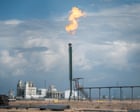
Your AI prompts aren't running on fairy dust and solar panels. Behind every chatbot response and cloud backup sits a warehouse packed with humming servers, and right now, US datacenter demand is triggering a massive resurgence in fossil fuel pipelines.
It sounds backward. Big Tech spent the last decade plastering sustainability pledges across press releases, promising net-zero grids and clean energy transitions. Yet as artificial intelligence models grew exponentially hungrier for electricity, those green timelines hit a brick wall. You can't run a 500-megawatt AI training cluster on intermittent wind when the breeze dies down at 2 PM. You need constant, unyielding baseload power, and across the United States, utilities and energy developers are turning straight back to natural gas to deliver it. For a closer look into this area, we recommend: this related article.
To make that happen fast, state and federal regulators are quietly—and sometimes loudly—rolling back environmental guardrails, fast-tracking permits, and discarding rules that used to keep fossil fuel infrastructure in check.
The Math Behind the AI Power Crunch
Let's look at the actual physics here. A traditional Google search takes roughly 0.3 watt-hours of electricity. A generative AI query uses nearly ten times that amount. Multiply that by hundreds of millions of daily users, plus the massive compute required just to train next-generation models, and the electrical grid starts buckling. For broader background on this development, comprehensive analysis is available on MIT Technology Review.
According to projections from the Electric Power Research Institute (EPRI), datacenters could consume up to 9% of all electricity generated in the United States by 2030, more than double their current share. In places like Northern Virginia's "Data Center Alley," the power draw is already so intense that Dominion Energy temporarily paused new grid connections a couple of years back because transmission lines simply couldn't carry the load.
Utilities don't have ten years to wait for transmission upgrades or experimental nuclear microreactors. Tech giants want campuses online in 18 to 24 months.
Natural gas turbines can be built relatively quickly, and they run 24/7 regardless of weather. There's just one catch. You can't fire up dozens of new gas-fired power plants without massive steel pipes to feed them.
How Pipeline Projects Are Surging Back to Life
Just three or four years ago, the conventional wisdom in energy finance was that major interstate natural gas pipelines in the US were practically dead. Activist litigation, strict Federal Energy Regulatory Commission (FERC) climate reviews, and state-level water permits had killed projects like the Atlantic Coast Pipeline and delayed the Mountain Valley Pipeline for years.
Datacenter demand flipped that script overnight.
Midstream energy companies like Williams, Kinder Morgan, and TC Energy are suddenly dusting off expansion blueprints and pitching brand-new lateral pipelines directly aimed at power-hungry tech corridors. Take the Southeast and Mid-Atlantic regions. Utilities like Duke Energy and Southern Company have dramatically revised their Integrated Resource Plans, adding gigawatts of new natural gas capacity specifically to service incoming industrial and datacenter loads.
In Virginia, North Carolina, Georgia, and Texas, pipeline operators are proposing hundreds of miles of new high-pressure pipe. Williams recently pointed to surging power generation demand—driven heavily by AI datacenters—as a primary catalyst behind its Transco pipeline expansion projects. In Louisiana, Entergy is building massive gas-fired generation facilities tied directly to Meta's sprawling new datacenter campus, requiring fresh pipeline infrastructure to keep the turbines spinning.
Honestly, the speed of this pivot has caught even veteran energy analysts off guard. Pipeline capacity that looked like stranded assets in 2021 is now booked solid through the 2030s.
Discarding the Rules to Feed the Grid
Building a pipeline in America used to mean navigating a brutal gauntlet of environmental impact statements, state water quality certifications, and federal emissions reviews. That regulatory friction is rapidly dissolving under the banner of grid reliability and national AI competitiveness.
Both federal lawmakers and state utility commissions are dismantling rules that previously slowed fossil fuel buildouts:
- Watered-down FERC climate assessments. Federal regulators have repeatedly scaled back attempts to force pipeline developers to account for downstream greenhouse gas emissions during the permitting process, narrowing the scope of environmental reviews so projects clear approval faster.
- State-level preemption and fast-tracking. Several states have moved to strip local municipalities of their ability to block energy infrastructure or impose strict zoning rules on power plants and pipelines serving industrial hubs.
- Relaxed emissions standards for "peaker" and backup plants. Datacenters require massive diesel or gas backup generators on-site in case the main grid fails. Regulators in Virginia and other states have entertained loosening air quality permit limits so these facilities can run fossil-fuel generators more frequently during grid stress.
- Weakened Clean Water Act vetoes. Recent federal policy shifts and Supreme Court rulings have severely restricted the ability of states to use Section 401 water quality certifications to stall interstate pipelines crossing rivers and wetlands.
The argument from lawmakers is simple. If the US doesn't build the energy infrastructure to power AI, China will take the lead. Once national security enters the chat, environmental rulemaking tends to get shoved out the door.
The Behind-the-Meter Workaround
Even more interesting is how tech companies are bypassing the public utility grid altogether. It's called "behind-the-meter" power, and it's exploding across Texas, Ohio, and Pennsylvania.
Instead of waiting five years for a local utility to build high-voltage transmission lines to a remote datacenter site, developers are striking direct deals with natural gas producers and pipeline operators. They build a massive datacenter right on top of a gas field—like the Permian Basin or the Marcellus Shale—construct a dedicated on-site gas power plant, and run a private pipeline straight from the wellhead to the server farm.
Because the electricity never touches the public interstate transmission grid, these setups sidestep huge chunks of federal utility regulation. No public ratepayer hearings. Minimal grid interconnection queues. Just raw hydrocarbons converted directly into compute power behind a chain-link fence.
Why Big Tech's Clean Energy Math Doesn't Add Up
If you read corporate sustainability reports from Microsoft, Google, or Meta, you'll still see impressive claims about 100% renewable energy matching. Don't let the accounting tricks fool you.
When a tech company buys a Renewable Energy Certificate (REC) from a wind farm in Kansas to "offset" a datacenter running on gas-fired electricity in Virginia, the physical electrons hitting those servers are still coming from fossil fuels. That gas still had to be fracked, compressed, and pushed through a newly permitted pipeline.
Google's own environmental reports have openly acknowledged that its greenhouse gas emissions have jumped nearly 50% since 2019, largely due to datacenter energy consumption and supply chain demands. Microsoft reported a similar spike of roughly 30% since 2020. You can't offset physics with financial instruments forever, especially when local grids physically lack clean baseload alternatives.
What Communities and Investors Need to Watch
This pipeline boom isn't happening in a vacuum. For communities living along proposed routes in Appalachia, the Gulf Coast, and the Midwest, discarding environmental rules means less public input, fewer safety buffer zones, and higher localized air pollution from compressor stations. Ratepayers also face serious financial risk. If utilities spend billions building gas plants and pipelines for tech companies, and AI efficiency breakthroughs suddenly slash power demand five years from now, everyday residential customers could get stuck paying off stranded infrastructure costs on their monthly electric bills.
If you're tracking this space—whether as an energy investor, a policy advocate, or a local resident—stop looking at tech company press releases and start watching state utility commission dockets. Look up Integrated Resource Plans (IRPs) filed by your regional electric utility to see how many megawatts of new gas generation they're quietly requesting. Track FERC docket filings for "lateral" pipeline expansions near existing fiber-optic corridors. Follow the steel and the permits, because right now, the real story of artificial intelligence isn't being written in code—it's being welded together underground.