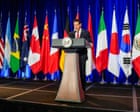
Diplomacy usually runs on awkward handshakes and forced smiles. Not this time.
When the United States canceled the traditional G20 "family photo" during the finance ministers and central bank governors meeting in Washington, D.C., it wasn't a scheduling glitch. It was a deliberate diplomatic freeze. Western nations—led by the US, Australia, the United Kingdom, and Canada—flatly refused to stand on a stage alongside Russian officials while Moscow's invasion of Ukraine continues.
Think about what a group photo actually represents at an international summit. It's the ultimate visual receipt of cooperation. Leaders stand shoulder-to-shoulder, projecting unity even when they're tearing each other apart behind closed doors. By pulling the plug on the G20 family photo, Washington and its allies sent an unmistakable message to the Kremlin. You don't get to bomb a neighbor and still enjoy the polite pageantry of global leadership.
The Washington Walkout and the End of Summit Pageantry
The breakdown happened at the Spring Meetings of the International Monetary Fund and World Bank, hosted right in the heart of Washington. Normally, these gatherings follow a predictable, almost boring script. Finance ministers discuss inflation, debt relief, and global supply chains, then line up on risers for the press cameras.
This time, the script went straight into the trash.
According to officials familiar with the planning, the US Treasury Department—which was hosting the event—decided to scrap the photo entirely rather than risk a chaotic, fragmented boycott on live television. Australia, the UK, and Canada had already made it clear they wouldn't participate if Russian representatives were included in the frame.
And this wasn't just about avoiding a photo op. During the actual working sessions, the tension boiled over into direct confrontation. When Russian Finance Minister Anton Siluanov began speaking virtually—and when Russian officials in the room took the floor—US Treasury Secretary Janet Yellen led a coordinated walkout. Representatives from the UK, Canada, the European Union, and Ukraine followed her out the door.
It was a stunning breach of G20 protocol. For an organization founded specifically to keep the world's largest economies talking during crises, seeing half the room get up and leave while a member state speaks is about as close to an institutional breakdown as you can get without formally expelling someone.
Why Can't the G20 Just Kick Russia Out?
You might be wondering why the US and its allies don't just revoke Russia's membership and move on. Honestly, it sounds like the obvious move. If a member violates international law and sparks a massive humanitarian and economic crisis, why do they still get a seat at the table?
The problem is that the G20 doesn't actually have a mechanism to kick anyone out.
Unlike the United Nations Security Council or formal treaty organizations, the G20 is an informal forum. There is no charter, no permanent secretariat, and no voting system for expulsion. Every major decision operates on consensus. That means removing Russia would require the agreement of all other 19 members—including China, India, Brazil, and South Africa.
That's simply not going to happen. Beijing has refused to condemn Moscow's invasion, consistently blaming NATO expansion for the conflict while ramping up trade with Russia. India, which maintains deep historical and defense ties with Moscow, has abstained from UN resolutions criticizing the war and continues buying discounted Russian oil.
So, the Western bloc is stuck in a diplomatic bind. They can't legally eject Russia from the room, and boycotting the entire summit would just hand the microphone over to Moscow and Beijing unchallenged. Canceling the G20 family photo and staging targeted walkouts became the middle ground—a way to show up, defend their economic interests, and still isolate Russia in front of the global press.
The Real Economic Stakes Behind the Photo Op
It's easy to dismiss a canceled photo as empty symbolism. Who cares if politicians stand on a riser together?
In international politics, though, optics dictate leverage. The G20 accounts for roughly 85% of global economic output and two-thirds of the world's population. When the finance ministers meet, they're supposed to be coordinating responses to massive threats—sovereign debt crises in developing nations, global food shortages, and runaway inflation.
Russia's war in Ukraine is directly fueling those exact crises. Blockaded Black Sea ports choked off grain exports to the Middle East and Africa. Energy shocks sent utility bills skyrocketing across Europe and Asia.
For Western finance ministers, standing next to Russian officials and smiling for the cameras would completely undermine the moral and political authority of their sanctions regime. How do you ask developing nations to endure higher energy prices to punish Moscow if your own treasury secretary is posing amicably with Putin's finance minister ten minutes later? You can't. The photo had to go because the visual contradiction was too toxic to survive a single news cycle.
How This Splits the Global Economy Into Two Blocs
If you look closely at who walked out and who stayed in the room, you're seeing the exact fault lines of a fracturing global economy.
On one side, you have the G7 nations—the US, UK, Canada, France, Germany, Italy, and Japan—alongside Australia and the European Union. They view the invasion of Ukraine as an existential threat to the post-World War II rules-based order. For them, isolating Russia isn't optional; it's the baseline requirement for maintaining international stability.
On the other side, you have the major emerging economies, often grouped under the BRICS banner—Brazil, Russia, India, China, and South Africa. None of these countries walked out when Russia spoke. In fact, many of them quietly resent the West for turning an economic forum into a geopolitical battleground over a European war.
From the perspective of leaders in New Delhi, Brasilia, or Jakarta, the G20 is one of the few places where the Global South has an equal voice alongside wealthy Western powers. When Washington cancels the family photo or shuts down joint communiqués over Ukraine, developing nations worry their own urgent priorities—like climate financing and debt restructuring—are getting shoved to the back burner.
The Death of the Joint Communiqué
The canceled photo is actually part of a much bigger trend. For years, the crowning achievement of any G20 meeting was the joint communiqué—a formal, negotiated statement signed by every single member outlining shared economic goals.
Since the invasion of Ukraine, getting all 20 members to agree on a single piece of paper has become nearly impossible. Western nations insist any official statement must explicitly condemn Russia's aggression. Russia obviously refuses to sign a document condemning itself, and China consistently backs Moscow by demanding that "geopolitical issues" be kept out of economic statements.
As a result, host nations have been forced to issue "Chair's Summaries" instead of official communiqués. It's a polite diplomatic euphemism that basically means: we talked, we argued, and we couldn't agree on anything official.
What Happens at Future Summits?
Don't expect the awkwardness to disappear anytime soon. Every major international gathering—from the G20 Leaders' Summit to APEC meetings—now requires months of painstaking choreography just to avoid diplomatic explosions.
Host countries are essentially acting as event planners for a divorced couple who refuse to be in the same room. They have to stagger arrival times, carefully curate seating charts so American and Russian officials aren't within arm's reach, and quietly drop traditional group photos before the media even asks about them.
If you want to track where global alliances are actually heading, stop listening to the prepared speeches at these summits and watch the staging instead. Pay attention to which countries join Western walkouts, which ones abstain from joint statements, and how host nations manage the room. The real state of global diplomacy isn't written in the press releases anymore—it's visible in the empty risers where the family photo used to be.


