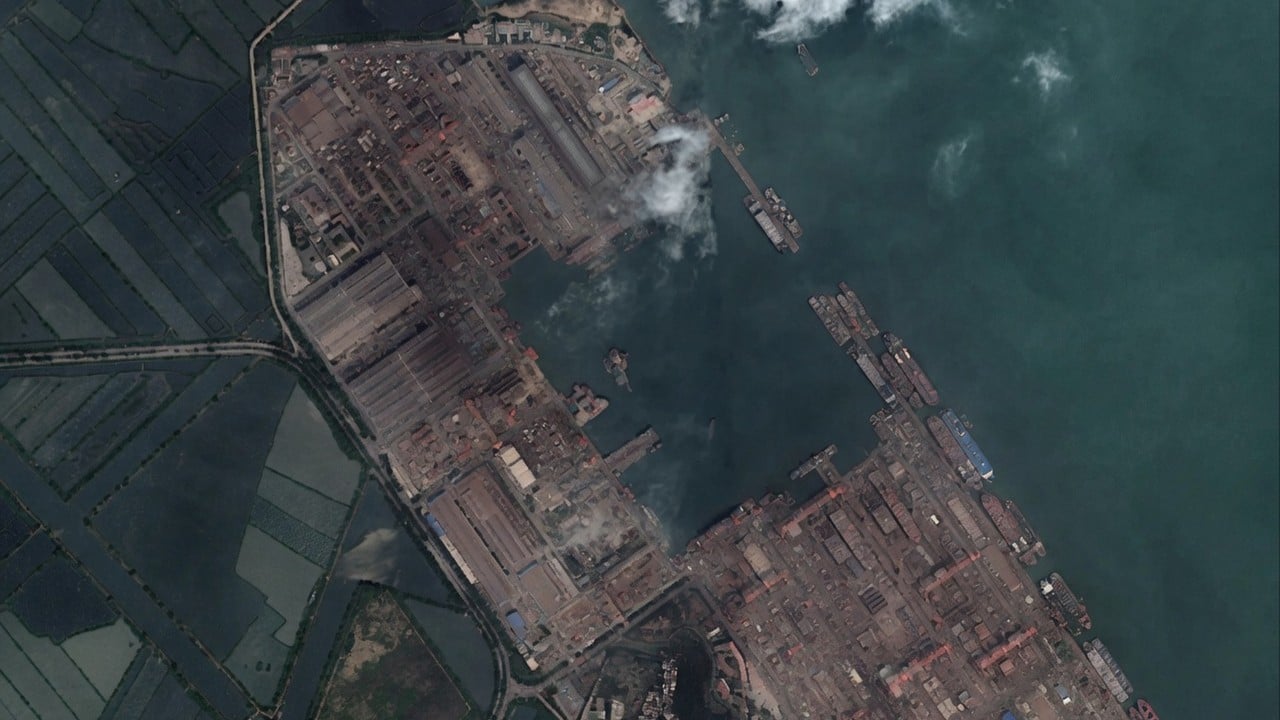
The metal grates of a shipyard at dawn do not care about geopolitical theory. They are cold, slick with morning condensation, and smell faintly of ozone and wet primer. For the men and women who weld the hulls, naval strategy is not a map with red and blue arrows drawn by think-tank analysts in climate-controlled offices. Strategy is a multi-ton block of steel hanging from a gantry crane, moving millimeters at a time.
For years, the world has stared obsessively at China’s expanding shipyards through a telescope of pure anxiety. The focus is almost always the same: the flat-top decks. The world watches the Type 003 Fujian with its electromagnetic catapults, and whispers with breathless anticipation about the rumored Type 004, a vessel whispered to be nuclear-powered, massive, and capable of projecting raw power across oceans. The carrier is the apex predator. It is the glittering symbol of a superpower’s ambition.
But look closer at the satellite feeds tracking the dry docks along the Yangtze River. Shift your gaze just a few hundred meters away from the carrier berths. There, sitting quietly in the gray soup of coastal haze, lies the real story of modern naval ambition.
It is a hull that carries no fighter jets. It possesses no vertical launch systems to rain missiles down from the sky. To an untrained eye, it looks like a bloated, awkward commercial tanker. Yet, this unnamed, oversized support ship is the most terrifying vessel currently under construction. Without it, the grandest aircraft carrier is nothing more than a multi-billion-dollar floating target, waiting to run out of breath.
The Tyranny of the Calorie and the Kilowatt
To understand why this massive new auxiliary vessel matters, we have to look past the weapons systems and confront the brutal, unyielding physics of the open ocean.
Consider a hypothetical sailor named Zhang. He is twenty-four years old, an aviation machinist mate stationed deep within the belly of a future Chinese carrier strike group operating two thousand miles from the mainland. Zhang does not think about grand strategy. He thinks about the high-pressure hydraulic fluid needed for a J-15 fighter’s landing gear. He thinks about the dry, salted pork and rice served at midnight shifts. He thinks about the sheer volume of fresh water required just to wash the salt film off the canopy of a stealth drone so its sensors do not fail.
A single carrier strike group is a floating city of six thousand human beings, surrounded by a ring of guided-missile destroyers and attack submarines. Every single day, this armada consumes resources at an agonizing pace. They burn aviation fuel by the kiloton. They consume tons of food, crates of medical supplies, and thousands of spare parts, from microscopic circuit boards to entire replacement turbine blades.
If a nation wants to fight near its own shores, logistics are simple. You run small fuel bladders out; you rely on coastal bases. But China is no longer building a coastal defense force. The Beijing leadership wants a "blue-water" navy—a force that can operate in the deep, ink-black expanses of the mid-Pacific or the Indian Ocean, far beyond the protective umbrella of land-based supply depots.
When a fleet crosses that invisible line into deep water, time begins to tick backward. Every mile sailed away from home is a mile closer to starvation.
The Chinese navy already possesses the Type 901 fast combat support ship, a massive 45,000-ton beast designed to steam at high speeds alongside a carrier group, throwing heavy fuel lines and supply cables across churning waves while moving at fifteen knots. For the current fleet, the Type 901 is enough.
But the future Type 004 carrier group presents an entirely different problem.
The Nuclear Paradox
The rumors surrounding the Type 004 suggest it will likely abandon conventional oil-fired boilers in favor of marine nuclear reactors. On paper, this sounds like the ultimate freedom. A nuclear-powered carrier can steam for decades without ever needing to pull up alongside a fuel tanker. It can run at top speed indefinitely, chasing typhoons or racing toward flashpoints without a care for its own bunker capacity.
This is where the amateur strategist stops reading. They assume nuclear power solves the logistics crisis.
The professional strategist knows better.
A nuclear carrier does not run on oil, but its planes do. The thousands of sorties a Type 004 would need to launch to defend itself or strike a target require millions of gallons of high-density aviation kerosene. Furthermore, the accompanying destroyers—the Type 055 cruisers and Type 052D escorts that shield the carrier from torpedoes and cruise missiles—are not nuclear. They run on conventional gas turbines that thirst for fuel every few days.
If the Type 004 is built to stay out at sea for months on end, its support ships must be able to stay out just as long, carrying twice the cargo of anything currently afloat.
That brings us back to the mysterious hull taking shape in the yards. Satellite analysts have noted dimensions that suggest a vessel dwarfing the Type 901. We are looking at a potential 50,000-plus-ton behemoth.
Why build it bigger? Because the math demands it.
If you increase the size of the carrier, you increase the size of the air wing. If you increase the air wing, you increase the consumption rate of ordnance. Missiles used in modern naval warfare are not small; a single anti-ship cruise missile can weigh as much as a small car. Moving these weapon systems from a supply ship to a carrier in the middle of a Pacific swell is an engineering nightmare. It requires massive internal hold space, specialized elevators, and automated cargo handling systems that can operate while the ship is pitching and rolling in twenty-foot seas.
The Human Geometry of Replenishment
The true test of this new support ship is not found in its blueprints, but in the terrifying choreography of underway replenishment.
Imagine two massive walls of steel, each weighing fifty thousand tons, riding parallel to one another in the open ocean. They are separated by a mere hundred and fifty feet of wild, white-capped water. The Venturi effect—the physical phenomenon where fluid speeds up as it passes through a narrow channel—pulls the two hulls toward each other with immense force. One wrong move by a helmsman, one sudden failure of a steering gear, and the two ships will collide, triggering a catastrophic disaster.
Between them, steel cables are shot across the void by pneumatic guns. Once the lines are secured, massive fuel hoses and high-speed cargo trolleys slide back and forth across the abyss.
This is where the human element becomes brittle. Sailors on the deck of the supply ship work in heavy helmets, life vests, and steel-toed boots, drenched in sea spray and the biting stench of fuel vapor. They must rig these lines in the dead of night, during rainstorms, or while evading hostile surveillance.
The newer, larger support ship China is building is designed to make this brutal process faster. Every minute spent connected to a supply ship is a minute the carrier is vulnerable. It cannot maneuver freely while hooked up to a tanker. It cannot easily launch or recover aircraft. It is, for those few hours, a sitting duck.
By building a larger support ship with advanced, high-capacity transfer stations, the Chinese navy aims to cut that vulnerability window in half. They are not just building a bigger bucket to carry more fuel; they are building a faster pump to reduce the time their crown jewel spends tied to a lifeline.
The Geography of Loneliness
There is a psychological weight to this naval expansion that rarely makes it into defense white papers.
For generations, Western navies, particularly the United States Navy, have mastered the art of global logistics. They have a century of experience, a global network of deep-water ports, and a seasoned culture of replenishment at sea. American sailors grow up in a navy that treats the middle of the Atlantic or Pacific as its backyard.
The Chinese navy does not have that history. Their sailors are pioneering a high-stakes discipline from scratch.
When a Chinese carrier group sails past the First Island Chain—the string of islands stretching from Japan to the Philippines—the psychological landscape changes. The reassurance of the mainland fades over the horizon. The water turns from the murky green of the East China Sea to the deep, terrifying blue of the open ocean.
In that vast desert of water, the presence of a single, massive support ship is the only thing keeping panic at bay. It is the floating piece of home that ensures the lights stay on, the radar keeps spinning, and the galley keeps serving hot meals.
If an adversary wants to defeat a Chinese carrier battle group in the future, they will not target the carrier first. They will look for the big, slow, high-value auxiliary ship lagging slightly behind the main formation. They will hunt the tanker. Because if you sink the tanker, the carrier group has a finite number of days before its destroyers go dark and its aircraft are grounded by empty tanks.
The Real Measure of Power
We have spent decades measuring military might by counting barrels, counting wings, and counting missile silos. It is an easy, clean way to look at power. It fits neatly into infographics and news broadcasts.
But the construction of this new, massive support ship tells us something that counts cannot. It tells us about intent.
China is not building a navy meant to stay at home and bully its neighbors from a position of coastal comfort. They are preparing for the grueling, unglamorous reality of long-distance expeditionary operations. They are building the infrastructure required to sustain an adversarial presence thousands of miles away from the nearest friendly port.
The steel is being cut. The welds are cooling. The heavy cranes are moving into position to drop the massive fuel bunkers into the belly of this new giant.
The next time you see a headline shouting about China’s newest, sleekest aircraft carrier, look past the flight deck. Look for the fat, heavy shadow trailing in its wake. That is where the real war of endurance is being won or lost, measured not in the fire of missile launches, but in the steady, rhythmic transfer of oil, bread, and bullets across a lonely ocean.