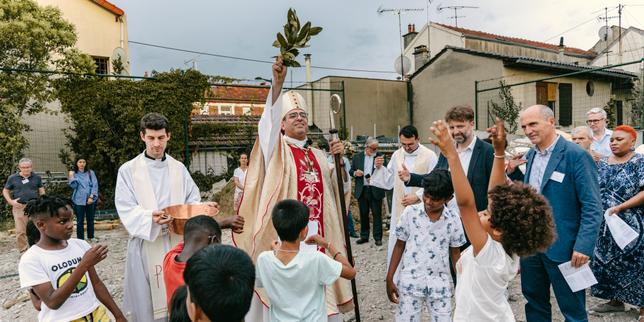
In the corridors of power, ecclesiastical appointments often follow predictable, time-worn tracks. Yet, the rise of Étienne Guillet to the bishopric of Saint-Denis defies the conventional mold of the French episcopate. Appointed in late 2024 and ordained in early 2025, Guillet brought a resume to the office that looks less like a traditional career in the clergy and more like a study in social navigation. With a background as an EDHEC graduate and experience in the shadows of the prison system, his arrival in the Seine-Saint-Denis department signifies a shift in how the Catholic Church is positioning its leadership in one of France's most complex social terrains.
The Seine-Saint-Denis department, or "the 93" as it is commonly known, represents a unique challenge. It is a region defined by high density, extreme economic disparity, and a mosaic of cultures that sit at the intersection of urban tension and institutional hope. When Guillet stepped into this role, succeeding Pascal Delannoy, he did not enter as a stranger to the fringes. His prior work as an aumônier—a chaplain—in the Porcheville juvenile detention center provided a grounding that few of his peers possess. This is not merely a detail of his CV; it is the engine of his approach.
Guillet represents a generation of church leaders who view their mandate through the lens of immersion rather than observation. During his time as a parish priest in Trappes and Mantes-la-Jolie, he operated within environments that tested the limits of traditional pastoral care. These were not gated communities. They were places where the church had to justify its relevance every single day. His transition from the boardrooms of business school to the concrete realities of the penal system is the core of his credibility. It suggests a man who understands how to manage resources but chooses to deploy them in service of those who are socially isolated.
Observers of French religious life often note the disconnect between the hierarchy and the realities on the ground. The choice of Guillet is an attempt to close that gap. By selecting someone whose formative years included volunteer work with the Karen people in Thailand and a stint in the corporate world, the Vatican signaled a desire for a pragmatist. This is a deliberate strategy. Institutional organizations frequently suffer from internal stagnation, and bringing in an outsider with a diverse cognitive toolkit is a standard, if risky, correction.
However, the reality of the bishopric in Saint-Denis is unforgiving. A bishop here must be a mediator, a diplomat, and a social worker all at once. The "tearing" mentioned by his supporters refers to the social fractures that define the area. To mend these, one needs more than theological authority. One needs the ability to speak the language of those who feel left behind by the Republic and the church alike. Guillet’s choice of a biblical motto concerning power in weakness suggests he understands that his authority will not come from the prestige of his title, but from his presence in the trenches of daily life.
Consider a hypothetical scenario where a community project in a neglected neighborhood faces a sudden loss of funding. A traditional administrator might draft reports and lobby officials. A leader like Guillet is expected to pivot differently, leveraging his network to find alternative support while keeping the community spirit alive. It is an approach that values the survival of the bond over the cleanliness of the process.
This is the central tension of his tenure. Can a product of elite French education genuinely connect with a demographic that views elite institutions with profound skepticism? His past suggests he can bridge that divide, but skeptics will rightly point out that moving from a parish to a diocese is a quantum leap in bureaucratic burden. He now oversees a vast structure that requires fiscal oversight, personnel management, and political navigation, all while maintaining the pastoral touch that got him there in the first place.
The stakes are high. Saint-Denis is a bellwether for the future of the Catholic Church in secular, diverse urban France. If Guillet can successfully integrate his business acumen with his pastoral commitment, he may well provide a blueprint for a more effective, grounded leadership. If he retreats into the administrative safety of his office, the gap between the church and the streets will only widen further.
His presence at the reopening of Notre-Dame in Paris highlighted the contrast between the historic center of the church and the periphery where he now serves. He is a man caught between the heavy, centuries-old weight of institutional tradition and the raw, unpolished energy of the modern suburb. He represents a gamble that the church is taking on its own relevance. The result of that bet will be decided not in the halls of the cathedral, but in the neighborhoods where he is now tasked with keeping the fabric from tearing further.
Mgr Etienne Guillet, évêque de Saint-Denis
This video provides an official look at the announcement of Mgr Étienne Guillet’s appointment to the Saint-Denis diocese, offering necessary context on his transition from parish leadership to the bishopric.
http://googleusercontent.com/youtube_content/1