Call it a "hole" if you want dramatic headlines. Call it a "70 billion euro gap" if you like neat little numbers.
Neither phrase is honest.
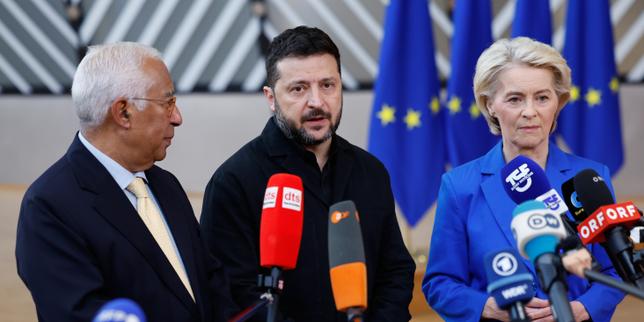
When European Commission President Ursula von der Leyen stood before the cameras this week to confirm Ukraine's roughly 70 billion euro additional financing need for 2027—and rolled out a fresh 45 billion euro loan proposal to cover roughly two-thirds of it—the live-blogging class treated the number like a settled law of physics. A hole appeared. Brussels must fill it. End of story.
Except it isn't a hole. It's a moving target built on assumptions that are already cracking before the ink is dry.
The Lazy Consensus Everyone Swallows Whole
Standard live coverage of EU crisis announcements follows a predictable script. A number drops. An official says it "must be filled." Reporters repeat the quote, stack the prior loan figures next to the new ones, and frame the entire story around whether Europe has enough political willpower to pass the check.
That framing misses almost everything that matters.
First, treat any multi-year war financing projection as a negotiation anchor, not an audit. Ukraine's Finance Ministry and the European Commission set that 70 billion euro additional requirement on top of the 45 billion euros already earmarked for 2027 under the earlier 90 billion euro support loan package covering 2026 and 2027. Add those pieces up, and the total sums look colossal. Yet even the International Monetary Fund—working on its own program reviews and war-duration assumptions—has projected a different residual financing gap figure for 2027 in dollar terms. Why do the numbers diverge? Because war budgets aren't fixed invoices. They depend on how hard Moscow hits energy grids and Black Sea shipping lanes, what artillery and air-defense stockpiles actually cost next spring, how fast domestic tax collection holds up, and how much burden other allies genuinely absorb.
Second, calling a "limited-recourse" loan a solution to a fiscal gap is financial sleight of hand. Under Brussels' design, the EU borrows on capital markets against budget headroom, splits the new 45 billion euros into up to 25 billion for military needs and up to 20 billion for civilian budget support, delays interest hits to the EU budget until 2028, and lets Kyiv off the hook for principal repayment unless and until Russia pays reparations.
That isn't a normal loan. That's a contingent claim dressed up as debt. Call it what it is: a bridge funded by European balance-sheet capacity today in hopes of a legal and geopolitical reckoning tomorrow.
The Real Question You Should Be Asking
Readers keep asking a deceptively simple question: Where will the missing 25 billion euros come from if Brussels puts up 45 billion toward a 70 billion euro gap?
Wrong question.
The real question is: Who actually eats the cost of keeping a sovereign state and a high-intensity war machine running through 2027 when allies don't move in lockstep?
Brussels has already signaled impatience with uneven burden-sharing. During the earlier borrowing push, rounding up non-EU partners like the UK, Canada, or Japan proved harder than press releases implied, even as individual capitals announce bilateral aid and weapon packages. Meanwhile, Washington and European capitals have openly clashed over operational strategy—such as deep strikes inside Russia—showing that "allied support" is neither a single pool of money nor a single strategy.
When an alliance isn't aligned on tactics, it gets even messier on cash. Every capital wants credit for generosity without signing a blank check for someone else's war plan.
What Happens When You Stress-Test The Math
Imagine a scenario where the 70 billion euro figure is taken literally on January 1, 2027, and every assumption holds steady. Even under that tidy picture, two frictions immediately collide: timing and conditionality.
Money announced in November doesn't hit accounts on schedule without legislative sign-offs, summit bargaining among member states, and capital-market execution. On the civilian side, macro-financial assistance and facility disbursements carry reform, rule-of-law, and anti-corruption conditions. On the defense side, industrial bottlenecks and procurement timelines dictate whether euros turn into hardware or sit in queues.
Now imagine a harsher scenario—one far closer to how protracted conflicts actually behave. Suppose Russian strikes escalate further against power generation and ports, pushing fiscal and military costs above baseline estimates, while one or two non-EU donors stall on their share of the remaining 25 billion. Then what? Either Brussels is forced back to the table for yet another top-up, or Kyiv has to ration cash between paying civil servants, keeping hospitals and schools open, and sustaining frontline operations.
Lessons From Watching Big-Ticket Bailouts Blow Up
I've watched institutions and corporate boards blow massive sums by confusing an announced funding package with solved solvency. In crisis finance, headline totals create a dangerous illusion of finish lines. Teams relax, political energy drifts elsewhere, and six months later everyone acts shocked that the burn rate didn't care about the press conference.
Precision matters here. A financing gap is an estimated shortfall between projected outflows and available resources over a defined period; a budget deficit is the gap between government revenue and expenditure; and limited-recourse financing means repayment depends on specific future proceeds rather than general borrower cash flow. Conflating those terms turns policy analysis into slogan-chanting.
Serious analysts of sovereign debt and war economies—from IMF fiscal staff to veteran European budget negotiators—know that headline packages are starting bids in a longer political grind. Every tranche tests unanimity rules, budget headroom limits, and domestic tolerance back home.
Where This Contrarian Bet Can Burn You
Going contrarian on crisis headlines carries its own traps, and I won't pretend otherwise.
First, dismissing a 70 billion euro gap as "political theater" can blind you to real liquidity pressure. Even inflated or provisional projections reflect genuine stress when a country is fighting for survival under constant bombardment. Calling a number a moving target doesn't mean the bills aren't real.
Second, underestimating institutional persistence is a classic mistake. Brussels moves slowly, bickers loudly, and leans heavily on joint borrowing—yet it has repeatedly found mechanisms to keep money flowing rather than admit defeat. Betting on sudden collapse just because the math looks messy has burned plenty of smart observers.
Practical Moves For Anyone Tracking The Numbers
If you're following this story for work, policy, or markets, stop counting total euros in headlines and start tracking three concrete signals:
- Watch the summit mechanics, not the speech. Look closely at how member states settle borrowing guarantees and cost-sharing ahead of Brussels summits, and whether conditionality rules slow civilian tranches.
- Separate military hardware from budget survival. Track how fast the military portion translates into actual munitions, air defense, and industrial output versus how much civilian support is needed just to keep basic state functions running.
- Audit the non-EU ledger. Don't treat "international partners" as a guaranteed 25 billion euro backstop until specific commitments from non-EU capitals are locked in.
A 70 billion euro number won't fill itself with optimism, and a loan backed by future reparations won't settle who pays if the war drags on past 2027. Until the allies align on both strategy and burden-sharing, every "final" financing gap is just the opening act to the next one.