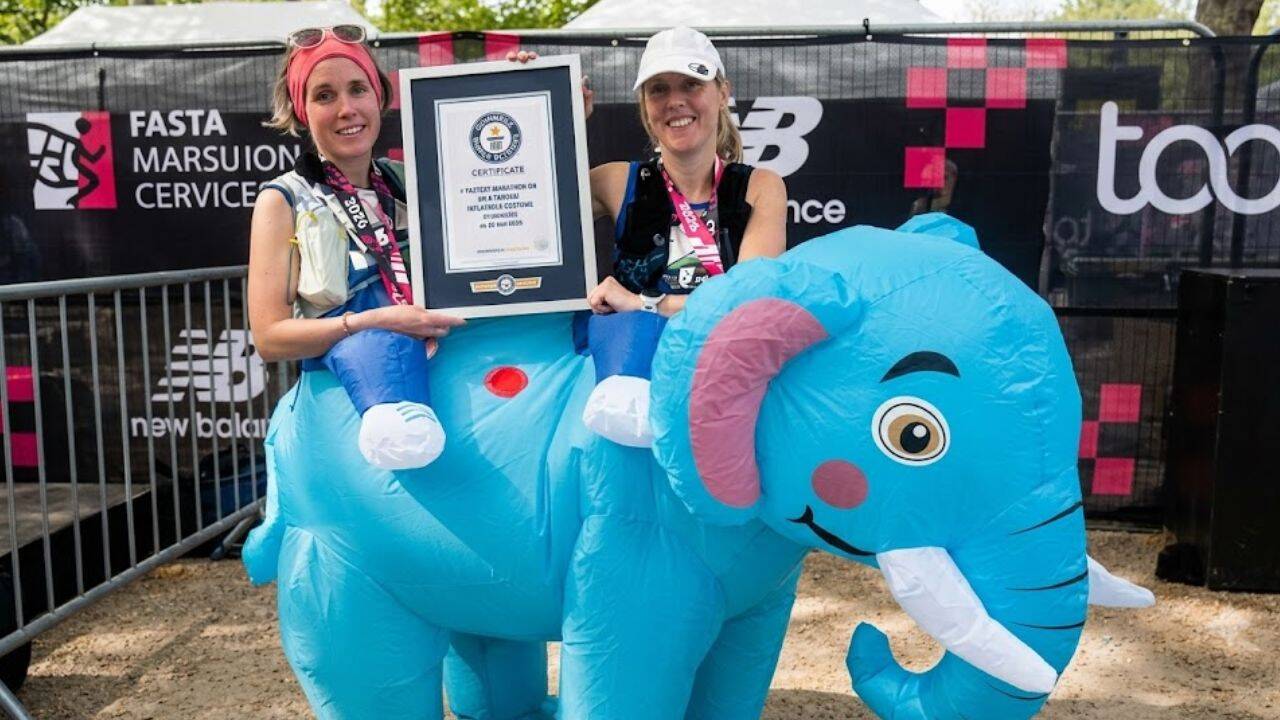
Running 26.2 miles is already an exercise in questioning your life choices. Now, try doing it while encased in a massive, air-filled costume shaped like an African mammal. That is exactly what two endurance athletes did at the London Marathon, carving their names into the record books and testing the absolute limits of human patience, sweat management, and aerodynamics.
Most people show up to a marathon in lightweight moisture-wicking gear, carbon-plated shoes, and tiny race bibs. They obsess over ounces. They calculate gel intake down to the exact milligram. Then you have runners who strap themselves into fiberglass ribs, heavy fabrics, and battery-powered fans just to see if they can cross a finish line without suffocating. It sounds completely absurd. It is absurd. Yet, it captures the weird, wonderful spirit of mass participation racing better than any elite runner pacing for an Olympic qualifier ever could.
Why People Run Marathons in Ridiculous Costumes
The London Marathon is famous for two things. Fast times on a flat course, and thousands of participants wearing things they really shouldn't be wearing for more than five minutes. From giant telephones to working toilets, the race course turns into a moving parade of bizarre engineering marvels.
Why do they do it? Attention is part of it. Charity fundraising is a massive driver. When you ask people to donate their hard-earned cash for a good cause, standing out in a sea of neon running shirts helps. But there is also a deeper psychological element at play. It transforms a grueling physical test into an absurd theatrical performance.
When you run in a giant inflatable elephant, nobody cares about your split times. Your entire focus shifts from chasing a personal record to basic survival. Can you breathe? Can you see the curb? Will the battery pack for the internal fan die at mile eighteen?
The Logistics of Running Inside a Pachyderm
People seriously underestimate the physics of mascot running. You aren't just carrying extra weight. You are wearing a wind sail.
On a calm spring day in London, running inside a sealed costume feels like working out inside a sauna. Add a gentle breeze off the Thames, and your inflatable suit transforms into an unpredictable kite. A sudden gust of wind can push you sideways right into a barrier or another runner.
Visibility is another nightmare entirely. Most costume runners look through a tiny mesh screen positioned somewhere around the creature's neck or chest. Your peripheral vision drops to zero. You rely entirely on a support crew running alongside you or shouting instructions from the crowd.
Temperature control simply does not exist. Inside an inflatable suit, your body heat has nowhere to go. Hydration becomes an extreme sport. You can't just grab a cup of water from a aid station and drink it while moving. Someone has to feed you water through a tube or you have to stop, deflate partially, hydrate in a panic, and zip back up before you lose your momentum.
Breaking Records the Hard Way
To set a Guinness World Record, you can't just finish the race. You have to follow a ridiculous rulebook. The costume must meet strict structural definitions. You cannot take the suit off for even a second during the entire 26.2-mile journey. If you deflate the elephant, the record attempt is instantly void.
Think about what that means for natural human bodily functions during a four-hour or five-hour ordeal. It requires meticulous planning, extreme dietary control leading up to race day, and a staggering amount of mental toughness. Elite runners break records through months of high-altitude training and meticulous interval sessions. Costume record holders break them through sheer stubbornness and high-grade chafing prevention.
The mental battle is brutal. At mile twenty, when every runner on the course hits the wall, the costume runners hit a brick wall coated in hot air. The foam padding rubs raw. The air circulation feels inadequate. Every single step sounds like a loud industrial vacuum cleaner humming right next to your ears.
What We Can Learn From the Madness
We take sports too seriously sometimes. We analyze shoe foam percentages, nutritional science, and recovery metrics until the joy gets sucked right out of the movement.
Seeing two runners lumber across the finish line inside a giant inflatable elephant resets our perspective. Running is supposed to be fun. It is supposed to challenge us, sure, but it is also a community celebration. Those runners didn't change the landscape of elite athletics. They didn't threaten Eliud Kipchoge's throne. But they made millions of people smile, raised awareness and funds for charity, and proved that human resilience comes in many different shapes—even spherical, gray, trunk-nosed shapes.
If you are training for your next endurance event, stop stressing so much about shaving thirty seconds off your tempo run. Build some joy back into your training. Or, if you are feeling truly unhinged, find a heavy, awkward costume and start training your core for the wind resistance. Just make sure you pack extra batteries.


