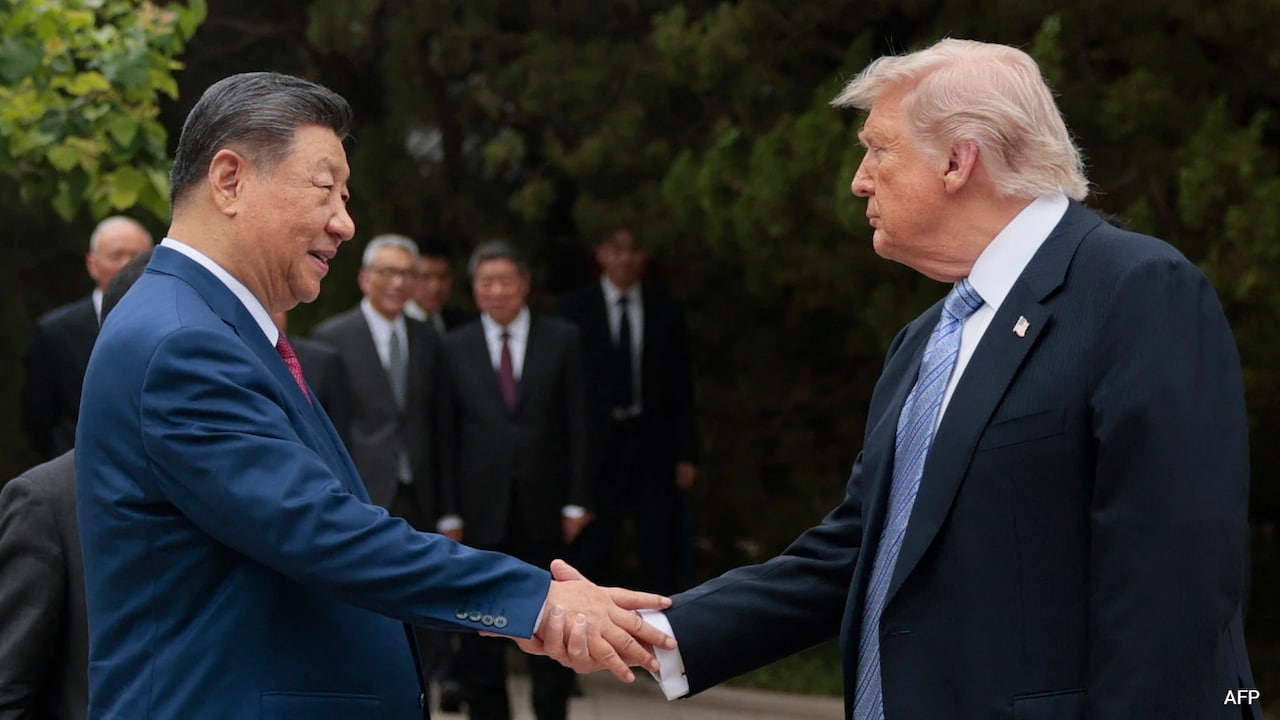
When Donald Trump rolled out the red carpet at the White House for Chinese President Xi Jinping, corporate executives like Elon Musk and Tim Cook grinned for the photo ops. Behind the extravagant toasts and state dinner fanfare, the core dynamic between the two superpowers shifted.
Washington and Beijing agreed to temporarily calm their economic warfare. They extended trade truces and agreed to talk about artificial intelligence and fentanyl. For American tech firms and Chinese exporters, that sounds like a win. But for New Delhi, every inch of tactical accommodation between the United States and China creates a fresh strategic headache.
If you've been following India's foreign policy strategy over the last decade, you know it relied heavily on a straightforward premise: as US-China friction grew, Washington would treat New Delhi as its indispensable counterweight in Asia. But when Washington shifts into transactional deal-making mode with Beijing, that assumption gets shaky.
Here is what the latest high-level US-China talks actually mean, what Beijing gains from Washington, and why India can't afford to play a passive hand.
What China Wants and What Washington Gives Away
China didn't come to Washington looking for a complete overhaul of relations. Xi Jinping's strategy is far more practical: buy time, ease immediate trade pressure, and prevent the US from building an unbreakable blockade around critical technologies.
In exchange for modest concessions—like short-term promises on agricultural purchases or minor extensions of tariff freezes—China gets three massive benefits:
- Breathing room for its domestic economy: Facing real internal economic strain, Beijing desperately needs predictable export markets and reduced trade volatility.
- Legitimacy on global technology guardrails: By sitting down directly with the US to negotiate AI rules and tech frameworks, Beijing positions itself as an equal partner rather than a target of isolation.
- Slowing the momentum of regional alliances: Every time Washington and Beijing signal a "détente," countries across the Indo-Pacific start questioning how firm American security commitments really are.
The problem for third-party partners is that Washington's current foreign policy is heavily transactional. When tariffs, tech access, and geopolitical support are treated as negotiable chips in bilateral talks, long-standing strategic partners are left wondering where they fit in.
Where India Gets Caught in the Crossfire
For years, Indian strategic planners built their economic and defense posture on the expectation that Washington would relentlessly push to de-risk supply chains away from China. That dynamic brought manufacturing investments, tech partnerships, and defense cooperation toward India.
When the US and China hit pause on their confrontation, India faces immediate collateral risks.
Supply Chain Realities and Tech Exposure
Despite headlines about moving supply chains out of China, Indian manufacturing still heavily relies on Chinese capital goods and raw materials. When Beijing responds to US pressure by restricting specialized tech exports—from tunnel boring equipment for urban rail to foundational AI frameworks—Indian industry feels the squeeze directly.
Commerce Minister Piyush Goyal recently noted that India will push for domestic production if imports get blocked, while External Affairs Minister S. Jaishankar reinforced that peace on the border remains mandatory for true normalization. But replacing deep technological dependencies doesn't happen overnight.
The Trap of Transactional Diplomacy
If Washington treats its regional security postures as leverage for economic deals, India's bargaining power shrinks. New Delhi has consistently avoided formal military alliances, preferring strategic autonomy. But autonomy requires predictable environments. If the US decides that managing its bilateral trade deficit with Beijing matters more than maintaining pressure in the Indo-Pacific, India loses its primary external leverage against Chinese expansionism.
Border Dynamics Don't Shift with Washington Toasts
While leaders in Washington and Beijing clink glasses, India still faces thousands of troops deployed along the Line of Actual Control (LAC). A diplomatic thaw between America and China does not resolve India's territorial friction with Beijing. In fact, a China that feels less pressure on its eastern flank from the US might feel more comfortable taking an aggressive stance on its southern border.
The Misconception About a Dual-World Order
Many geopolitical commentators love to describe the world as locked into a rigid Cold War rerun: US on one side, China on the other, and everyone else forced to choose.
That view completely misunderstands how middle powers operate in 2026.
Neither Washington nor Beijing can construct a closed economic ecosystem. China needs Western markets, the US relies on Asian manufacturing capacity, and countries like India act as vital nodes linking the entire system.
India isn't looking to join a tight US-led bloc, nor is it going to submit to a Beijing-dominated Asia. The real game is hedging. When Washington and Beijing negotiate behind closed doors, India's only safe play is to aggressively diversify its diplomatic, military, and trade relationships so no single bilateral summit can undercut its security.
Watching senior diplomats explain India's strategic reaction shows how New Delhi works to maintain room for maneuver whenever US-China dynamics shift.
What India Needs to Do Next
New Delhi cannot afford to sit back and wait to see what Washington and Beijing agree to next. Here are the concrete moves India must make to protect its interests:
- Accelerate domestic industrial manufacturing: Relying on Chinese intermediate components while hoping Washington limits Chinese exports is a losing strategy. Capital investments in specialized industrial goods and tech hardware must move from policy drafts to factory floors immediately.
- Deepen regional partnerships outside the US-China axis: India needs to double down on bilateral economic and defense ties with Japan, Australia, France, and key ASEAN nations. Stronger middle-power networks provide a buffer against bilateral US-China bargaining.
- Maintain pragmatic border diplomacy with clear boundaries: As Jaishankar emphasized, economic normalization with Beijing cannot happen at the expense of border security. India must keep communication lines open with Beijing to manage immediate operational risks without backing down on territorial integrity.
- Build alternative technology supply pipelines: From artificial intelligence frameworks to semiconductor packaging, relying entirely on US software or Chinese hardware creates massive vulnerability. Building indigenous tech infrastructure is no longer just an economic goal—it's an absolute national security requirement.
Washington and Beijing will keep holding high-level summits whenever it suits their national interests. India's job isn't to worry about the optics in the Oval Office—it's to ensure that no matter what deal gets struck across the Pacific, New Delhi holds enough leverage to defend its own back yard.
For further analysis on how New Delhi evaluates the high-level dialogue between Washington and Beijing, watch NDTV's breakdown of the Trump-Xi summit's impact on India. This report provides essential context on how changing US-China trade dynamics directly affect India's economic and regional security posture.