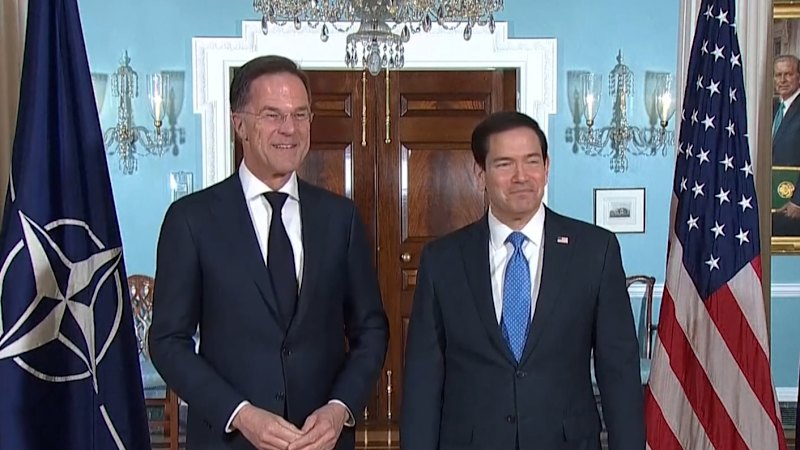
Donald Trump isn't interested in traditional diplomacy anymore. If you thought his first term was a headache for Brussels, 2026 is looking like a full-blown migraine. On Wednesday, Trump sat down with NATO Secretary General Mark Rutte at the White House, and the vibe wasn't exactly "united we stand." It was more like "pay up or I'm out."
The core of the friction isn't just the old complaint about defense spending. It’s about the war with Iran. Trump is furious that European allies didn't jump into the cockpit with the U.S. and Israel during the recent bombing campaigns. To Trump, NATO has become a "paper tiger"—a high-maintenance club that doesn't show up when the bullets fly.
The Paper Tiger Problem
Trump doesn't mince words. He’s been telling anyone who’ll listen that the U.S. is being taken for a ride. The logic is simple: why should Washington spend roughly 16% of the NATO budget and trillions on defense if Europe won't help secure the Strait of Hormuz?
The timing of this meeting is critical. We're currently in a fragile two-week ceasefire with Tehran. Trump wants the Strait of Hormuz open for oil, and he wants NATO to do the heavy lifting to keep it that way. But European diplomats are dragging their feet. They’re worried that getting involved now just invites more escalation.
Rutte, often called the "Trump whisperer," has the impossible job of keeping the U.S. at the table. He’s been flattering Trump, calling him the "daddy" of the alliance, and pointing out that European defense spending actually surged by 20% in 2025. But flattery only goes so far when the President is eyeing the exit sign.
Five Percent or Bust
The old goal was 2% of GDP. That’s ancient history. Trump is now demanding 5%. To put that in perspective, most European nations were barely hitting the 2% mark a few years ago.
Rutte is trying to bridge this gap with a new proposal:
- 3.5% for core defense spending: Direct military hardware, troops, and readiness.
- 1.5% for "indirect" spending: This covers things like protecting power grids and critical infrastructure from cyberattacks.
It's a clever accounting trick, but Trump isn't a fan of nuances. He sees the U.S. footing the bill while Europe hides behind "resilience" spending. A leaked White House memo even suggested cutting the U.S. contribution to NATO’s administrative budget to zero. That $3.5 billion hole would be a nightmare for the alliance to fill on short notice.
Can He Actually Leave
You've probably heard that Trump can't just quit NATO because of a law passed in 2023. That law requires two-thirds of the Senate to approve a withdrawal. While that’s true on paper, it doesn't mean much in practice if the Commander-in-Chief decides to stop showing up.
Think about it. If a member state is attacked and Trump refuses to send troops, Article 5 is effectively dead. You don't need a formal exit to break an alliance. You just need to stop believing in the "all for one" promise. Analysts at the Centre for Strategic and International Studies (CSIS) warn that even the hint of a U.S. withdrawal is enough to embolden Russia to test the waters in the Baltic states.
The Greenland and Ukraine Factors
It isn't just Iran. Trump is still fixated on Greenland. He views it as a national security asset, much to the horror of Denmark. Toss in his desire for a "rapprochement" with Russia to end the Ukraine conflict, and you've got a recipe for total alienation.
European leaders like Mark Rutte are basically in damage-control mode. They’re trying to show they’re "leaning into" the Hormuz issue without actually committing ships. They're buying more American jets to keep Trump happy. But the fundamental question remains: does the U.S. still see value in a collective defense model?
What Happens Now
Rutte’s visit continues through April 12. He’s heading to the Ronald Reagan Presidential Foundation next to give a speech that will likely be filled with more "Trump whispering." After that, he’s off to the Bilderberg Meeting.
If you're watching this from the outside, don't get distracted by the handshakes. The real story is the math. If Europe doesn't find a way to meet that 5% demand—or at least look like they're trying—the 77th anniversary of NATO might actually be its last.
Keep an eye on the Islamabad talks later this week. Vice President J.D. Vance is leading a delegation to talk with Iran. Whatever happens there will dictate Trump’s mood for the next NATO summit. If the ceasefire holds, Rutte might have some breathing room. If it doesn't, expect more "paper tiger" tweets and more pressure on Europe to pick a side.
Start looking at how your local markets are reacting to the Strait of Hormuz news. Energy prices are already twitchy. If NATO stays on the sidelines and the U.S. pulls back, the cost of shipping oil is going to be the first thing to hit your wallet.