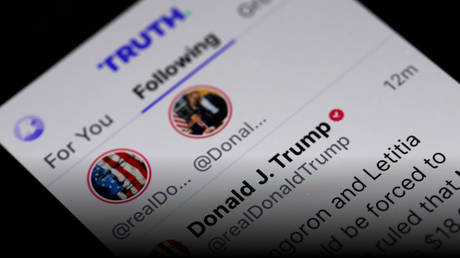
The media is laughing at Trump Media & Technology Group again.
Reports indicate the company behind Truth Social is considering a premium tier that charges users for first access to specific social media posts. The instant consensus among tech pundits and financial commentators was predictable: a collective eye-roll. They call it desperate. They call it a sign of a dying platform trying to squeeze blood from a stone.
They are completely missing the mechanics of modern digital attention economies.
The lazy critique assumes Truth Social is trying to be Twitter or Facebook. It isn't. Truth Social is an attention arbitrage engine anchored to a single, highly volatile, hyper-relevant political figure. In that specific ecosystem, delayed information is dead information.
Charging a premium for real-time access to market-moving, news-generating statements isn't a sign of desperation. It is a masterful exploitation of information asymmetry.
The Flawed Premise of the Free Social Network
Mainstream tech analysis suffers from a terminal case of monoculture thinking. For fifteen years, Silicon Valley drilled a single commandment into our heads: growth requires a free, frictionless onboarding process. You accumulate hundreds of millions of daily active users, track their behavior, and sell their eyeballs to programmatic advertisers.
That model works for mass-market utilities. It fails miserably for polarized, high-affinity niche platforms.
Advertising thrives on brand safety and broad demographics. Truth Social has neither. Fortune 500 companies are not going to bid up ad inventory next to hyper-partisan political firestorms. Relying purely on traditional digital ads for a platform like Truth Social is financial suicide. I have watched niche media networks burn through tens of millions of dollars trying to court mainstream advertisers who were never going to show up anyway.
When advertising is off the table, you have to monetize the intensity of your user base, not the size of it.
The media acts like charging for social media access is unprecedented. It happens every day in institutional finance. Bloomberg terminals cost tens of thousands of dollars a year primarily because they deliver market data seconds faster than public feeds. If a post on Truth Social can shift a stock price, alter a prediction market payout, or drive a cable news cycle, then being ten minutes late to that post means you lost money.
Information Asymmetry as a Service
Let us break down the actual mechanics of who buys this hypothetical premium access. The critics think Trump Media expects average retail voters to cough up a monthly fee just to see political opinions. Some will, out of pure tribal loyalty, but they are not the primary target.
The real customers are three specific groups:
High-Frequency Traders and Algorithmic Funds: Political statements from high-profile figures regularly trigger sharp movements in specific sectors—energy, defense, crypto, and domestic manufacturing. A five-minute delay on an announcement about tariffs or regulatory rollbacks is the difference between a profitable trade and a massive loss.
The Political Journalism Industrial Complex: Cable news producers, political reporters, and newsletter editors live and die by the scoop. If a major policy shift or political attack is locked behind a ten-minute paywall, every major newsroom in America will pay the fee. They have to. The alternative is letting their competitors break the news first.
Opposition Research and Campaign Staffers: Political campaigns spend millions on monitoring tools. Paying a premium to instantly parse an opponent’s statements for rapid-response messaging is a rounding error in a modern campaign budget.
This is not a social media feature. It is a business intelligence subscription disguised as a social media feature.
The Friction Problem is a Feature, Not a Bug
The immediate counterargument from tech purists is obvious: someone will just copy and paste the premium posts onto a free platform immediately. The information will leak. Paywalls on the internet are porous.
This argument underestimates the value of programmatic speed.
Imagine a scenario where a premium post goes live. Even if a subscriber copies the text and tweets it out thirty seconds later, that thirty-second window is an eternity in digital media and automated trading. By the time the free scrapers repost the content, parse it, and distribute it to their own followers, the primary economic value of that information has already been extracted.
Furthermore, Truth Social can easily combat manual leaks through basic technical measures—disabling copy-paste functions on premium accounts, employing dynamic watermarking to track and ban leaking accounts, or utilizing APIs that feed directly into enterprise sentiment analysis tools before the user interface even renders the text.
The friction of a paywall actually increases the perceived value of the content. In behavioral economics, scarcity drives desire. By restricting immediate access, Trump Media transforms standard political rhetoric into an exclusive commodity.
Dismantling the Practical Objections
Let us address the most common queries and objections surrounding this strategy with some blunt reality.
Won't this shrink the platform's overall reach and cultural relevance?
Yes, slightly, but reach does not pay the bills when your monetization-per-user on ads is abysmal. A business that makes ten dollars a year from one million hardcore subscribers is far healthier than a business that makes five cents a year from twenty million casual users who use ad-blockers.
Does this violate the unwritten rules of social media?
The unwritten rules of social media were authored by platforms that are currently struggling to maintain profitability amid shifting privacy regulations and declining ad yields. Following their playbook is a recipe for stagnation. Elon Musk proved with Twitter Blue (now X Premium) that a segment of users will pay for verification and algorithm boosts, despite years of pundits claiming users would never pay for social media features. Trump Media is simply taking that logic to its natural conclusion: charging for the content itself, not just the badge next to your name.
The Hard Truth About Niche Networks
The downside to this approach is clear, and we must be honest about it. Once you transition from a public square to a premium information broker, you cap your potential to become a mass-market utility. You accept that you will never be Facebook. You alienate the casual user who just wants to scroll through a free feed without feeling like a second-class citizen.
But trying to be everything to everyone is how mid-tier tech companies die. They overspend on infrastructure to support millions of non-monetizable users, hoping that scale will magically solve their revenue problems. It rarely does.
Trump Media possesses a unique asset: an audience with an unprecedented level of emotional and financial commitment to the platform's figurehead. Attempting to build a standard, ad-supported Silicon Valley clone with that asset is a complete waste of leverage.
Stop looking at this through the lens of traditional tech metrics like Monthly Active Users or Average Revenue Per User driven by ad impressions. This is an enterprise data play wrapped in a political flag. It is unconventional, it flies in the face of established Web 2.0 dogma, and it is exactly how a highly specialized platform survives in a market dominated by tech monopolies.
Stop expecting every digital network to follow the same tired playbook. The era of the completely free public square is ending. The era of monetizing high-value, time-sensitive attention is here. Pay the fee or wait in line with everyone else.