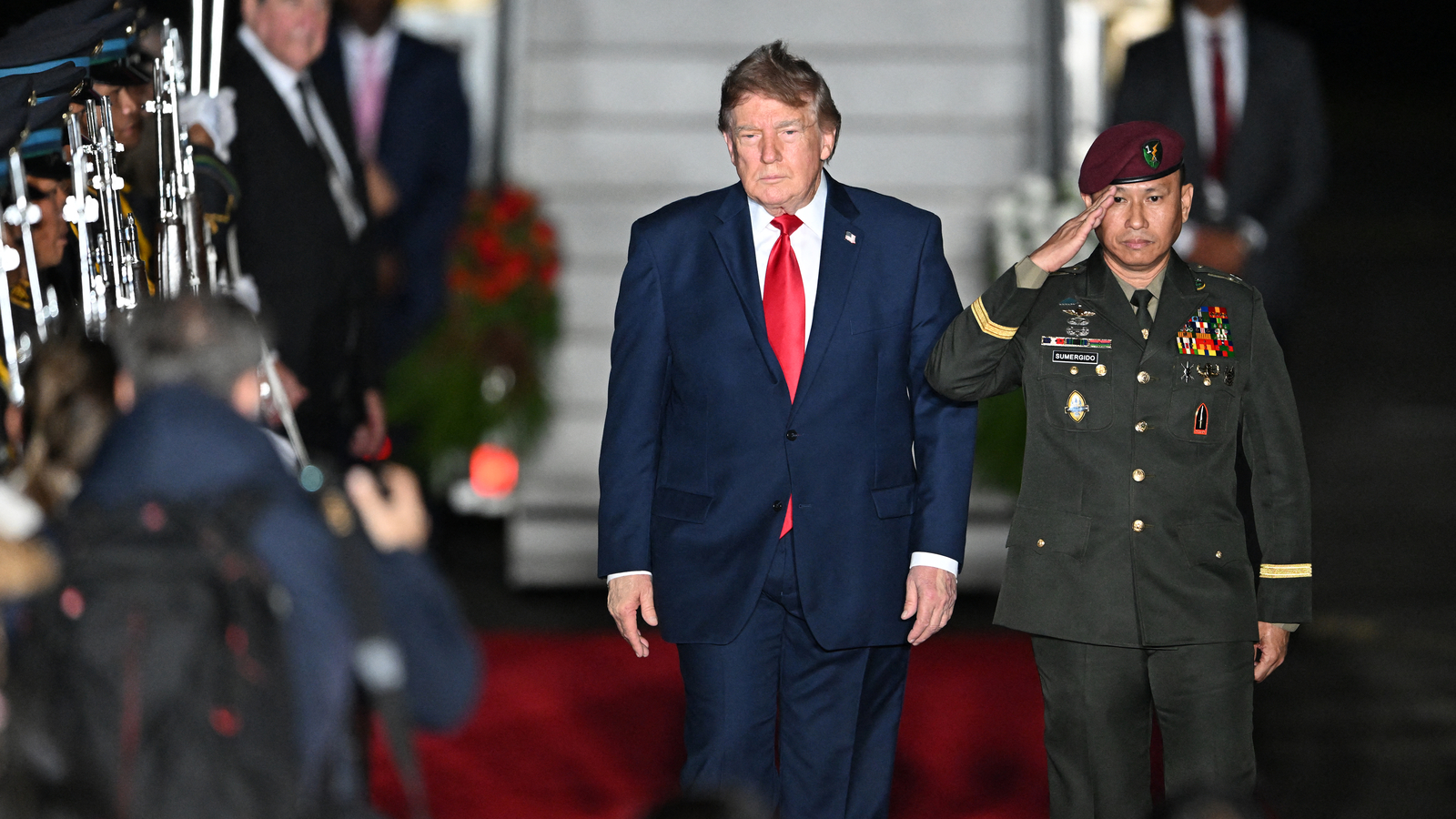
Mainstream foreign policy desks are breathless right now. Donald Trump has touched down in the Philippines for the ASEAN Summit, and the diplomatic press corps is already writing the same recycled script they pull out every single autumn. You know the drill. Handshakes on the tarmac. Breathless speculation about the Quad leaders meeting on the sidelines. Endless chatter about "reassuring allies," "projecting strength in the Indo-Pacific," and "countering Beijing."
Stop reading that script. It is fiction written by people who mistake a motorcade for a strategy. If you enjoyed this piece, you might want to read: this related article.
If you think an American president flying into Manila for a four-day multilateral photo-op changes the structural reality of the South China Sea, you have been sold a comforting lie. The lazy consensus in Washington and Brussels treats ASEAN and the Quad as interlocking gears in a grand machine designed to contain Chinese expansion. In reality, those two groupings are operating on completely incompatible operating systems. Bringing Trump into the middle of that friction does not create alignment. It exposes the rot underneath the polite diplomatic communiqués.
I have sat in enough back-room briefings from Singapore to Tokyo to watch defense contractors and think-tank fellows burn millions of dollars on white papers that assume Southeast Asian capitals actually want to choose a side. They do not. And pretending that a bilateral handshake in Manila overrides decades of economic gravity is how nations sleepwalk into a crisis they cannot win. For another angle on this development, see the latest update from Reuters.
The Myth of the Unified Front
Let us look at what is actually happening on the ground in Manila, stripped of the State Department talking points.
First, define the terms properly. ASEAN (the Association of Southeast Asian Nations) operates on a strict doctrine of consensus and non-interference. Ten countries, wildly different political systems, and wildly different threat perceptions. The Quad (the Quadrilateral Security Dialogue—United States, Japan, India, and Australia) is an informal strategic grouping explicitly designed to balance China's maritime and technological reach.
The press treats Trump's dual engagement—attending ASEAN functions while pulling Quad leaders into a separate huddle—as a masterclass in multi-layered diplomacy. Here is the reality. ASEAN nations despise the Quad's quiet dominance of the security agenda, even when they privately welcome the American military umbrella.
When Washington stages a Quad summit on the margins of an ASEAN event, it sends an unmistakable message to Jakarta, Kuala Lumpur, and Bangkok. That message is simple: Your regional architecture is too slow, too divided, and too compromised to handle real security threats, so the four big powers are going to handle it in the room next door.
Do you think that builds trust? It breeds resentment. Indonesia and Malaysia have spent years warning that the Quad risks militarizing the region and forcing smaller states into a binary Cold War trap. Meanwhile, the Philippines under Ferdinand Marcos Jr. has leaned aggressively into its Mutual Defense Treaty with Washington, turning itself into the tip of the spear in the Second Thomas Shoal. Manila wants hard security guarantees. Jakarta wants trade surpluses and zero kinetic risk. You cannot paper over that divide with a joint statement drafted by junior diplomats at three in the morning.
What Everyone Gets Wrong About Trump in Manila
The conventional wisdom splits into two predictable camps whenever Trump enters an Asian summit.
Camp A claims he will blow up the alliances, demand protection money from Manila and Tokyo, and hand the region to Xi Jinping on a silver platter. Camp B claims his unpredictability will terrify Beijing into backing down and force allies to finally pay their fair share.
Both camps are asking the wrong question. They are obsessed with Trump's temperament when they should be looking at transactional realism as a permanent shift in American statecraft.
Trump is not an anomaly interrupting a golden age of American altruism. He is the blunt instrument executing a correction that Washington's fiscal reality made inevitable years ago. The United States cannot subsidize the security of the global commons while running multi-trillion-dollar deficits and rebuilding a hollowed-out industrial base. Every president since Obama has tried to "pivot to Asia," and every single one got dragged back into European land wars or Middle Eastern quagmires.
When Trump sits down with Quad leaders in Manila, he is not there to recite boilerplate commitments to the "rules-based international order." That phrase is dead on arrival in a Trump White House. He is there to audit the ledger.
- To Japan: How fast are you actually deploying those counter-strike capabilities, and what happens to our bilateral trade deficit?
- To Australia: Where is the industrial capacity to make AUKUS more than a multi-decade PowerPoint presentation?
- To India: Why are you still buying discounted Russian energy and stalling on defense interoperability while asking for high-end American jet engine technology?
- To the Philippines: We are rotating missiles onto Luzon and expanding EDCA (Enhanced Defense Cooperation Agreement) sites—what is Manila putting on the table besides real estate?
This is brutal, uncomfortable diplomacy. It strips away the polite fiction that alliances are built on shared values rather than cold, hard mutual utility. And frankly, it is the only conversation worth having. If an alliance cannot survive an honest audit of who pays and who bleeds, it was never going to survive a shooting war in the Taiwan Strait anyway.
Dismantling the "People Also Ask" Delusions
Whenever a major summit kicks off in Southeast Asia, the search engines light up with the exact same predictable queries. Let us tear apart the flawed premises behind them.
"Will the Quad become an Asian NATO?"
No. Stop using that phrase. Anyone who calls the Quad an "Asian NATO" either does not understand Article 5 of the North Atlantic Treaty or does not understand India.
NATO is a formal, treaty-bound collective defense alliance with an integrated military command structure. An attack on one is an attack on all. The Quad has no treaty, no permanent secretariat, no joint command, and zero mutual defense obligations. More importantly, India will never sign a mutual defense treaty with Washington. New Delhi's entire foreign policy doctrine—strategic autonomy, championed by External Affairs Minister S. Jaishankar—is built on avoiding formal alliances. India uses the Quad to balance China along its Himalayan border and in the Indian Ocean, while simultaneously maintaining deep ties with Moscow and leading the Global South. Expecting India to send troops to defend a Philippine resupply ship in the South China Sea is pure fantasy.
"Is ASEAN losing its centrality?"
ASEAN centrality is already a zombie concept. It walks around, wears a nice suit, and issues statements, but there is no pulse.
When the bloc cannot even enforce its own Five-Point Consensus on a civil war raging inside one of its own member states—Myanmar—it has zero credibility to mediate a superpower standoff between Washington and Beijing. ASEAN remains a vital forum for trade facilitation and keeping regional diplomats talking so they do not shoot at each other. That is valuable. Pretending it is a decisive security actor is dangerous self-deception.
"Does Trump's visit deter China in the South China Sea?"
Summits do not deter gray-zone warfare. Physics and economics deter gray-zone warfare.
Beijing does not care about a press conference in Manila. China's strategy in the South China Sea relies on incremental, sub-threshold coercion—water cannons, laser dazzlers, coast guard blockades, and artificial island militarization. None of these actions cross the threshold that would trigger the 1951 U.S.-Philippines Mutual Defense Treaty. A president flying in for seventy-two hours does not alter the fact that China's Coast Guard vessels are larger, more numerous, and permanently stationed miles away from Philippine reefs, while the nearest major U.S. naval repair yards are thousands of miles away in Japan, Guam, or Hawaii.
The Uncomfortable Truth About Economic Gravity
Here is the massive blind spot in almost every Western analysis of the Manila summit: you cannot contain a country that is everyone's primary banker and supply chain hub.
China is ASEAN's largest trading partner. Not by a small margin. Trade between China and ASEAN routinely clears $900 billion annually, dwarfing U.S.-ASEAN trade. Chinese state-backed firms are building the railways in Laos, the high-speed rail in Indonesia, the industrial parks in Malaysia, and the power grids across the Mekong sub-region.
Imagine a scenario where Washington demands that ASEAN leaders choose between American security guarantees and Chinese capital. You do not need a crystal ball to know what happens. Nine out of ten capitals will quietly take Beijing's money, nod politely at Washington's speeches, and hedge until the last possible second.
This is the fatal flaw in the American approach. Washington shows up to summits offering weapons systems, joint naval patrols, and lectures on maritime law. Beijing shows up offering infrastructure loans, immediate market access, and zero lectures on domestic governance. Until the United States offers a serious, scalable economic alternative—not a toothless framework like IPEF (Indo-Pacific Economic Framework) that refuses to offer actual market access—American presidents will always be playing defense in Southeast Asia.
The Downside of the Contrarian Playbook
Let us be completely honest about the risks of this hard-nosed, transactional approach. Strip away the diplomatic niceties, and you break things.
If Trump pushes the transactional audit too hard in Manila, he risks triggering a massive backlash among middle powers. Allies like Japan and Australia have invested tremendous political capital in anchoring the United States to the region. If Washington looks like a mercenary protection racket rather than a reliable security guarantor, Tokyo and Seoul will inevitably accelerate quiet conversations about independent nuclear deterrence.
Furthermore, humiliating ASEAN leaders by treating their summit as a mere backdrop for Quad power politics could push fence-sitters like Indonesia and Vietnam closer to Beijing's orbit out of sheer diplomatic self-preservation. Realism without tact is just bullying, and bullying creates strange bedfellows.
What Needs to Happen Instead
If policymakers in Washington, Manila, and Tokyo want actual deterrence rather than cable-news theater, they need to abandon the summit circus and execute three concrete shifts.
- Decouple the Quad from ASEAN optics. Stop staging Quad meetings on the sidelines of ASEAN summits. It insults the host bloc and forces Southeast Asian leaders into defensive postures. Hold Quad summits quietly in Honolulu, Darwin, or Yokosuka, and focus exclusively on hard operational logistics—shared submarine tracking, joint munitions production, and undersea cable protection.
- Pre-position industrial capacity, not just ships. A carrier strike group sailing through the Luzon Strait makes a great photograph, but it is a high-value target in a missile-saturated environment. Real deterrence means decentralizing fuel depots, repair facilities, and anti-ship missile batteries across northern Luzon and the Ryukyu Islands so Beijing knows any kinetic move turns the first island chain into an impassable kill zone.
- Fix the trade deficit in the diplomatic toolkit. If Washington will not sign traditional free-trade agreements, it must weaponize targeted industrial incentives—extending tax credits, critical mineral partnerships, and semiconductor packaging investments directly to ASEAN nations that diversify supply chains away from mainland China. Give them a paycheck, not a speech.
The cameras in Manila will capture plenty of smiles over the next few days. Leaders will wear traditional Barong Tagalog shirts, link arms for the group photo, and promise a new era of regional cooperation.
Do not mistake the choreography for power. Power in the Indo-Pacific is measured in shipbuilding capacity, missile stockpiles, and supply chain control—and right now, a tarmac handshake is not closing that gap.