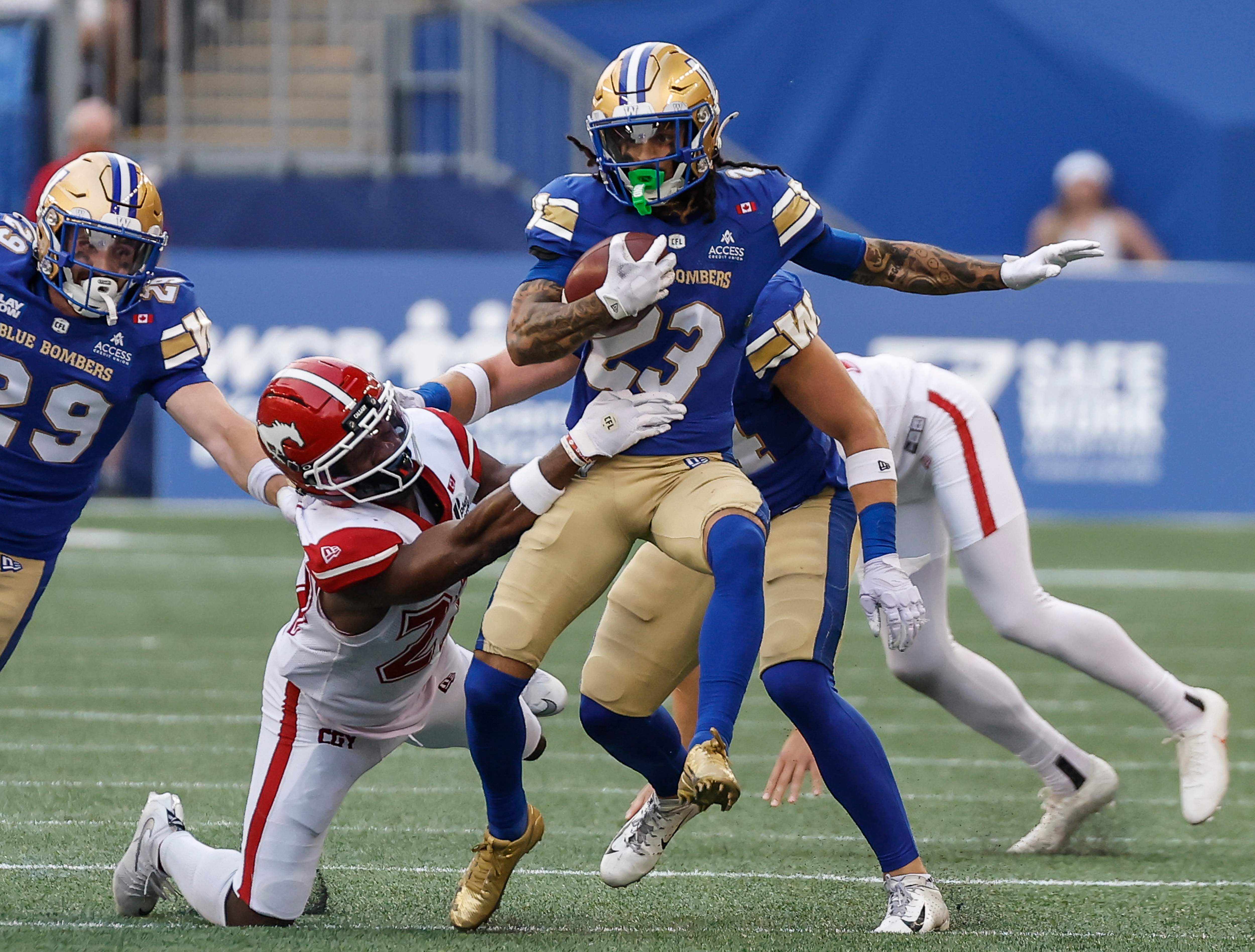
Winnipeg Blue Bombers returner Trey Vaval has officially been named a finalist for the Canadian Football League’s Most Outstanding Special Teams Player award, cementing his status as one of the most dangerous field-position manipulators in North American football. While standard press releases celebrate the nomination with box-score summaries, the real story lies in how a young returner mastered the unique geometry of the Canadian game to rescue drives and tilt the math of entire football games in Winnipeg’s favor.
Most casual observers treat kick returns as chaotic coin flips. They see a wedge of blockers, a sprint toward daylight, and an eventual collision. Anyone who has spent decades watching three-down football knows that view is dangerously incomplete. In the CFL, where the field is 110 yards long, 65 yards wide, and devoid of the NFL’s fair-catch safety net, the return game is not an auxiliary phase. It is the primary engine of offensive efficiency.
The Geometry of the Five-Yard Halo
To understand why Vaval’s nomination matters, you have to understand the environment he operates in. Unlike American football, where a punter can hang a ball in the air and let gunners stand a yard away waiting for a fair catch, Canadian rules mandate a five-yard restraining zone around the returner until the ball is touched.
That five-yard buffer is a psychological trap for inexperienced players. It creates an illusion of safety that vanishes the microsecond leather hits palms. Ten defenders are converging at full speed, and the wider field means those defenders are attacking from acute angles that simply do not exist on a 53-and-a-third-yard American gridiron.
Vaval thrived because he solved the spatial geometry early. Instead of drifting laterally to outrun pursuit—a classic mistake made by former NCAA stars adjusting to the Canadian width—he attacked the vertical seams before the coverage lanes could compress. By planting his foot and driving north-south immediately upon securing the catch, he forced coverage units to tackle in tight quarters rather than using the sideline as an extra defender.
Why Field Position Dictates Three-Down Survival
In a four-down league, an offense starting on its own 20-yard line has three chances to gain ten yards before facing a punting decision. In the CFL, you get two. A single negative play on first down—a dropped screen, a two-yard sack, a false start—effectively kills the drive before it begins.
This structural reality makes hidden yardage the most valuable currency in the Canadian Football League. When Vaval consistently turns routine punts into 15-yard gains or flips the field on missed field goals, he is not just padding individual statistics. He is fundamentally altering the playbook available to Winnipeg’s offensive coordinator.
Consider the difference between starting a drive at your own 28-yard line versus your own 44-yard line. At the 28, conservative run calls and high-percentage horizontal passes dominate early downs to avoid a catastrophic second-and-long punt from deep in your own territory. At the 44, you are already one explosive play away from scoring range. Play-action opens up. Deep shots become viable on first down because a miss does not trap your defense against its own goal line.
Vaval’s consistency gave Winnipeg that breathing room week after week. Even on returns that failed to break into the open field, his ability to squeeze seven or eight extra yards out of a dead play kept the Blue Bombers out of the shadow of their own end zone.
The Art of Tracking the Missed Field Goal
One of the most misunderstood elements of CFL special teams—and an area where Vaval separated himself from the pack—is the missed field goal return. Because Canadian end zones are 20 yards deep and the goalposts sit on the goal line, missed kicks routinely land in play rather than sailing harmlessly out the back.
Returning a missed field goal requires a completely different skill set than fielding a punt. The trajectory is lower, the spin is erratic, and the covering unit consists mostly of heavy offensive and defensive linemen rather than fleet-footed defensive backs.
If a returner hesitates, those linemen build momentum and form an impenetrable wall. If he fields it cleanly on the run, he has 120-plus yards of open grass against athletes who are not built to tackle in space. Vaval demonstrated a rare poise on these plays, judging depth accurately under pressure and hitting the crease at top speed before Winnipeg’s opponents could transition from kick protection to pursuit.
What Standard Box Scores Miss About Return Excellence
When voters evaluate finalists for Most Outstanding Special Teams Player, they naturally gravitate toward highlight-reel touchdowns and raw yardage totals. Those numbers are easy to digest, yet they frequently obscure the true value of an elite returner.
Ball security remains the bedrock of the job. A returner who averages 14 yards per punt return while putting the ball on the turf four times a season is a net negative. Fumbles on special teams are sudden-change turnovers that frequently result in immediate points for the opposition. Vaval earned the trust of the Winnipeg coaching staff because his hands remained reliable in swirling prairie winds and late-season cold.
Decision-making inside the 10-yard line is another metric that never shows up in a standard stat line. Knowing when to let a bouncing punt roll into the end zone for a conceded rouge versus when to field a short hop to save 20 yards of field position requires split-second calculation. Mistakes there cost games. Vaval consistently made the high-percentage choice, protecting his offense from starting drives pinned against the back line.
The Historical Weight of Special Teams in Winnipeg
Winnipeg has long treated special teams as a foundational pillar rather than an afterthought. Under head coach Mike O’Shea—a former CFL linebacker and special teams stalwart himself—the Blue Bombers have built an organizational culture where roster spots are won and lost on punt coverage and kick return blocking.
That institutional commitment creates a symbiotic relationship. Vaval did not operate in a vacuum; he ran behind a veteran unit drilled relentlessly on leverage, legality, and finishing blocks without drawing holding penalties.
Anyone who watches the CFL closely knows that flags are the silent killers of the return game. A breathtaking 60-yard punt return means nothing if a gunner gets tugged at the point of attack and a yellow handkerchief brings the ball all the way back to the 15-yard line. Winnipeg’s discipline allowed Vaval’s vision to translate into real, countable yardage, while Vaval’s patience allowed his blockers time to establish their angles.
The Counter-Argument Against Return Specialists
Despite Vaval’s undeniable impact, a growing faction of football analysts questions the long-term sustainability of building around dynamic returners. The argument is rooted in attrition.
Returners take some of the most violent, high-speed collisions in professional sports. Unlike running backs, who generally see defenders coming in front of them, a punt returner spends crucial seconds looking straight up into stadium lights while 220-pound athletes sprint toward his blind spots. Durability is always a gamble.
Furthermore, modern CFL punters have become remarkably adept at directional kicking and rugby-style rollouts designed specifically to neutralize elite returners. By pinning the ball near the boundary or generating awkward end-over-end bounces, opposing specialists can artificially suppress a returner’s opportunities, forcing teams to win purely through conventional offensive execution.
There is also the salary cap equation. In a league with strict financial limits, paying a premium for a dedicated return specialist becomes difficult if that player does not also contribute meaningfully as a starting receiver or defensive back. Vaval’s dual utility and developmental upside helped Winnipeg bypass that cap crunch, giving them elite production without compromising depth elsewhere on the roster.
Decoding the Award Voting Dynamics
Winning the CFL’s Most Outstanding Special Teams Player award is notoriously tricky because voters are asked to compare apples to hammers. Every year, the ballot pits dynamic returners against veteran placekickers who hit 90 percent of their field goals and cover-team demons who lead the league in special teams tackles.
Placekickers hold a natural advantage in the minds of many voters because their contributions are directly tied to the scoreboard. A game-winning 48-yard field goal in the fourth quarter is visceral and definitive. A series of 18-yard punt returns that set up three touchdown drives requires a slightly deeper appreciation of cause and effect.
To take home the hardware, a returner cannot simply be good; he has to be unavoidable. He has to force opposing coaches to alter their game plans, kick away from the middle of the field, and sacrifice net punting average just to keep the ball out of his hands. Vaval cleared that bar. Opponents spent the second half of the season visibly scheming around his presence, yet he still found ways to manufacture explosive plays when Winnipeg needed a spark.
The Blueprint for Surviving the Postseason
As the calendar turns toward November and the brutal realities of the CFL playoffs, the value of a player like Vaval multiplies exponentially. Postseason football across the Canadian prairies is rarely won through pristine, 400-yard passing clinics. Cold temperatures, gusting winds, and defensive familiarity compress the margin for error until every possession feels like a trench war.
In those environments, special teams often decide who advances to the Grey Cup and who goes home. A single broken tackle on a punt return can supply the only touchdown of a freezing afternoon. A clean catch in heavy wind prevents the kind of catastrophic turnover that defines playoff collapses.
Vaval’s nomination is a well-earned nod to his regular-season dominance, yet the true test of his impact lies in how defenses continue to adjust when everything is on the line. Whether he walks away with the trophy or not, he has already forced every special teams coordinator in the league to rewrite their preparation sheets whenever Winnipeg comes to town.