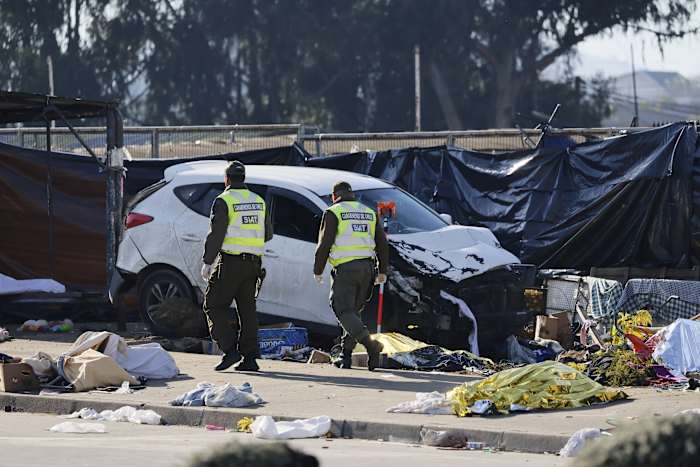
A quiet Sunday morning at a bustling open-air market shouldn’t turn into a scene of absolute devastation. Yet, that’s exactly what happened in the coastal city of Viña del Mar, Chile, when a private car driven by an off-duty navy officer plowed directly into crowded market stalls. The sudden impact shattered lives in seconds, leaving at least six people dead and sending shockwaves across the country.
The disaster unfolded at the Caupolicán market, a massive trading hub in the upper part of the city that features more than 1,000 stalls and routinely draws massive crowds on Thursdays and Sundays. When a vehicle suddenly careens into an area packed with families, vendors, and weekend shoppers, the results are bound to be catastrophic. For a different look, read: this related article.
What We Know About the Viña del Mar Market Crash
Eyewitness accounts and residential security camera footage paint a terrifying picture of the incident. According to Colonel Jorge Guaita, the police prefect for Viña del Mar, witnesses reported seeing the vehicle traveling at an incredibly high speed right before the disaster. The car was moving in the correct direction of traffic, but something caused the driver to lose control.
When the car mounted the sidewalk, it spun completely around. It tore through the crowded stalls, crushing structures and pedestrians alike. Investigators noted that a local bus stop ultimately brought the vehicle to a halt. If that structure hadn't been there to absorb the final impact, the car likely would have kept moving forward, multiplying an already horrific body count. Further analysis on this matter has been published by The Guardian.
In the immediate aftermath, chaos erupted. Surviving bystanders and vendors, fueled by shock and fury, swarmed the vehicle. Social media footage quickly surfaced showing angry crowds shouting and chasing after a police car as officers rushed the detained driver away from the scene to prevent a lynching.
The Driver and the Investigation
The public anger is compounded by the identity of the driver—an off-duty member of the Chilean Navy. While the navy quickly issued a statement expressing cooperation with civilian authorities to clarify what happened, the defense of the driver has already raised eyebrows.
Colonel Guaita revealed to reporters that the driver claims he has absolutely no memory of the event.
Many initial assumptions pointed toward drunk driving, a frequent culprit in high-speed morning crashes. However, Interior Undersecretary Máximo Pavez confirmed that the detained navy officer tested negative on an initial breathalyzer test.
"At this stage, the cause for the incident is yet to be determined." — Colonel Jorge Guaita, Police Prefect
So, what actually happened? Investigators are currently looking into alternative theories. Local media reported that some witnesses saw a separate collision just moments before, suggesting the navy officer may have lost control of his vehicle trying to avoid or recovering from a prior impact. Mechanical failure or an abrupt medical emergency are also on the table, given the driver's claims of total amnesia regarding the crash.
The Human Cost and Official Reactions
While the investigation grinds on, families are left to pick up the pieces. Local media reports indicate at least six people lost their lives in the carnage. Emergency responders, including police, firefighters, and paramedics, swarmed the Caupolicán market to treat dozens of people on-site.
Several victims required immediate hospitalization. Officials at the nearby Gustavo Fricke Hospital confirmed they admitted five injured patients suffering from various traumatic injuries. Horrifically, two of those patients were babies.
Denise Cataldo, the hospital's deputy director, stated that the admitted patients are currently stable and out of life-threatening danger, though they remain under close observation as doctors complete necessary medical examinations. Two other injured individuals were treated and have already been discharged.
The tragedy has resonated at the highest levels of Chile's government. Chilean President José Antonio Kast took to social media to express his condolences, stating that the incident has plunged the entire country into mourning. Kast emphasized that all state institutions are actively working to assist the victims' families and ensure that legal responsibilities are established with absolute clarity.
Safety Flaws in Open-Air Markets
This tragedy highlights a glaring vulnerability that urban planners and safety experts have warned about for years. Open-air markets like Caupolicán are dense, vibrant community spaces, but they lack basic physical protection from the roadways directly adjacent to them.
When over a thousand temporary stalls set up on sidewalks and plazas next to high-speed traffic lanes, a single driver's mistake or medical episode can easily turn into mass casualty events. The fact that a simple bus stop was the only thing preventing further deaths in Viña del Mar proves how exposed these pedestrian zones truly are.
Going forward, local municipalities across Chile face growing pressure to re-evaluate how these markets operate. Simple fixes, like installing heavy-duty temporary bollards or closing down adjacent traffic lanes during market hours, could mean the difference between a normal Sunday and national mourning.
The immediate next steps rest with the Chilean fiscalía (prosecutor's office) as they analyze the vehicle’s mechanical state, review blood toxicology reports, and piece together the final moments before the car veered off the road.