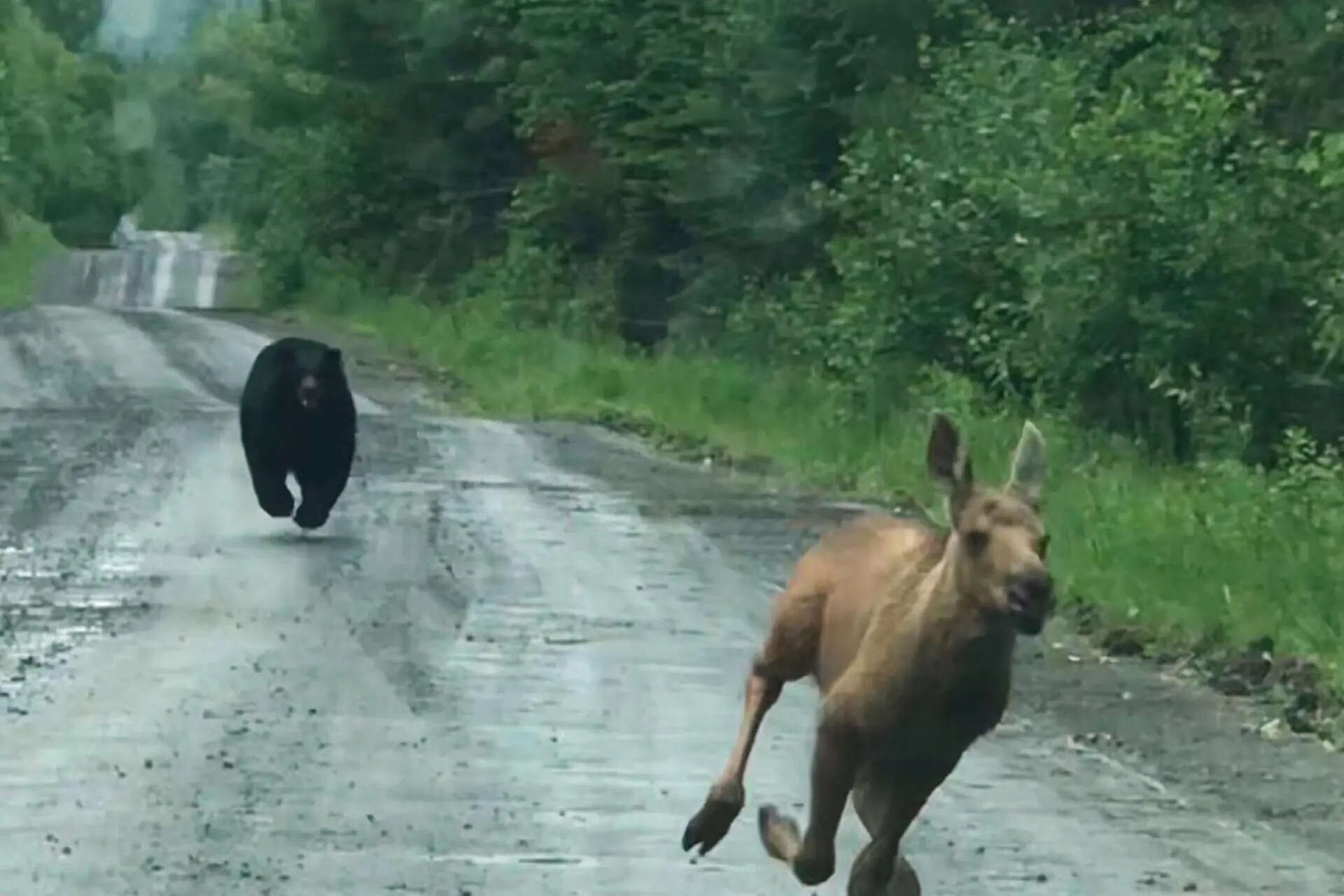
Every spring, the same viral headline cycles through the media cycle. A well-meaning couple or a group of hikers spots a dramatic predator-prey interaction in the woods—a bear chasing a moose calf, a coyote closing in on a fawn—and the internet loses its collective mind over the "split-second decision" of whether to intervene.
This framing is not just dramatic; it is fundamentally broken.
The lazy consensus driven by clickbait journalism suggests that humans face a profound moral dilemma when witnessing the harsh realities of the food chain. It positions us as the righteous arbiters of the forest, weighing our empathy against the brutal mechanics of evolution.
Here is the cold truth nobody wants to print: there is no dilemma. The desire to step in and "save" a wild animal from a predator is not heroism. It is an act of profound ecological ignorance driven by an anthropomorphic savior complex. When you interrupt a predator's hunt, you are not protecting nature. You are actively disrupting it.
The Flawed Premise of Human Heroics
The media loves to romanticize the idea of the human protector. We are conditioned by animated movies to view predators as villains and prey as innocent victims. This creates a psychological trap when people enter actual ecosystems.
When a black bear pursues a moose calf, observers see a tragedy. Biologists see a caloric necessity.
"Wildlife management is not about individual outcomes; it is about population dynamics and energy transfer."
I have spent decades tracking wildlife populations and working alongside field biologists who have to clean up the messes left behind by overzealous tourists. I have seen entire local ecosystems thrown out of balance because people thought they knew better than millennia of evolutionary design.
Let's break down the mechanics of what actually happens when a human decides to play god in the woods.
1. Starving the Predator
Predation is an incredibly high-energy, low-success endeavor. A grey wolf misses up to 90% of its prey attempts. A Canadian lynx fails the majority of its hunts. A bear emerging from hibernation is operating on a razor-thin caloric deficit.
When you scare off a predator to save a calf, you aren't just saving a life. You are actively starving another. That bear has expended vital energy stores on a chase that you ruined. The consequence? The predator must now hunt again, often targeting even more vulnerable targets, or face starvation.
2. Weakening the Gene Pool
Predators do not choose their targets at random. They exploit weakness. The calf or fawn that gets caught is frequently the one with genetic defects, underlying illness, or poor reflexes.
By intervening, humans artificially preserve weak genetic traits within the prey population. This undermines natural selection, leading to a long-term decline in the overall health of the species you think you are protecting.
3. Creating Conflict Cycles
Habituating prey to human presence as a safe haven creates dangerous behavioral shifts. Animals quickly learn that humans act as a shield against predators. This drives prey populations closer to human settlements, leading to increased vehicular collisions, property destruction, and eventual culling by wildlife authorities. Your short-term empathy creates a long-term death sentence.
Dismantling the Common Justifications
People love to rationalize their interference with a handful of predictable arguments. Let's dismantle them with actual biological principles.
"But the species is threatened!"
This is the most common justification used by amateur conservationists. Unless you are dealing with a highly controlled, captive-breeding reintroduction program managed by state biologists for a critically endangered species, this argument holds zero weight.
In the vast majority of viral encounter stories—such as those involving moose or white-tailed deer—the populations are stable or overabundant. Intervening in a localized, natural predatory event does absolutely nothing to aid species conservation. In fact, overpopulation of ungulates leads to overbrowsing, which destroys forest understories and collapses local bird and insect habitats.
"We are part of nature, so our intervention is natural."
This is a philosophical cop-out. Humans operate outside the energetic constraints of the local food web. We do not hunt to survive in that immediate ecosystem; we do not rely on the biomass of that forest to make it through the winter.
Our presence in these spaces is disruptive by default. Adding deliberate, emotionally driven manipulation to that presence is an escalation of human interference, not an integration with the natural world.
| Human Action | Perceived Outcome | Ecological Reality |
|---|---|---|
| Intervening in a hunt | Saving an innocent life | Starving a predator, wasting its energy |
| Feeding an abandoned calf | Preventing starvation | High probability of maternal abandonment or habituation |
| Moving a fawn | Protecting it from predators | Separating it from a mother who left it cached intentionally |
The Real Danger of the Secondhand Narrative
The problem isn't just the people in the woods; it is the media ecosystem that rewards them. When outlets publish breathless accounts of couples who "had seconds to decide whether to act," they validate the premise that acting is a viable option.
This narrative creates a culture of interference.
Walk into any national park or state forest, and you will see the results of this mindset:
- Fawns kidnapped from high grass because hikers assumed they were abandoned (when, in reality, mothers cache their young to avoid drawing predators).
- Bears euthanized because they learned to associate humans with an easy meal after being driven off natural kills.
- Bison calves rejected by their herds after tourists decided they looked "cold" and put them in the back of an SUV.
The downside to the contrarian approach—the approach of absolute non-intervention—is that it is deeply uncomfortable to watch. It requires you to sit quietly and witness violence. It forces you to accept that nature is not a sanctuary designed for your emotional comfort. It is an engine fueled by death.
The Actionable Framework for Wildlife Encounters
If you find yourself in a position where you are witnessing a predation event or a seemingly vulnerable young animal, your script should be rigid and unyielding.
Stop looking for a reason to be the main character in a Disney movie.
First, look at your distance. If the animals are reacting to your presence, you are already too close. You are changing the outcome of the event simply by standing there. Step back immediately.
Second, keep your hands to yourself and your mouth shut. Do not yell to distract the predator. Do not throw rocks. Do not try to herd the prey toward safety.
Third, understand the biological reality of caching. Most young animals found alone are not abandoned. Their primary defense mechanism is staying perfectly still while their mother forages miles away. Your intervention is the single greatest threat to their survival.
If you genuinely suspect human activity caused the distress—such as an animal caught in a fence or hit by a car—the solution is still not to intervene yourself. You call state wildlife biologists who possess the training, tools, and ecological context to make an informed decision. You do not take a selfie and post a long narrative about your moral agonizing on social media.
The next time you see an article praising someone for saving a wild animal from the jaws of a predator, do not share it. Do not celebrate it. Recognize it for what it is: a failure of basic ecological literacy wrapped in a cloak of unearned virtue.
Nature does not need your rescue squad. It needs your absence.