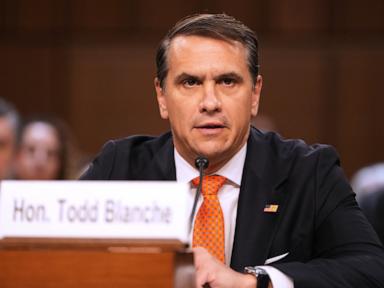
Todd Blanche wants you to believe he's just a traditional law-and-order guy trying to restore sanity to the Department of Justice.
But as he sat before the Senate Judiciary Committee on Wednesday, the reality of his position became impossible to ignore. He isn't just any nominee. He's Donald Trump's former personal defense attorney, a man who built his current reputation by shielding the president from felony charges in New York and federal investigations in Washington. Now, he's asking the Senate to permanently hand him the keys to the nation's most powerful law enforcement agency.
The confirmation hearing was never going to be a walk in the park, but the opening day of testimony on July 15, 2026, quickly turned into a grueling, multi-front defense of his short but highly controversial tenure as acting attorney general.
If you think this is a routine partisan food fight, you're missing the real story. Blanche isn't just facing fire from predictable Democratic critics. He is actively struggling to secure the lockstep Republican support he needs to pass a razor-thin committee. With the recent passing of Senator Lindsey Graham, the committee's makeup stands at 11 Republicans and 10 Democrats. Blanche cannot afford a single GOP defection if he wants his nomination reported favorably to the full Senate.
And right now, some key Republicans aren't biting.
The Epstein files and the unredacted names
The most emotionally charged moments of the hearing centered on Blanche's handling of the highly sensitive Jeffrey Epstein files.
As deputy attorney general and subsequently acting attorney general, Blanche personally oversaw the review and release of these documents. Under intense questioning from Senator Richard Blumenthal, a Connecticut Democrat, Blanche was forced to apologize directly to the survivors of Epstein's crimes. The DOJ had mistakenly published records containing the unredacted personal information of victims.
"I will absolutely say that any mistake that we made should not have been made. And I very much apologize," Blanche testified.
Blanche tried to frame the issue as a minor administrative slip-up, arguing that only a small percentage of the massive cache of documents went out with errors and that his team worked 24/7 to pull them down within minutes of realizing the mistake. But the political damage was done.
The oversight raised uncomfortable questions about whether the DOJ rushed the release to serve a political timeline. Critics like the New York City Bar Association, which formally opposed his nomination just days before the hearing, point to reports that Blanche met privately with White House staff in the Situation Room to strategize on how to protect Trump from compromising details in those very files.
The IRS tax settlement and the ghost of the weaponization fund
If the Epstein files exposed operational flaws, the line of questioning regarding Trump's personal finances exposed the philosophical divide over Blanche's true loyalties.
Democrats hammered Blanche over a recent Justice Department settlement resolving a lawsuit over the disclosure of Trump's tax returns. The settlement included an incredibly broad provision shielding the president and his sons from legal liability for past tax violations.
Blanche didn't flinch. He insisted these kinds of agreements are "done regularly" and defended the sign-off. But to critics, it looked like a classic inside job—the president's former defense lawyer using the weight of the federal government to grant his old client blanket immunity.
Then came the "anti-weaponization" fund, a planned $1.8 billion initiative that critics labeled a taxpayer-funded slush fund designed to protect administration allies. Under a sharp exchange with California Senator Alex Padilla, Blanche was forced to defend whether Jan. 6 rioters who assaulted police officers could have accessed those funds. Blanche claimed they likely wouldn't qualify, and later sought to defuse the entire issue by stating the fund "is dead" and that the White House wouldn't object to legislation killing it off entirely.
Why the math is a nightmare for Blanche
Let's look at the raw numbers. The Senate Judiciary Committee is a minefield.
With an 11-10 Republican majority, Blanche needs a clean sweep of the GOP block. Republican Senator Thom Tillis of North Carolina has emerged as a crucial swing vote, and he didn't give Blanche a free pass. While the administration has tried to pressure senators to fall in line, some Republicans are deeply uncomfortable with how fast Blanche has moved to "clean house" at the DOJ and FBI, removing career officials who worked on federal investigations into the president.
Yet, even if the Senate Judiciary Committee stalls, the administration has a backup plan that bypasses the constitutional confirmation process altogether.
Under the Attorney General Succession Act (28 U.S.C. § 508), because Blanche was previously confirmed as deputy attorney general, he can technically run the department as acting attorney general indefinitely. There is no explicit statutory limit on how long he can stay in that role under Section 508.
If Republicans break ranks and block his formal confirmation, Trump could simply leave Blanche in place as the acting head. It would be a massive middle finger to the Senate's advice-and-consent role, but legally, it's a loophole the administration is fully prepared to use.
What happens next
The confirmation hearings will continue to dissect Blanche's record, including his antitrust decisions—like the DOJ's quick sign-off on the $110 billion Paramount-Warner Bros. Discovery merger. Expect Democrats to keep painting him as a loyalist placing the president above the Constitution, while Blanche continues to argue he's merely normalizing a department that had run amok.
Watch the votes of moderate Republicans on the committee over the next 48 hours. Their public statements will tell you whether Blanche gets a clean path to confirmation or if the White House will have to rely on legal loopholes to keep their preferred man at the top of federal law enforcement.