The screen glows in the dark room, casting a cold, blue tint across tired faces. We swipe through another display of impossibly clear skin, private islands, and gold-plated indifference. It feels harmless. Entertainment, packaged neatly for an audience grappling with a relentless cost-of-living crisis. But behind the parody ice cubes and satirical commentary on luxury products, a deeper fracture runs through modern society.
Enter Shabaz Ali. For a closer look into this area, we suggest: this related article.
Known to millions online as @ShabazSays, the Blackburn-born former secondary school teacher built an empire of wit by pointing out the absurdity of the ultra-rich. Armed with sharp humor and the self-appointed title of the king of the povvos, he gave millions of internet users permission to laugh at the impossible standards shoved down their timelines. Yet, laughing at the symptoms of extreme inequality is very different from examining the disease.
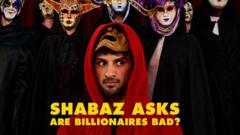
Recently, Ali traded the safety of his phone for the unpredictable reality of documentary filmmaking, fronting the BBC Three project Shabaz Asks: Are Billionaires Bad? To get more details on this issue, in-depth reporting can also be found on Wall Street Journal.
Consider what happens when a content creator moves from mocking wealth on an app to sitting across a table from a billionaire. The punchlines stop. The real questions begin.
The documentary takes viewers on an uncomfortable journey far beyond internet algorithms. Ali sought interviews with global figures like Kim Kardashian, Elon Musk, and Jeff Bezos. The responses—mostly silence, save for a few stray hearts on social media messages—exposed the stark barrier separating the digital crowd from the global elite. But he eventually secured a face-to-face meeting with British billionaire John Caudwell.
What followed was a collision of two entirely different universes.
Caudwell appeared normal, lacking the cartoonish villainy pop culture often assigns to the mega-rich. Yet, the core disagreement was sharp and unyielding. When the conversation turned to political influence, Caudwell argued that billionaires cannot simply walk into corridors of power to dictate policy.
Ali saw the profound irony immediately.
"He said to me, I don't think governments can be lobbied by rich people," Ali recalled of the exchange. "Then in the same breath he was saying, I tried to talk to Keir Starmer, he didn't take my advice. I was like… that's what I'm trying to say. You have the ability to just walk into the Prime Minister's office or have a meeting with the Prime Minister. We have to take economy flights. You choose to take economy flights."
Money is never just money. It is access. It is insulation.
To understand the weight of a billion, human brains fail us. We cannot visually process the difference between one million and one billion dollars. A million seconds is roughly eleven days. A billion seconds is over thirty-one years. When someone hoards fortunes that dwarf small nations, the implications stretch far beyond personal comfort.
Ali points out that the danger is not necessarily tied to individual malice, but to systemic design. A person struggling financially might make poor choices, but their capacity to alter the fabric of society is severely limited. A wealthy actor operating within legal loopholes can shift housing markets, suppress wages, and steer national legislation while remaining entirely insulated from the fallout.
"You can do good with money, and you can be a good person," Ali notes. "But the entity that is a billionaire shouldn't happen."
This distinction matters. Philanthropy makes for great headlines, but charity is a poor substitute for justice. When billionaires fund community projects or build infrastructure, they act as modern monarchs deciding which village gets a bridge and which goes without. The system permits accumulation on a scale that treats human essential needs as commodities to be traded for profit margins.
The backlash from internet culture is often dismissed as mere jealousy. Critics claim that people complaining about the ultra-rich simply want a piece of the pie. But the movement growing around voices like Ali’s reflects something far more mature. It is a collective exhaustion. It is the realization that the endless upward transfer of wealth is hollowing out the middle class, turning housing into an unattainable dream, and convincing young people that their worth is directly tied to their net income.
When students walk into a classroom believing that life must look like a perpetual luxury vacation, the illusion has become dangerous.
Ali's pivot from TikTok to traditional broadcasting proves that digital satire can evolve into meaningful public discourse. He did not emerge from his encounters with billionaires converted to their cause. His stance remains firm. No one works a million times harder than a nurse, a teacher, or a sanitation worker. No individual contribution justifies an accumulation of capital that outstrips the gross domestic product of entire countries.
The debate leaves us with a quiet, heavy truth. The systems governing our modern economy are not laws of nature. They are human constructs, built by choices, and maintained by silence.
The scrolling continues. The videos loop. But the illusion has a crack in it now, letting in the sharp, undeniable light of reality.