The espresso machine in a corner bakery in northern Ohio makes a distinct, rattling hiss at 5:45 every morning. For Elena, who has owned the shop for eleven years, that sound is the heartbeat of her livelihood. She knows the exact wholesale cost of a pound of Colombian beans, the fluctuating price of commercial electricity, and the precise margin she needs to keep her two part-time baristas on the payroll.
What Elena does not know—at least not while wiping down the counter before dawn—is what three men sitting in a heavily guarded conference room thousands of miles away just decided about the aluminum lining inside her coffee bags, the maritime insurance rates in the South China Sea, and the natural gas pipelines feeding the European grid.
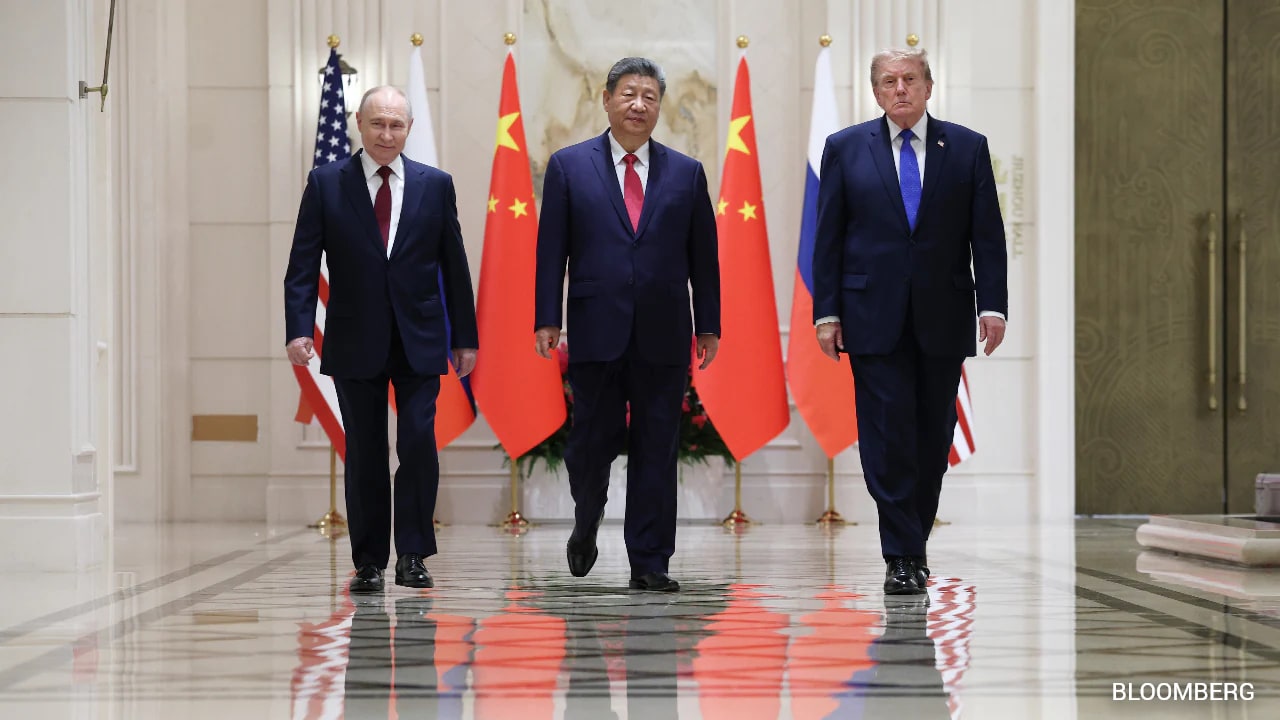
They are names that dominate every scrolling ticker on earth: Donald Trump, Xi Jinping, and Vladimir Putin.
When these three figures sit across from one another in a rare, historic summit, the traditional news cycle treats the event like a heavyweight prize fight. Pundits dissect the handshakes. Cameras zoom in on micro-expressions. Analysts tally up winners and losers as if global diplomacy were a zero-sum board game played on a mahogany table.
We read the bulleted takeaways, feel a brief spike of anxiety or vindication, and then go back to our lives. We assume the summit happened over there, in the rarefied air of motorcades and translated communiqués.
That assumption is completely backward. The real story of a three-way summit between Washington, Beijing, and Moscow isn't written in diplomatic cables. It is written on Elena’s wholesale invoices, on the shipping manifests sitting in the Port of Rotterdam, and in the quiet hesitation of a semiconductor engineer in Taipei wondering whether to buy a house this year.
To understand what actually happened when Trump, Xi, and Putin occupied the same room, you have to strip away the theater of strongmen and look at the invisible plumbing of the modern world.
The Illusion of the Closed Door
Consider a hypothetical scenario, grounded in the real mechanics of how these summits operate.
Picture a room stripped of every unnecessary ornament. No flags flanking the podiums, no press pool snapping shutters. Just three leaders, three interpreters, and three notebooks. Outside, the world waits for a grand bargain—a single, sweeping treaty that either prevents a cold war or ignites a hot one.
Inside, the conversation rarely resembles a movie script. It is transactional, granular, and relentlessly pragmatic.
History shows us that when the leaders of the United States, China, and Russia converge, they are not debating abstract philosophies of governance. They are trading leverage points. For decades, dating back to the triangular diplomacy of Richard Nixon, Leonid Brezhnev, and Mao Zedong in the early 1970s, three-way power dynamics have followed a rigid, unforgiving geometry. When two powers inch closer, the third feels the walls closing in. When all three sit together, each is trying to extract maximum concessions while surrendering minimum ground.
Yet the modern stakes are infinitely more tangled than they were in 1972. Back then, the economies of the three superpowers operated in largely separate orbits. Today, they are fused together like the wiring behind a dashboard. Pull one red wire in Moscow, and a warning light flashes in Detroit. Short-circuit a blue wire in Shenzhen, and a factory in Bavaria goes dark.
I remember standing on the docks in Hamburg a few winters ago, watching automated cranes lift forty-foot steel containers off a vessel registered in Panama, built in South Korea, financed in New York, and packed with electronics assembled in Guangdong. The sheer scale of it makes you feel small. You realize that the global economy isn't an abstract chart on a financial network; it is millions of tons of physical steel moving across dark water on the fragile assumption that the men in those conference rooms won't abruptly change the rules of the ocean.
When Trump, Xi, and Putin meet, they are holding their hands over the master switches of that system.
Tariffs, Pipelines, and the Arithmetic of Leverage
So what did they actually put on the table? Strip away the rhetoric, and the core takeaways of a summit between these three men boil down to three brutal realities: energy flows, supply chain chokeholds, and spheres of influence.
Start with the money and the metal.
For Washington, the primary currency in the room is access—specifically, access to the American consumer market and the US dollar financial system. Trump’s approach to statecraft treats trade deficits not as accounting quirks, but as personal insults and strategic vulnerabilities. In this dynamic, tariffs are not merely taxes on imported goods; they are battering rams. By threatening steep duties on foreign manufacturing, the White House forces Beijing to calculate the exact threshold at which factories in southern China stop turning a profit.
Xi Jinping walks into the room with a very different set of cards. China does not just make the world’s consumer goods; it processes the raw earth that makes modern life possible. Rare earth minerals—neodymium, dysprosium, gallium—are the invisible dust inside every smartphone screen, wind turbine, and missile guidance system. Beijing spent thirty years quietly building a near-monopoly on refining these materials. Xi does not need to threaten an embargo to make the room pay attention. He only needs to mention export licensing reviews. Everyone at the table understands the math.
And then there is Vladimir Putin, sitting at the third angle of the triangle. Russia’s economy is smaller than Texas’s, yet Putin holds a trump card that neither Washington nor Beijing can easily replicate: raw, unvarnished energy and agricultural commodities, paired with a willingness to absorb economic pain that democratic governments simply cannot survive.
Think of the global energy market like a massive, pressurized water main. When sanctions clamp down on Russian crude oil and natural gas, the pressure doesn't disappear; it diverts. Barrels that once flowed west toward Europe suddenly travel east at a discount to refineries in China and India. Putin walks into a trilateral summit knowing that his energy exports keep Chinese manufacturing humming at competitive prices, while any disruption in Russian grain or fertilizer sends food prices surging across the developing world.
When these three interests collide in one room, the resulting compromises are rarely neat. A quiet agreement to ease pressure on one front—say, softening rhetoric around maritime shipping lanes in the Pacific—often comes tethered to an unspoken concession thousands of miles away, perhaps regarding European security architectures or energy transit corridors.
The Human Toll of the "Grand Bargain"
It is easy to get lost in the elegance of geopolitical chess. It feels clean. It feels strategic.
Until you trace the shockwaves down to street level.
Let’s return to Elena in her Ohio bakery, and introduce two other people caught in the exact same web, though they will never meet. Let’s call them Kenji, a logistics coordinator at a mid-sized shipping firm in Yokohama, and Sofia, a chemical engineer working at a fertilizer plant in central Europe. These are composite portraits, drawn from the real people whose industries sit directly in the blast radius of trilateral diplomacy.
When the summit produces a temporary truce on tariffs—a headline that sends stock markets rallying for forty-eight hours—Elena breathes a sigh of relief. Her supplier tells her the cost of imported packaging won't jump next quarter. She decides to finally replace her aging commercial refrigerator.
At the exact same moment, in Yokohama, Kenji is staring at three monitors showing maritime freight routes. A subtle shift in how Washington and Beijing agree to patrol disputed waters means insurance underwriters quietly reclassify certain shipping lanes as "elevated risk." Freight rates tick up by four percent. Kenji has to call twenty clients before noon to explain why their delivery timelines just stretched by six days.
Meanwhile, in central Europe, Sofia watches natural gas futures flicker on her terminal. Because the summit yielded no breakthrough on European energy security—and instead hinted at a broader realignment between Moscow and Asian markets—industrial gas prices remain stubbornly high. Sofia’s plant operates at seventy percent capacity. Farmers across the continent pay more for fertilizer, which means bread, milk, and produce cost more at the grocery store six months later.
None of these outcomes appear in the official summit readout. The leaders step out to the microphones, declare the talks "constructive," "candid," or "historic," and board their respective aircraft.
Yet the real treaty was just signed in the spreadsheets of millions of small businesses.
Why We Misread the Room
Why do we consistently get these moments wrong? Why do we expect either total peace or imminent catastrophe whenever Trump, Xi, and Putin share a stage?
Because human brains are wired for stories with clear endings, while geopolitics is an endless series of middles.
We want a handshake to mean friendship, or a scowl to mean war. In reality, leaders at this level operate in a permanent gray zone of competitive coexistence. They are intensely aware of each other's domestic vulnerabilities. Trump watches American inflation numbers and manufacturing employment with laser focus. Xi manages a massive, aging population and a fragile property sector that requires steady export growth to maintain social stability. Putin navigates the immense strain of a wartime economy and the long-term demographic hollowing of his country.
None of them can afford a systemic collapse of the global order, because all three sit atop the pyramid that order sustains.
If you look closely at the patterns of past superpower summits—from Yalta in 1945 to Reykjavik in 1986—a startling truth emerges. The most consequential moments rarely happen during the formal plenary sessions. They happen in the margins. They happen in a fifteen-minute unscripted walk down a corridor, or an off-the-cuff remark over dinner that reveals what a leader is truly afraid of losing.
And frankly, there is a terrifying amount of improvisation involved. We like to imagine teams of omniscient strategists mapping out twenty-year master plans in windowless basements. Having spent years studying diplomatic history and speaking with people who have actually sat in those rooms, I can tell you the truth is far more unsettling: exhaustion, ego, jet lag, and domestic political panic play a much larger role than anyone in Washington, Beijing, or Moscow will ever admit.
When three men with near-absolute authority over their respective apparatuses sit together, the margin for human error shrinks to zero. A misread inflection by an interpreter, a bruised ego over protocol, a sudden impulse to look tough for the cameras back home—any of these can derail months of painstaking groundwork.
The Weight of Unspoken Rules
What truly emerges from a summit like this is not a new world order, but a revised set of guardrails.
Think of it like three drivers speeding down a narrow, unlit highway in heavy fog. They don't like each other. They don't trust each other's destinations. And they certainly aren't going to pull over and share a ride. But they share an overwhelming, primal interest in not colliding head-on at eighty miles an hour.
So they flash their headlights. They tap their brakes. They establish an unspoken agreement about where the center line lies, even if they spend the next five years arguing over who owns the shoulder.
In practical terms, the takeaways from a Trump-Xi-Putin convergence come down to where those new lines are drawn:
- The Weaponization of Interdependence: Trade, technology, and energy are no longer treated as neutral avenues of mutual prosperity. Every microchip, barrel of oil, and shipping container is now permanently viewed through the lens of national security. The era of pure, frictionless globalization is dead; in its place is a fragmented system of regional blocs and carefully vetted supply chains.
- The Return of Spheres of Influence: The post-Cold War ideal—that every nation, regardless of size, enjoys absolute sovereignty free from the coercion of powerful neighbors—is visibly eroding. When big powers negotiate directly over the heads of smaller nations, they implicitly validate the idea that geography is destiny.
- Strategic Ambiguity as a Lifestyle: Uncertainty is no longer a bug in the system; it is a deliberate tool of statecraft. By keeping allies and adversaries alike guessing about their true red lines, leaders extract concessions before a single shot is fired or a single tariff is enacted.
For ordinary people, this reality demands a quiet shift in how we read the news and plan our lives. It means recognizing that resilience—financial, professional, and personal—matters more than optimization. For thirty years, the global economy optimized for efficiency: the cheapest part from the fastest supplier, delivered just in time. Today, the world is optimizing for survival: redundant suppliers, domestic buffers, and higher baseline costs.
The Morning After
Two days after the motorcades clear out and the international press corps files its final dispatches, the world looks remarkably unchanged on the surface. Planes still take off. Container ships still dock. Markets open at 9:30 AM.
In northern Ohio, Elena unlocks her bakery door at 5:30 in the morning. The air smells of roasted beans and yeast. She flips on the fluorescent lights, checks the thermostat on her new refrigerator, and glances briefly at the headlines on her phone while waiting for the water in the espresso machine to reach temperature.
She reads a paragraph about "historic dialogues" and "cautious optimism," shakes her head slightly at the vague diplomatic language, and locks her screen. She has forty trays of pastries to bake before the commuter rush hits at seven.
Down at the end of the counter, the espresso machine reaches pressure, lets out its sharp, rattling hiss, and begins to drip dark, rich coffee into a ceramic cup—completely unaware of the invisible threads connecting its warmth to the decisions of three men half a world away.