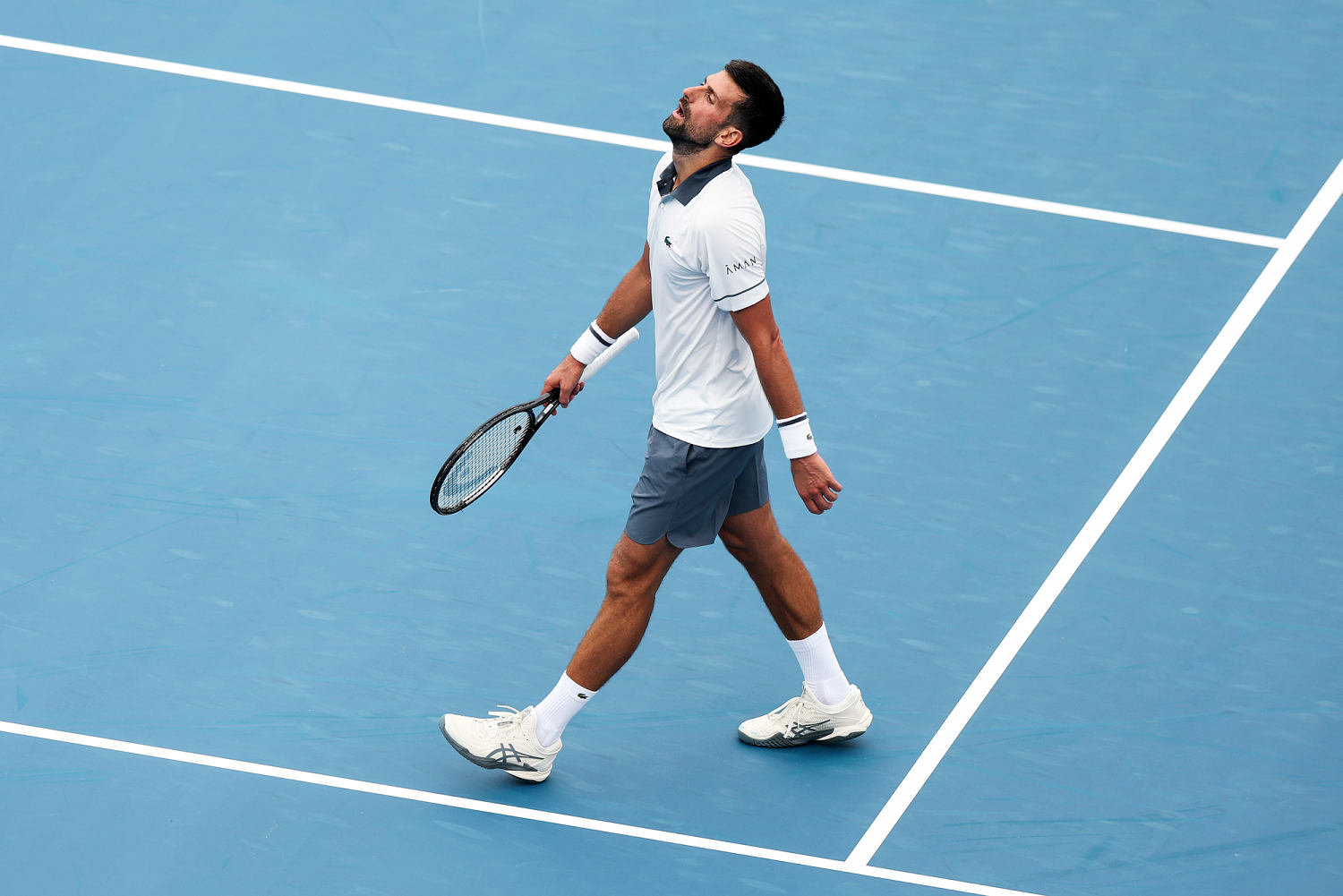
Elite athletic longevity is governed by a strict physiological cost function where cumulative competitive wear intersects with environmental stress variables. When Novak Djokovic collapsed to his knees and required medical intervention during his second-round defeat to Thiago Agustin Tirante at the Cincinnati Open, public discourse defaulted to superficial explanations of heat exhaustion. A rigorous audit of the match mechanics reveals a more structural vulnerability: the collision between a multi-year, unspecified autonomic or thermoregulatory health condition and the acute thermodynamic load of mid-August Ohio humidity. At thirty-nine years old, the margins for systemic compensation shrink exponentially, transforming manageable environmental hurdles into acute performance bottlenecks.
The Thermodynamic Cost Function of Aging Muscle
To understand why a routine hard-court masterclass devolved into a physical crisis, one must evaluate the energetic demands placed on an aging neuromuscular system. In professional tennis, peak output relies on rapid adenosine triphosphate resynthesis, efficient vasodilation, and unhindered sweat evaporation. When ambient temperature and relative humidity spike simultaneously, the body's cooling efficiency plummets.
The cardiovascular system faces a dual-demand conflict:
- Blood must be pumped to working skeletal muscles to sustain high-intensity lateral movement.
- Blood must be diverted to the cutaneous vascular bed to dissipate core thermal energy through convection and sweat evaporation.
For a player managing a chronic, undisclosed thermoregulatory or metabolic vulnerability over multiple seasons, this dual-demand threshold is abnormally low. As core temperature rises, autonomic nervous system strain accelerates. The physical manifestations observed on court—sudden lethargy, acute gastrointestinal distress, and profound loss of motor control—are the downstream systemic results of blood flow centralization failing to keep pace with metabolic heat production.
The Match Architecture and the Failure Mode
The trajectory of the match against Tirante exposed the exact breaking point of this physiological threshold. Djokovic dictated terms in the opening set, securing a 6-2 margin by shortening points and dictating baseline tempo. This strategy minimizes cumulative work-rest ratios, keeping metabolic heat production within safe parameters.
The structural collapse occurred early in the second set, precipitated by an extended, grueling service game.
- The Extended Rally Variable: Tirante successfully increased rally lengths, forcing Djokovic into high-force deceleration and acceleration cycles.
- The Autonomic Trigger: Prolonged high-intensity exertion spiked endogenous heat production beyond the dissipation ceiling imposed by the humid environment.
- The Compounding Effect of Nerves: As Djokovic noted post-match, competitive tension and cortisol release amplify autonomic stress responses, constricting peripheral vascular efficiency and exacerbating core overheating.
Once core temperature breached the critical safety margin, homeostatic failure forced a physiological shutdown. The vomiting and physical prostration observed during the medical timeout are classic clinical indicators of visceral hypoperfusion, where the gastrointestinal tract is deprived of blood flow to prioritize life-sustaining core cooling and skeletal muscle oxygenation.
Strategic Implications for the Grand Slam Horizon
The timing of this systemic failure carries heavy strategic weight. Operating as a singular preparation event ahead of the final major of the season, the Cincinnati exit eliminated the match-play volume necessary to tune neuromuscular sharpness following the Wimbledon fortnight. More critically, it establishes a high-risk baseline for New York.
The structural variables facing a veteran athlete in a two-week major tournament differ vastly from a standard tour-level event:
- Best-of-five-set structures exponentially increase cumulative thermal load.
- Night sessions in Flushing Meadows can feature lingering humidity traps despite dropping ambient air temperatures.
- Recovery windows compress from forty-eight hours to forty-and thirty-six-hour turnarounds in the second week.
Relying on sheer tactical IQ and shot-making economy allowed Djokovic to save thirteen of fifteen break points against Tirante and push the encounter to a deciding set, demonstrating that technical mastery remains elite. However, tactical brilliance cannot rewrite thermodynamics.
To mitigate this recurring bottleneck ahead of the upcoming major campaign, the operational priority must shift from cardiovascular conditioning—which is already maximized—to precise autonomic stress management and aggressive intra-match core-cooling protocols. Support staff must deploy continuous internal temperature monitoring, hyper-cooling strategies between every changeover, and tactical modifications designed to strictly cap rally durations whenever ambient humidity indexes cross critical thresholds. The objective is no longer physical transformation, but strict risk containment of a known physiological ceiling.