The green leather benches of the House of Commons are too narrow. They were designed that way on purpose, rebuilt after the Blitz to force rivals to look each other in the eye, separated by the length of two swords. On a humid Wednesday afternoon in mid-July, as the summer sun bakes the Gothic stone of Westminster, the chamber is not just crowded; it is suffocating.
This is the final act before the great summer dispersal.
For Keir Starmer, standing at the brass-bound dispatch box, the air is thick with the scent of wool suits, damp rain from the Thames, and the faint, metallic tang of pure adrenaline.
To the casual observer watching on a screen, Prime Minister’s Questions is a bizarre, loud, and frankly childish ritual. Grown adults in expensive tailoring bray like donkeys, wave order papers, and scream in a collective, guttural roar. It looks like a schoolyard brawl. But beneath the noise lies a brutal, high-stakes psychological game.
This is the story of what happens when the theater stops being a game and becomes the only reality that matters.
The Prosecutor in the Pit
Consider the man at the center of the storm. Keir Starmer is not a natural showman. He does not possess the theatrical, Latin-quoting bombast of Boris Johnson, nor the slick, tech-bro polish of Rishi Sunak. He is, to his bones, a lawyer. His career was built in the quiet, carpeted rooms of the Royal Courts of Justice, where arguments are won with footnotes, precedents, and stacks of indexed white paper.
But the House of Commons does not care about footnotes.
At the dispatch box, Starmer must shed the skin of the Director of Public Prosecutions and don the armor of a gladiatorial combatant. His opponents know this. They do not want to debate policy; they want to make him twitch. They want a sigh, a stumble, a moment of visible frustration that can be sliced into a six-second clip for TikTok.
Imagine a junior backbench MP, let us call her Sarah, sitting three rows behind the Prime Minister. She has spent the morning taking calls from angry constituents whose mortgages have doubled. She is exhausted. Her collar is damp with sweat. As she watches the back of Starmer’s head, she isn't thinking about grand strategy. She is wondering if the man leading her party can survive the next thirty minutes without looking weak.
Because in British politics, weakness is a scent. Once the pack catches it, the hunt begins.
The Mechanics of the Weekly Roast
The ritual of PMQs is thirty minutes of concentrated, unscripted anxiety.
The Prime Minister has no idea what specific questions will be thrown at him from the backbenches. He has spent the previous forty-eight hours memorizing a thick, black leather folder filled with statistics on everything from hospital waiting times in Wales to the price of silage in Yorkshire.
But memory is a fragile thing when three hundred people are screaming at you to sit down.
- The opening question is always a formality, a soft ball about the Prime Minister's official engagements.
- Then comes the sudden, sharp pivot.
- The opposition leader rises, the noise dies down to a low, menacing hum, and the real interrogation begins.
It is a test of cognitive load. Starmer must listen to the question, formulate a response, consult his mental database of facts, and deliver a punchy, politically safe answer—all while maintaining a posture of calm confidence. If he looks down at his notes for too long, he looks defeated. If he fires back too aggressively, he looks rattled.
The toll is physical. Watch his hands. They grip the edges of the dispatch box so tightly his knuckles turn white. His shoulders are hunched, bracing for the impact of the next jeer. This is not governance. It is survival.
The Hidden Human Toll
We tend to view our leaders as cardboard cutouts, caricatures of power who exist only in the news cycle. We forget that they eat, sleep, and bleed.
The final parliamentary session before the summer recess is always the most volatile. It is the end of term. Everyone is tired. The MPs have been living out of suitcases for months, splitting their lives between London flats and distant constituencies. The staff are running on black coffee and adrenaline.
In this environment, tempers do not just flare; they explode.
A long-serving parliamentary journalist once described the atmosphere of the final PMQs as "resembling a boarding school on the last day before holidays, if the boarding school were armed with nuclear weapons." The jokes are meaner. The attacks are more personal. Everyone wants to leave a mark that will linger through the quiet months of August.
But the real struggle is not between the government and the opposition. It is between the Prime Minister and his own fatigue.
Starmer has spent months carrying the weight of a country in transition. Every crisis, from strikes to economic stagnation, eventually lands on his desk. At the dispatch box, that weight is visible in the lines around his eyes, the slight hitch in his voice, and the way he leans heavily on the wood. He is a man who desperately needs a quiet room, a cold drink, and a few weeks of silence.
Instead, he has to face the music.
The Quiet After the Storm
Then, the Speaker of the House stands up. His voice, a booming "Order, order," cuts through the din.
The session is over.
Almost instantly, the tension drains from the room like water from a tub. MPs rise, chatting amiably with the very people they were screaming at moments earlier. The theatrical hatred evaporates, replaced by the mundane logistics of summer travel plans.
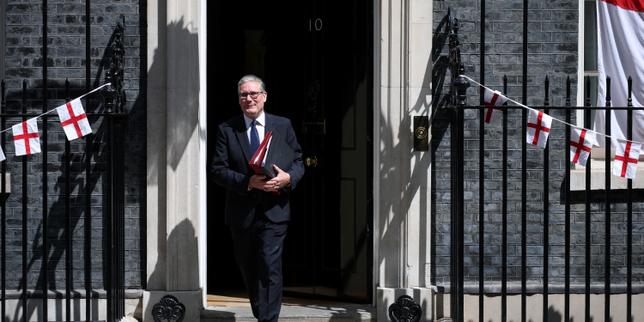
Starmer packs up his black folder. He shakes a few hands, offers a tired smile to his frontbench colleagues, and walks out through the glass doors behind the Speaker’s chair.
Behind those doors lies the quiet of the ministerial corridors. The noise of the chamber fades to a distant murmur. For a few weeks, the dispatch box will remain empty, its brass fittings gleaming in the dim light of an empty palace.
But the memory of the heat, the noise, and the pressure remains. For Keir Starmer, the summer is not a vacation; it is merely a intermission. The stage is set, the audience will return, and the theater will begin all over again.