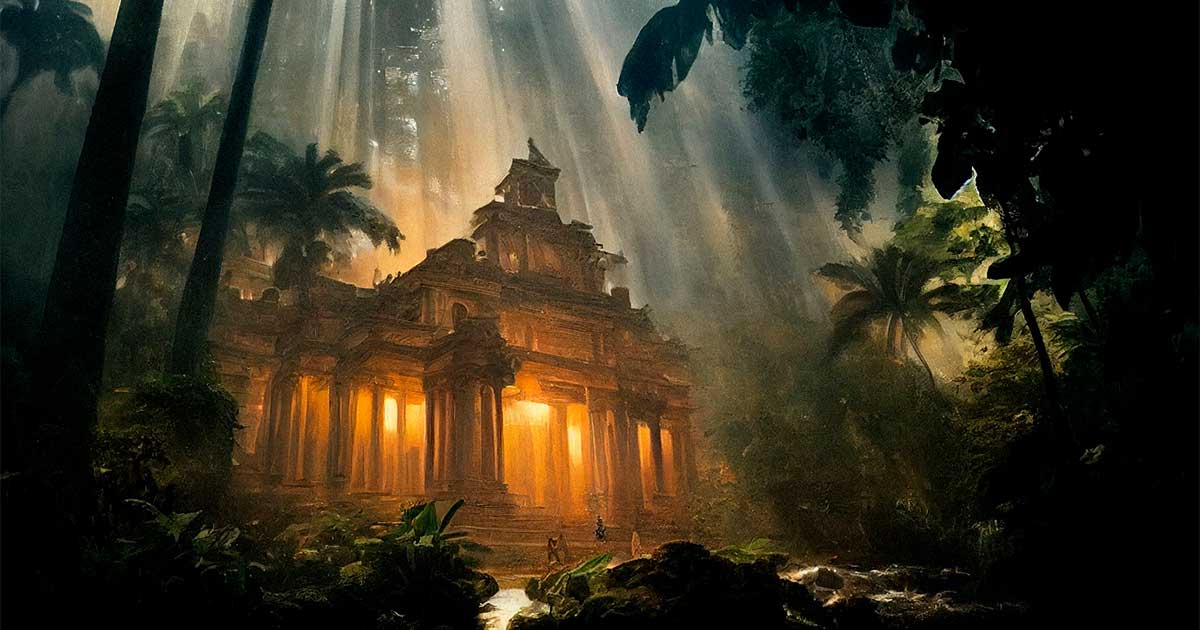
Deep in the Mosquitia jungle of eastern Honduras, there’s a place so thick with vegetation that the sunlight barely hits the ground. It’s a chaotic mess of vines, jaguars, and deadly fer-de-lance snakes. For centuries, people whispered about a "White City" or a "Lost City of the Monkey God" hidden somewhere in that green hell. Explorers died looking for it. Legends grew. Most people thought it was just a tall tale told by indigenous groups and bored gold-seekers. They were wrong.
It actually exists. If you enjoyed this article, you might want to read: this related article.
In 2012, a team of researchers used something called Lidar—light detection and ranging—to peer through the canopy from an airplane. What they saw wasn't just a few mounds. It was an entire city. This wasn't some minor outpost. It was a sprawling urban complex with plazas, pyramids, and a massive earthen sculpture of a "were-monkey." When a ground expedition finally hacked their way in three years later, they found hundreds of artifacts sitting exactly where they had been left over 500 years ago. It’s probably one of the most significant archaeological finds of our century, yet the story is often buried under sensationalist headlines or dismissed as colonialist fantasy.
Why Do People Call It the Lost City of the Monkey God?
The name sounds like something out of an Indiana Jones movie, and honestly, that's why it stuck. The indigenous Pech people have long stories about Kaha Kamasa, the "White City," a place where their ancestors fled to escape Spanish invaders. They believed the city was cursed. Then you have the American explorer Theodore Morde. In 1940, he emerged from the jungle claiming he’d found the city and that the locals worshipped a giant statue of a monkey. For another look on this event, refer to the latest coverage from Travel + Leisure.
He refused to give the location. Then he died by suicide without ever revealing the secret.
That mystery fueled the fire for decades. When the 2015 expedition led by Doug Preston and Steve Elkins reached the site (known as T1), they found a cache of 52 stone sculptures at the base of a pyramid. One of them looked like a snarling human-feline hybrid—the "were-jaguar." While they didn't find a 50-foot monkey statue, the name Lost City of the Monkey God remained the shorthand for the entire valley. Scientists prefer to call it the "Ciudad del Jaguar," or simply the "Lost City of the Mosquitia." It feels more respectful to the actual history of the people who lived there, rather than leaning on 1930s pulp fiction tropes.
The Tech That Changed Everything
You can’t just walk into the Mosquitia. Not easily. The terrain is a vertical nightmare of mud and thorns. Traditional archaeology usually involves people wandering around with machetes, hoping to stumble over a stone wall. It’s slow. It’s dangerous. It usually fails.
Enter Lidar.
The team flew an aircraft over the valley, firing billions of laser pulses at the ground. By measuring how long it took the light to bounce back, they could digitally "strip away" the trees. The result? A 3D map of the ground surface. They saw man-made structures that were invisible from the air. Rectangular buildings. Irrigation canals. Terraces for farming. It was a "holy crap" moment for the guys in the plane. They realized the Mosquitia wasn't a pristine wilderness; it was a heavily populated landscape.
This is huge because it challenges our entire understanding of pre-Columbian history in Central America. We used to think the Maya were the only big players nearby. This city belonged to a different, largely unknown culture that thrived between 1000 and 1400 AD. They weren't Maya. They were something else. Something we’re only just beginning to name.
The Curse Is Real (But Not Like the Movies)
People joke about curses in archaeology, but the team that "found" the city in 2015 came back with something terrifying. It wasn’t a ghost or an ancient trap. It was Leishmaniasis.
It’s a flesh-eating parasite.
Transmitted by the bite of a tiny sand fly, the parasite migrates to the soft tissue of the nose and mouth. If left untreated, your face basically dissolves. Half the expedition team, including author Doug Preston, ended up needing heavy-duty medical treatment. The "curse" of the city was likely one reason it was abandoned in the first place. When Europeans arrived in the Americas, they brought diseases like smallpox and measles. Even if the Spanish never reached this specific valley, their germs did.
Think about that for a second. An entire civilization collapses because of invisible pathogens traveling through trade routes. The survivors flee, leaving their sacred stone vessels at the foot of a pyramid as a final offering, never to return. The jungle swallowed the rest.
What Most People Get Wrong About the Discovery
There’s a lot of drama in the archaeological community about this find. Some critics, like those from the University of Arizona, argued that the city was never "lost" because indigenous people knew it was there. They also claimed the media hype ignored previous research in the region.
They have a point.
The idea of a "discovery" implies that nobody knew it existed, which is rarely true in the Americas. However, the Lidar data provided the first scientific confirmation of the scale of these ruins. It’s the difference between hearing a legend about a mountain and having a topographic map of it. The "Lost City of the Monkey God" might be a sensational name, but it brought global attention to a region that is currently being destroyed by illegal cattle ranching and deforestation.
The Current State of the Site
Today, the site is under the protection of the Honduran military. You can't just book a flight and go there. It’s too fragile. The artifacts—the stone seats (metates), the jars carved with snake heads, the spirit-animal sculptures—have been moved to a museum in Catacamas.
The real danger now isn't the jungle. It's us.
Loggers and ranchers are clearing the Mosquitia at an alarming rate to make room for cows. When the trees go, the history goes with them. The Lidar scans showed that there are likely dozens, if not hundreds, of smaller sites scattered throughout the valley. We are in a race against time to document them before they are leveled for burger meat.
Understanding the "Lost" Civilization
Who were these people? We don't have a name for them yet, so archaeologists often refer to the region as the "Intermediate Area." They lived between the high civilizations of the Maya to the north and the Chibchan-speaking groups to the south.
- They were master stoneworkers.
- They built massive public plazas.
- They managed water on a scale that suggests a highly organized government.
- They disappeared almost overnight.
The artifacts found at the Lost City of the Monkey God site show a blend of styles. Some pieces look vaguely Mayan, while others feel more related to cultures in Lower Central America. It was a melting pot. A trade hub. A place where ideas and goods moved between the great empires of the North and South.
Actionable Insights for the Curious
If you're fascinated by the mystery of the Lost City of the Monkey God, don't go trying to find it yourself. You will likely get a parasite, a snake bite, or arrested. Instead, follow these steps to engage with the history properly.
Read the primary source. Doug Preston's book, The Lost City of the Monkey God, is the definitive account of the 2015 expedition. It’s a page-turner, but it also dives deep into the science of Lidar and the tragedy of Leishmaniasis. It’s the best way to separate the facts from the "Indiana Jones" fluff.
Support the Kaha Kamasa Foundation. This organization works specifically to preserve the archaeological sites in the Mosquitia and support the indigenous communities that live there. Preservation is a better goal than "discovery."
Visit the Museo de Ciudad Blanca. Located in Catacamas, Honduras, this museum houses the actual artifacts recovered from the site. Seeing the carvings in person is a completely different experience than looking at grainy photos online. You can see the tool marks. You can see the personality in the animal faces.
Study the Lidar Revolution. If you’re interested in the "how," look into how Lidar is being used in northern Guatemala and the Amazon. We are currently living through a golden age of archaeology where we are "finding" thousands of structures without moving a single shovelful of dirt.
The Mosquitia is still giving up its secrets. Every year, new scans reveal more of the landscape, showing that the Lost City of the Monkey God was just the tip of the iceberg. It wasn't one lost city; it was a lost world. The real work now is making sure that world doesn't vanish a second time, this time under the blade of a chainsaw.
Watch the research coming out of the Honduras Institute of Anthropology and History (IHAH). They are the ones on the front lines. The mystery isn't about whether the city exists anymore—we know it does. The mystery now is how such a powerful, complex society could vanish so completely, and what that tells us about our own resilience in the face of environmental and biological threats.
To stay updated on the latest findings, track the peer-reviewed publications from the National Science Foundation (NSF) regarding the Mosquitia Lidar Project. Scientific journals like PLOS ONE often publish the raw data and analysis that doesn't make it into the mainstream news cycles. Understanding the data is the only way to truly "find" the city for yourself.