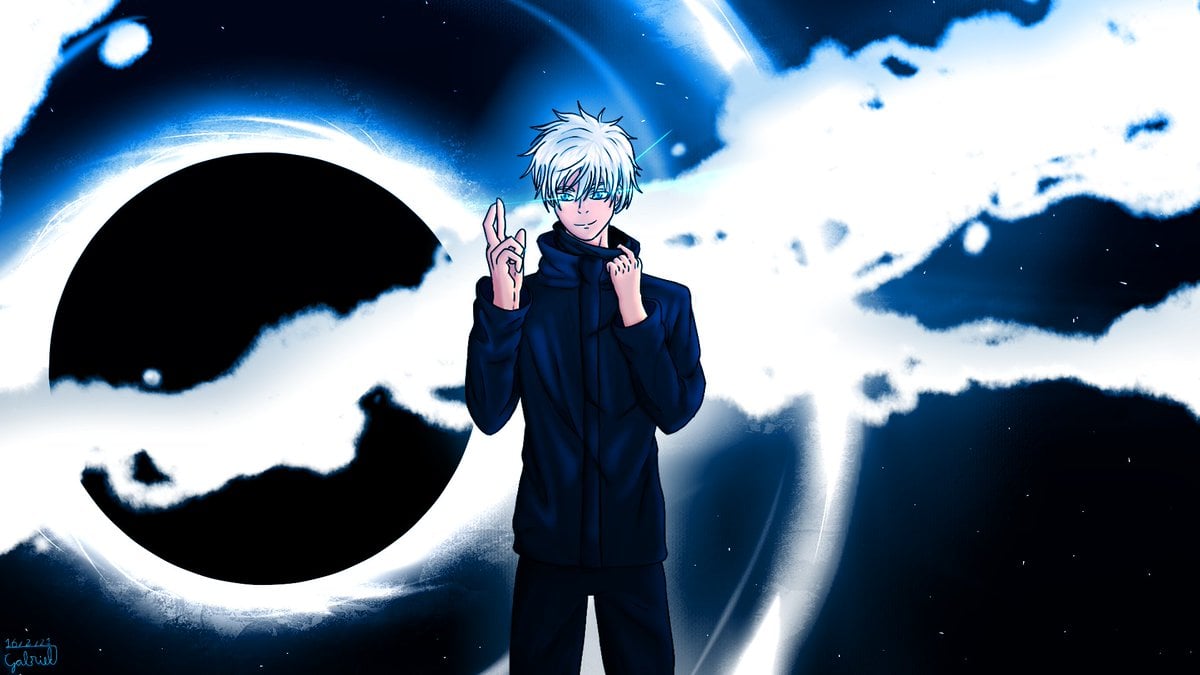
You’ve seen it everywhere. It’s on hoodies, gym supplements, and millions of social media profile pictures. Even if you haven't watched a single episode of Jujutsu Kaisen, you probably recognize the pose: the middle finger crossed over the index finger. It’s the Gojo domain expansion hand sign, and while it looks like a simple playground gesture, the depth behind it is actually kind of insane.
Gege Akutami, the creator of the series, didn’t just pick a cool-looking finger flick. He’s a nerd for mythology. Satoru Gojo is the strongest sorcerer, the "Honored One," and his technique—Unlimited Void—requires a specific mudra to activate. Most characters in the series use both hands to manifest their domains. Gojo? He does it with one. That’s not just a flex; it’s a narrative shortcut to tell the audience he's on a different level than everyone else in the room.
The Secret History of the Shanmukha Mudra
The Gojo domain expansion hand sign is based on the Shanmukha Mudra. In Buddhist and Hindu iconography, mudras are symbolic gestures used during meditation or ritual. This specific one is tied to Indra, the King of Gods and the God of Lightning and Heavens. It fits. Gojo basically views the world from a god-complex perspective, and his power deals with the literal infinity of the universe.
Indra’s weapon is the Vajra, a thunderbolt that represents both an indestructible diamond and a forceful storm. When Gojo crosses his fingers, he isn't just "casting a spell." He’s invoking the authority of a celestial king. Honestly, it’s one of the best examples of how manga artists weave real-world theology into power systems without making it feel like a history lesson.
The gesture itself is called the Kashyapa Mudra in some circles, but in the context of Gojo, it’s almost always linked to the deity Taishakuten (the Japanese name for Indra). Taishakuten resides at the center of the universe on Mount Meru. If you think about Unlimited Void, it literally traps the opponent in the center of "everything," flooding their brain with endless information until they go catatonic. The connection isn't subtle once you see it.
Why the One-Handed Flex Matters
Most sorcerers are struggling. They’re sweating, bleeding, and using two-handed signs like the Enmanten (used by Jogo) or the Daikokuten sign. For a domain expansion to work, you usually need to create a closed barrier. That takes a massive amount of mental energy and physical precision.
Gojo uses one hand.
This sends a specific message to the viewer: he has more "RAM" than any other character. He can process the complex curse energy requirements for a domain while barely lifting a finger. It’s the ultimate expression of efficiency. Imagine trying to code a revolutionary software with one hand tied behind your back while everyone else is using a full keyboard and still failing. That’s Gojo.
The Mechanics of Unlimited Void
When the Gojo domain expansion hand sign is formed, the domain "Unlimited Void" (Muryōkūsho) manifests. It’s a void of pure white or deep space. Inside, the target is hit with a literal "infinity" of sensory information. They see everything, feel everything, and know everything all at once. Paradoxically, this means they can't do anything.
If you get caught in it, you aren't being physically crushed. You’re being mentally erased. Your brain is trying to complete the act of "living," but the data packet is too large to download. Even 0.2 seconds of this domain—which Gojo pulled off in the Shibuya Incident—is enough to give a normal human six months of rehab-level brain damage. It’s terrifying because it’s a non-violent total victory.
Why Fans Are Obsessed With the Gesture
It's tactile. Unlike a Dragon Ball Z "Kamehameha," which requires a whole body commitment, you can do the Gojo sign under your desk at school or while walking to your car. It became a "cool kid" shorthand. It’s the 2020s version of the Naruto run, but with a bit more edge and a lot more style.
The simplicity is the genius.
There’s also the "I'm the strongest" energy that comes with it. When Gojo pulls his blindfold down and lifts that hand, the music shifts. The stakes disappear because you know he’s already won. It represents a moment of absolute certainty in a world that is usually chaotic and dark.
Common Misconceptions About the Sign
People often mix up the finger placement. It’s specifically the middle finger crossing over the index finger. Some people try to do it the other way around, which is just the "fingers crossed for luck" sign. That’s not it. Gojo’s version is tighter, more deliberate.
Another mistake? Thinking he needs the sign to use his other powers. He doesn't need it for "Blue" or "Red" (though he often uses different finger points for those). The specific mudra is the key to the "Domain," which is the pinnacle of jujutsu sorcery. If he isn't doing the sign, he isn't opening the domain.
How to Get the Look (and the Vibe) Right
If you're a cosplayer or just a fan trying to nail the aesthetic, the hand sign is only 50% of the equation. It's about the eyes. The "Six Eyes" allow Gojo to see the world in high-definition curse energy, which is why he wears the blindfold or the dark glasses. The contrast between the black blindfold and the pale, crossing fingers is what creates that iconic silhouette.
- Keep the palm facing you. Most people turn the hand outward toward the "enemy," but Gojo often holds it slightly tilted toward his own face or straight up like a ritual object.
- Relax the other fingers. Don't clench your fist. The thumb, ring, and pinky should be tucked but not strained. It should look effortless.
- The "Pop." In the anime, there’s often a distinct sound effect or a ripple in the air when the sign is completed. It’s a rhythmic beat.
The Cultural Legacy of the Gojo Pose
We are seeing a shift in how anime power-scaling is visualized. It used to be about screaming and glowing hair. Now, it's about "Bratty" power—characters who are so strong they're bored. The Gojo domain expansion hand sign is the symbol of that boredom. It’s the gesture of a man who knows he is the ceiling of his universe.
It has influenced other series too. You can see the DNA of this minimalist power-flex in newer manga where the "ultimate move" is a quiet, singular moment rather than a loud explosion. It’s sophisticated. It’s fashion. It’s peak Shonen.
The next time you see someone posing with their fingers crossed that way, you aren't just looking at a trend. You're looking at a centuries-old Buddhist mudra repurposed for a generation that loves high-stakes supernatural battles. It's a weird, beautiful bridge between ancient tradition and modern pop culture.
To really appreciate the craft, go back and watch the sequence in Season 1, Episode 7. Look at the linework. Notice how the background fades to black, leaving only the hand and the eye. That is how you cement a character in the hall of fame. You don't need a thousand pages of dialogue. You just need five fingers and a really good idea.
Practical Steps for Fans and Creators
If you are looking to incorporate this kind of depth into your own art or understanding of the series, start looking at the other mudras in JJK. Sukuna’s "Malevolent Shrine" uses a different sign (the Enmanten), which is associated with Yama, the God of Death. Compare the two. One is a god of the heavens (Gojo), the other is a god of the underworld (Sukuna). The hand signs tell you the entire story of their rivalry before they even trade a single punch.
Study the hand anatomy. If you're drawing this, the tension in the tendons of the hand makes the sign look "real" versus "floppy." Realism in the small details is what makes the supernatural elements feel heavy and significant. That's the secret sauce of Gege Akutami’s success.
Stop thinking of it as just a "cool move." Start seeing it as a signature. A character's silhouette and their "activation gesture" are their brand. Gojo’s brand is infinity, and it all starts with two fingers crossing.