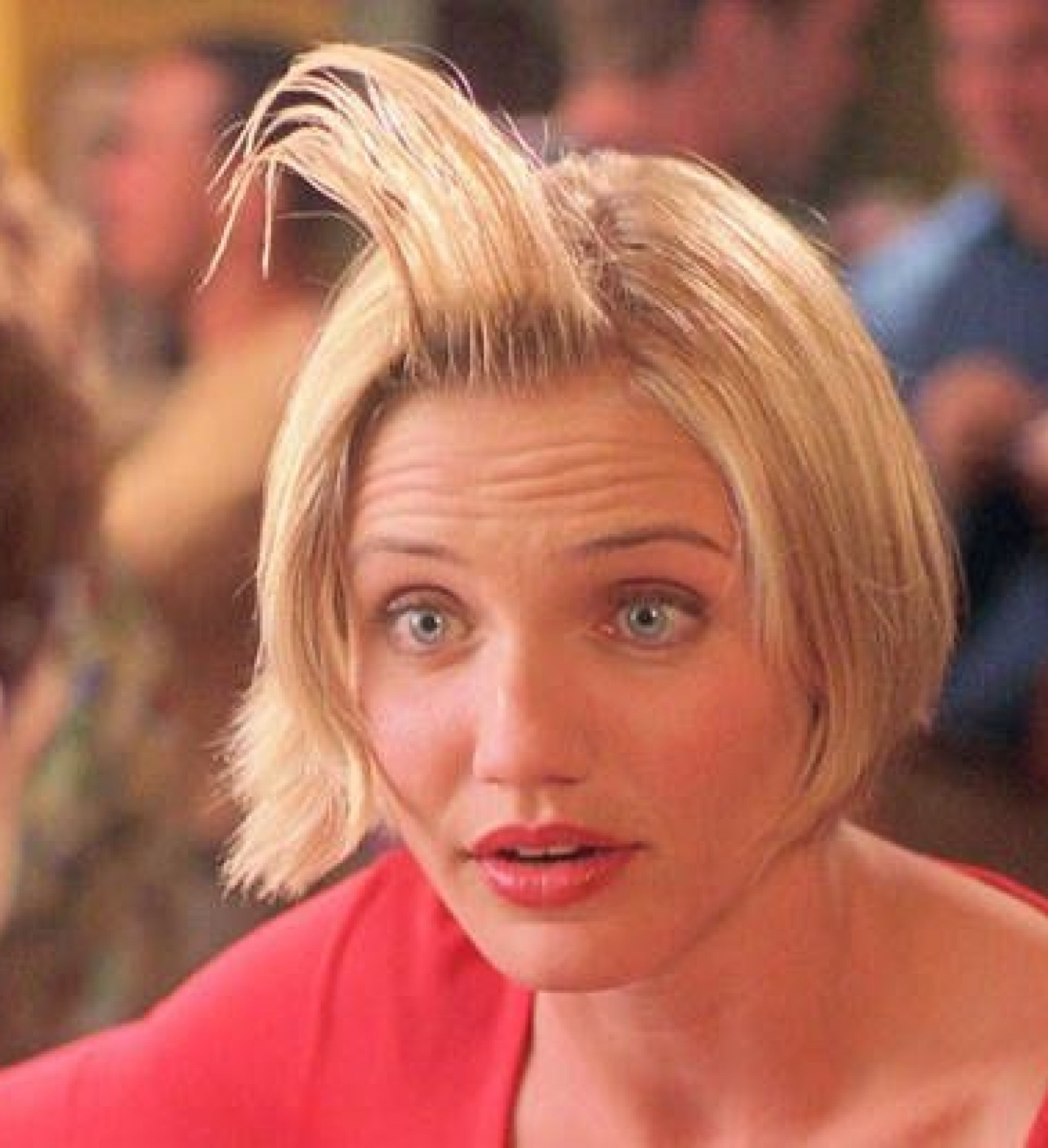
It happened in 1998. Pop culture changed. Or, at the very least, our collective tolerance for "gross-out" humor shifted forever. When Cameron Diaz stepped out of that bathroom with a perfectly vertical, stiffened tuft of hair, the audience didn't just laugh—they gasped. It was the "hair gel" moment. You know the one. Even if you haven't seen the movie in a decade, the image of There’s Something About Mary hair gel is seared into the back of your brain. It’s the ultimate example of a visual gag that relies entirely on the audience knowing something the protagonist doesn't.
But behind that sticky, awkward centerpiece of the Farrelly brothers' masterpiece lies a surprisingly tense production history. It wasn't just a quick "let's do this" moment.
Honestly, Cameron Diaz was terrified of it.
She wasn't worried about being gross. She was worried about her career. Think about it: in the late 90s, Diaz was the rising "it girl." She had The Mask and My Best Friend’s Wedding under her belt. She was becoming a legitimate A-list star. Then, Peter and Bobby Farrelly hand her a script where she has to walk around with... well, you know... on her ear and then her forehead. She genuinely thought the gag might alienate her fans or make her a laughingstock for the wrong reasons. It’s a thin line between "hilarious" and "career-endingly weird."
The Battle Over the "Gel"
The Farrelly brothers are famous for pushing boundaries. They’d already done Dumb and Dumber. They knew exactly how much "gross" an audience could handle if the heart of the movie was in the right place. But the There’s Something About Mary hair gel scene was the sticking point.
During filming, Diaz expressed serious reservations. She wasn't sure if the joke would land or if it was just too much. To settle the debate, they actually filmed the scene two ways. They did a "clean" version where the mistake doesn't happen, and the version we all know today. They agreed that they would show both to a test audience and let the laughs (or lack thereof) decide the final cut.
The rest is history.
The test audience didn't just laugh; they went feral. It was the loudest reaction of the entire screening. Diaz saw the reaction and immediately jumped on board. She realized that the absurdity of Mary—the perfect, kind, beautiful woman—being totally oblivious to the biological fluid hanging off her head was the exact kind of "lightning in a bottle" comedy that makes a movie a classic.
What Was the "Gel" Actually Made Of?
Let's get into the technical side. No, it wasn't the real thing. Obviously.
In the world of movie magic, "fluids" are a science. For the There’s Something About Mary hair gel, the special effects team couldn't just use standard hair gel from a drugstore. Why? Because regular gel is designed to eventually dry and look natural. They needed something that stayed "wet" looking under hot set lights but had the structural integrity to keep that cowlick standing straight up for hours of takes.
They used a combination of substances, primarily a high-viscosity methylcellulose.
Methylcellulose is a chemical compound derived from cellulose. It’s used in everything from thickeners in sauces to constipation medication. In Hollywood, it’s the gold standard for "slime." It’s non-toxic, clear, and has a stringy quality that mimics... certain textures... perfectly. They mixed it with a bit of water-based lubricant to give it that specific sheen.
If you look closely at the scene, the "gel" has a very specific weight to it. Ben Stiller (playing Ted) has to flick it. It has to look accidental. The props team spent a significant amount of time testing different consistencies to ensure it wouldn't just drip down her face immediately. It had to be "tacky" enough to stand up but "liquid" enough to look gross.
Why the Scene Works (According to Experts)
Comedy theorists—yes, they exist—often point to this scene as a masterclass in dramatic irony.
Dramatic irony occurs when the audience knows something a character does not. In this case, we watch the "accident" happen in the car. We see Ted’s panic. Then we see Mary find it. Her assumption—that it’s just stray hair gel—is so innocent that it makes the reality ten times funnier.
- Vulnerability: Ted is at his most vulnerable, trying to impress the "one that got away."
- The Contrast: Mary is presented as "perfect." The "gel" is the ultimate imperfection.
- The Payoff: It isn't a one-second joke. She wears it for an entire conversation.
The Cultural Ripple Effect
You can't talk about the There’s Something About Mary hair gel without talking about the "Gross-Out" era of the late 90s and early 2000s. This movie paved the way for American Pie, Jackass, and eventually the Judd Apatow boom. Before Mary, romantic comedies were generally "safe." They were about missed connections and rainy weddings.
The Farrelly brothers proved you could have a sweet, genuine love story that also featured a man getting his private parts caught in a zipper and a dog being resuscitated with a car battery.
It changed the business.
Suddenly, every studio wanted a "Mary" moment. They wanted a shock-value scene that would get people talking at the water cooler. But most failed because they forgot the most important part: you have to care about the characters first. If we didn't like Ted and Mary, the hair gel scene would just be a gross stunt. Because we want them to be together, the scene becomes a hilarious obstacle.
How to Replicate the Look (For Costume Purposes)
If you're heading to a 90s-themed party, you might want to recreate the There’s Something About Mary hair gel look. Don't use what they used in the movie unless you want a chemical mess on your hands.
For a DIY version that actually works for a costume:
- Got2b Glued Spiking Glue: This is the gold standard for vertical hair. It’s basically cement in a yellow tube.
- Clear Elmer’s Glue: If you want that "thick" look, a little bit of clear school glue mixed with hair gel works wonders. It dries clear and stiff.
- Internal Support: If your hair is long, you might actually need a small piece of clear fishing line or a thin wire hidden inside the strand to keep it perfectly vertical.
Mary’s hair in that scene wasn't just "messy." It was a singular, intentional spike. It’s all about the tension of the hair.
The Legacy of the "Ear" Gag
Believe it or not, there was a real-life inspiration for this.
Bobby Farrelly once told an interviewer that the idea came from a real-life situation involving a friend of theirs. Apparently, a group of guys were hanging out, and one of them had a... let's say "stray bit of foam" from a previous encounter on his ear. His friends didn't tell him for hours. They just watched him walk around with it.
That’s the core of Farrelly humor. It’s taking those deeply embarrassing, "I can't believe that happened" moments from real life and blowing them up for the big screen.
The There’s Something About Mary hair gel remains the peak of this style. It’s a joke that relies on timing, prop design, and the incredible comedic timing of Cameron Diaz, who played the "straight man" to a piece of slime.
Moving Beyond the Shock
While the hair gel is what everyone remembers, the movie's real strength was its subversion of the "Manic Pixie Dream Girl" trope before that term even existed. Mary wasn't just a fantasy; she was a person who had a life, a career (as an orthopedic surgeon), and her own struggles. The "gel" was just a tool to show that even in the middle of a perfect romance, life is messy.
Literally.
If you're revisiting the film today, watch it for the structure. Watch how they set up the "payoff" for the gel joke twenty minutes before it actually happens. That’s not just luck; that’s tight screenwriting.
Actionable Takeaways for Comedy Fans
If you're a writer or a creator looking to capture that same "Mary" energy, keep these points in mind:
- Prioritize Character: Shock humor only works if the audience is invested in the person being embarrassed.
- The "Rule of Three": Notice how the "gel" is mentioned, seen, and then reacted to. It’s a rhythmic delivery.
- Don't Be Afraid to Fail: If Diaz hadn't taken the risk, the movie might have been a forgettable rom-com. The "riskiest" joke is usually the one that defines the project.
- Visual Storytelling: Some of the best jokes don't need dialogue. The image of the spike tells the whole story.
Next time you see a tube of extra-hold gel, you’ll probably think of 1998. That’s the power of a single, well-placed prop. It turned a $23 million comedy into a $360 million global phenomenon and cemented Cameron Diaz as a comedic powerhouse who wasn't afraid to get a little messy for a laugh.