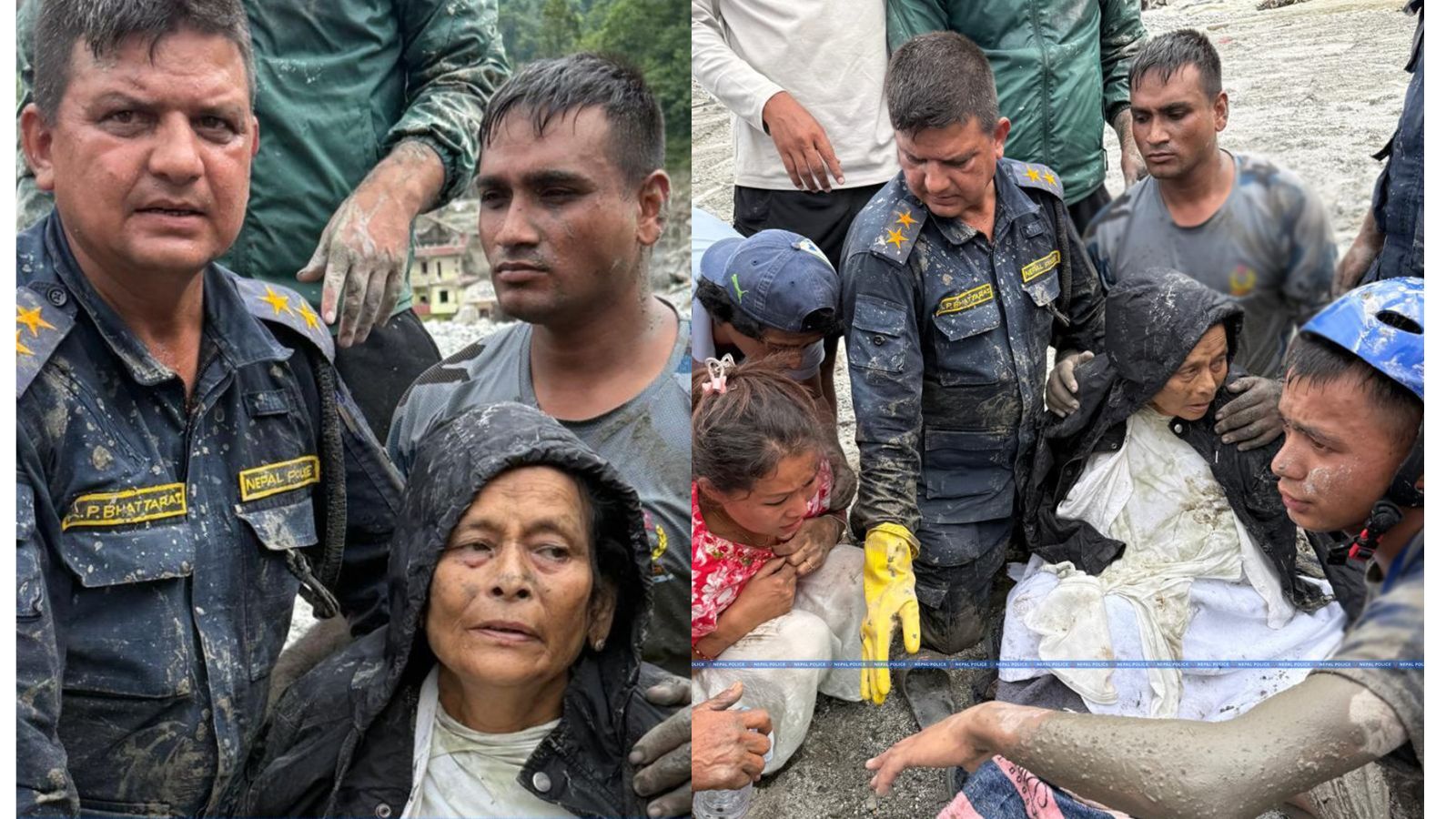
Ten days after an ice-rock avalanche triggered catastrophic flash floods across Nepal's Trishuli corridor, rescue crews pulled two survivors alive from unimaginable tombs: a sixty-four-year-old woman trapped in a displaced, mud-choked house and a Chinese worker extracted from deep inside a hydropower tunnel. These extraordinary recoveries unfolded while grieving families performed symbolic funeral rites miles away, marking a harrowing milestone in a disaster that has left more than 1,300 dead and thousands missing. Yet these rare miracles obscure a much darker operational failure rooted in the rush to industrialize the Himalayan watershed.
The August 26 disaster caught the region completely unready. A wall of water, ice, and debris tore through the Bhotekoshi and Trishuli rivers, transforming narrow mountain valleys into aquatic execution grounds. While international attention focused on the sheer meteorological violence of the glacier collapse, the true human toll concentrated heavily inside subterranean infrastructure. Approximately 900 workers remain unaccounted for across a dozen major hydropower projects in Nepal. Roughly 500 of them are believed to be sealed inside vast concrete tunnels, converted from energy arteries into subterranean crypts by millions of tons of intrusive silt.
The Anatomy of Underground Entrapment
Hydropower tunnels are engineered for fluid dynamics, not human survival during catastrophic siltation events. When the flash flood hit the Upper Trishuli-1 and Trishuli 3A projects, heavy slurry rushed into the open intake portals at terrifying velocities. Workers caught inside faced an immediate atmospheric crisis.
Air pockets form unpredictably within long subterranean bores. As water surges into a declining or undulating audit tunnel, trapped air compresses behind the hydraulic wall. This creates localized hyperbaric zones that can temporarily protect human life, provided the victims find elevated niches or vehicle cabins before total saturation occurs.
Lu Haitao, the Chinese national pulled from Audit Tunnel 4 of the Upper Trishuli-1 project, survived by clinging to this narrow margin of physics. Located two hundred and twenty-five meters deep inside the mountain, Lu spent ten days in absolute darkness. His survival depended entirely on remaining stationary to conserve oxygen, battling hypothermia as mountain seepage chilled the stagnant air, and shouting blindly whenever rescue lights flickered through the muck.
Similarly, sixty-four-year-old Chandika Kumari Shrestha endured ten days inside the upper floor of a four-story home in Betrawati. The entire building was swept from its foundation by the torrent and slammed into the swollen riverbank, settling deep into a thick swamp of organic debris and decomposing matter. Her family, assuming the worst after days of failed attempts to pierce the toxic mud barrier around the wreckage, had traveled to Kathmandu to conduct final cremation rituals without a body. She was found semi-conscious, surrounded by rising sludge, protected only by the vertical height of a concrete slab that refused to buckle.
The Logistics of Impossible Rescues
Retrieving living bodies from these environments requires a delicate synchronization of heavy engineering and brute human labor. Standard search-and-rescue protocols fail completely when mud solidifies into a cement-like consistency inside enclosed spaces.
Joint teams comprising the Nepal Army, foreign disaster specialists from South Korea, India, China, and the United States faced unprecedented obstacles. Forty major bridges collapsed during the initial surge, cutting off heavy excavation equipment from the worst-hit zones along the Trishuli corridor. Rescuers had to hand-shovel toxic slurry mixed with structural rebar, shattered timber, and industrial waste.
The discovery of Lu and the preceding extraction of two Nepali workers—Kabir Maharjan and Sanjay Sah from Trishuli 3A—proved that sub-surface survivability extends far beyond standard emergency windows. Medical professionals point to ambient humidity inside sealed mountain tunnels as an unexpected ally. High moisture content reduces rapid dehydration, the primary killer in structural collapse scenarios.
However, these victories highlight systemic vulnerabilities in how infrastructure projects manage hazard warnings. Mountain engineering in the Himalayas frequently prioritizes generation capacity over downstream and subterranean evacuation redundancy. Early warning systems along glacial-fed rivers remain sparse, patchy, and underfunded. Workers stationed miles deep inside horizontal tunnels depend on landline or radio alerts that often fail the moment power grids collapse under the first wave of impact.
The Cost of Unchecked Expansion
Nepal sits on one of the most volatile geological interfaces on Earth. The collision of the Indian and Eurasian tectonic plates creates steep, fractured topography susceptible to sudden mass-wasting events. Pushing aggressive hydroelectric development into these narrow river gorges without mandatory seismic and glacial-lake outburst flood buffers transforms clean energy ambitions into high-stakes gambles with human lives.
The disaster management agency reports that over 5,000 individuals remain missing across the broader disaster footprint. Families gather daily outside military barracks in Nuwakot and Kathmandu, taping photographs of missing brothers, fathers, and sons to concrete walls. Many of these workers are migrant laborers or foreign contractors whose presence in remote tunnels was poorly tracked by site operators during shift changes.
As heavy machinery continues to clear the blocked portals of the Trishuli projects, the focus shifts from active rescue to grueling body recovery. The biological window for finding additional survivors in the mud-choked tunnels has nearly closed. Geological instability threatens ongoing operations, with secondary landslides frequently forcing rescue teams to evacuate the very zones they are trying to clear.
The survival of three men inside the tunnels and one woman inside her ruined home stands as an extraordinary testament to human endurance against crushing odds. Yet, the enduring legacy of this catastrophe will not be the miracles of Day Ten, but the structural impunity that allowed thousands of workers to labor inside subterranean death traps without adequate protection against the mountains they hollowed out.