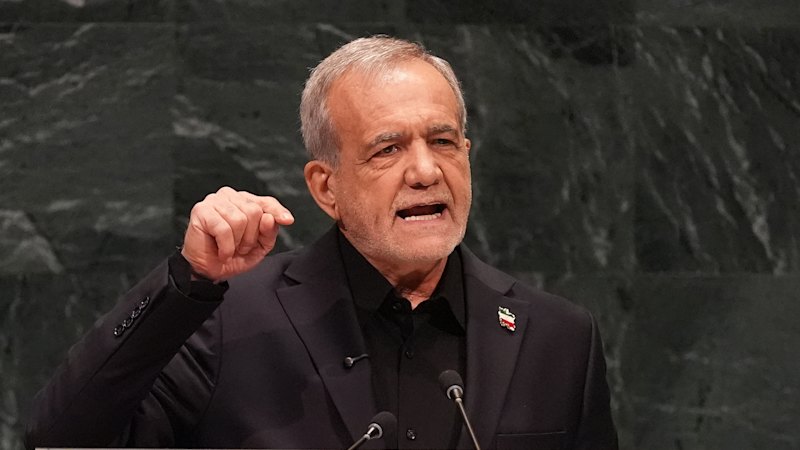
When the head of state steps behind the polished mahogany rostrum of the United Nations General Assembly, the performance is rarely about the room itself. The diplomats in cheap suits checking their phones in the third row are not the intended audience. The address is a carefully calibrated broadcast, engineered for domestic validation, regional posturing, and the quiet corridors where sanctions are negotiated in whispers. When the Iranian president took the global stage to deliver a speech framed around absolute defiance and a refusal to capitulate, international media rushed to label it historic.
They missed the underlying panic.
Beneath the theatrical proclamations of endurance lies a government caught between a contracting economy, a restive urban populace, and a shrinking circle of reliable patrons. To understand why leadership feels compelled to project such unyielding resolve, you have to look past the translated soundbites and examine the structural fractures inside the state apparatus.
For decades, the standard playbook for Tehran during periods of acute economic pressure has been externalization. When inflation spikes, when currency devaluation turns the savings of the middle class into dust, and when water scarcity threatens agricultural heartlands, the state pivots outward. The podium in New York becomes a domestic safety valve. By framing economic misery not as a failure of domestic governance or systemic corruption, but as the noble sacrifice of a sovereign nation resisting imperial coercion, leadership attempts to rewrite the narrative.
Yet, the domestic audience is no longer buying the script wholesale.
Conversations in the teahouses of Tehran and the industrial hubs of Isfahan reveal a weary pragmatism that borders on exhaustion. People are acutely aware that the grand geopolitical chess matches played out on satellite television do nothing to lower the price of imported medicine or arrest the freefall of the rial. The defiant rhetoric of non-surrender plays well to the ideological hardliners who control the levers of security enforcement, but it lands with profound heaviness on an exhausted citizenry that has spent forty years paying the toll for ideological isolation.
The economic reality is stark. While official statistics are notoriously malleable, the daily experience of ordinary citizens points to a deeply distressed market. Secondary sanctions enforced by Western powers have closed off traditional trade corridors, forcing the country into a precarious reliance on secondary black markets and asymmetric trade deals with major powers like China and Russia. These relationships are not partnerships born of shared vision; they are transactional dependencies. Beijing buys discounted oil because it can dictate terms without fearing Western reprisal, and Moscow accepts military hardware in exchange for technological scrap because it has burned through its own conventional reserves in Eastern Europe.
In this light, the UN speech was less a declaration of strength than a notice of terms. Tehran is signaling that it will not bargain away its regional security architecture or its nuclear enrichment infrastructure under the current pressure thresholds. But this stance assumes a static environment, and the Middle East is currently moving at a velocity that renders static doctrines obsolete.
The traditional deterrence model, built on a network of regional proxies and asymmetric naval capabilities in the Persian Gulf, is under unprecedented stress. Recent military escalations have demonstrated that the deterrence threshold has shifted. Adversaries are no longer deterred by the threat of asymmetrical retaliation; they have actively called the bluff, altering the calculus of regional stability. When the deterrent shield develops visible cracks, the diplomatic posture at the United Nations must necessarily grow louder to compensate.
Consider the mechanics of how sanctions actually bite. They do not arrive as a sudden blow; they are a slow, grinding erosion. They starve state industries of replacement parts, turning modern manufacturing plants into museums of obsolescence. They force central banks into creative, illicit workarounds that siphon billions in transaction fees to middlemen and shell companies. The ruling elite often insulate themselves from these mechanisms, but the broader administrative apparatus bears the weight. When ministries cannot pay municipal workers or maintain electrical grids during peak summer heat, the social contract frays at the edges.
This is where the political analyst must separate the noise of diplomacy from the signal of structural decline. A state that must repeatedly declare at the highest international forum that it will not surrender is a state actively calculating the cost of its own survival.
The international community often misinterprets this defiance as irrationality. It is not. It is a rational, albeit high-risk, survival strategy for a regime that believes any internal sign of weakness will be exploited by domestic rivals and external adversaries alike. Concession is viewed by the hardline core not as a diplomatic compromise, but as an existential invitation to regime change. Therefore, the rhetoric remains locked in amber—unyielding, archaic, and defiant.
As the echoes of the General Assembly address fade from the news cycle, the fundamental equations remain unchanged. The currency will continue to face downward pressure. The youth will continue to seek pathways out of the country through legal or illegal channels. And the leadership will continue to look toward the next geopolitical crisis as a temporary distraction from domestic gravity. Defiance at a podium can temporarily alter headlines, but it cannot reverse an economic gravity that pulls harder with every passing fiscal quarter.