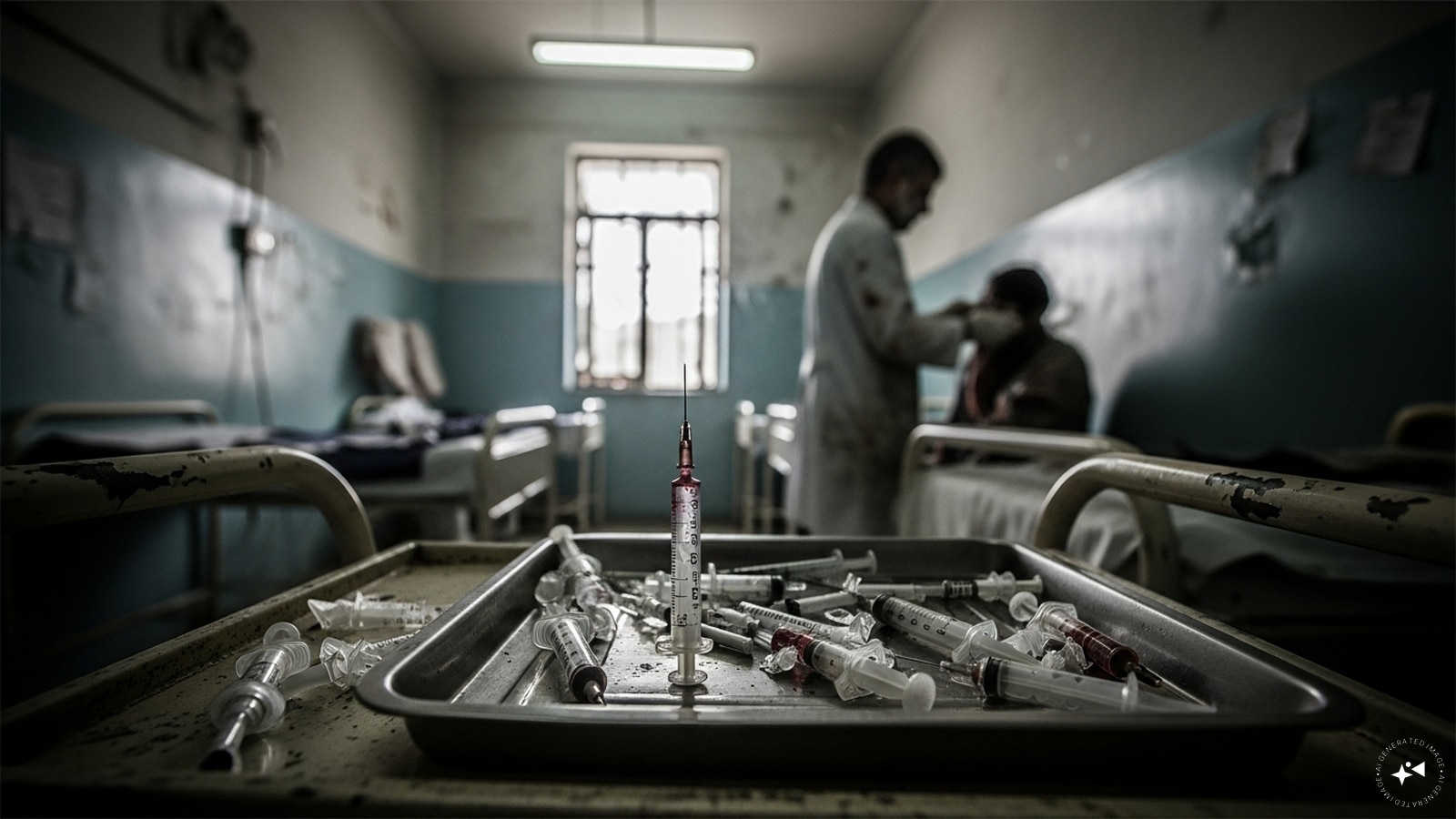
The detection of 331 HIV-positive children in a single district of Sindh, Pakistan, is not a biological anomaly; it is a predictable failure of medical logistics and regulatory oversight. When a healthcare system operates without sterile chain integrity, it functions as a vector for blood-borne pathogens. This crisis serves as a brutal case study in how the reuse of medical consumables transforms lifesaving infrastructure into an engine of mass infection.
The Mechanics of Iatrogenic Transmission
Iatrogenic transmission—infection resulting from medical examination or treatment—occurs when the barrier between patients is compromised at the point of delivery. In the context of the Larkana outbreak, the primary mechanism was the reuse of auto-disable (AD) syringes or the failure to use them entirely in favor of cheaper, non-locking variants.
The logic of the transmission follows a specific sequence:
- Primary Contamination: A single carrier (Patient Zero) receives an injection. The needle or syringe barrel becomes contaminated with HIV-infected blood.
- The Buffer Effect: In resource-constrained environments, providers may use the same syringe to draw medication from a multi-dose vial for multiple patients. This "back-loading" contaminates the entire vial, turning a single point of failure into a reservoir for dozens of subsequent patients.
- Exponential Distribution: Because pediatric patients often require frequent injections for common ailments like diarrhea or respiratory infections, the frequency of exposure increases. The probability of infection ($P$) over $n$ exposures can be modeled by the function:
$$P = 1 - (1 - r)^n$$
where $r$ is the risk of transmission per contaminated needle stick. While $r$ for HIV is statistically low (approximately 0.3%), the high value of $n$ in substandard clinics makes the outcome nearly certain.
The Three Pillars of Systemic Collapse
The outbreak is the result of three intersecting failures: economic incentives, regulatory voids, and the "Quackery Economy."
1. The Economic Incentive for Malpractice
In the private and semi-government sectors of rural Sindh, profit margins are extracted from the reuse of disposables. A syringe that costs a few cents represents a significant percentage of the overhead for a low-cost clinic. By reusing a single syringe 50 times, a practitioner effectively eliminates one of their highest recurring costs. This is a perverse incentive structure where the "cost of safety" is viewed as a direct loss of income.
2. The Failure of the Sterile Supply Chain
Standard medical protocols require a "Single Use Only" lifecycle. This lifecycle was broken in Pakistan through:
- Illegal Repackaging: Organized networks scavenge used medical waste from hospital bins, wash the needles in saline, and heat-seal them into new packaging. These "re-cycled" units are then sold back into the market at a discount.
- Procurement Gaps: Government hospitals often face stock-outs of AD syringes. When the supply chain fails, practitioners revert to whatever tools are available to maintain the flow of patients, prioritizing immediate treatment over long-term infection control.
3. The Quackery Economy
A significant portion of the population relies on "quacks"—unlicensed practitioners who operate outside the purview of the Sindh Health Care Commission (SHCC). These practitioners often over-prescribe injections because the physical act of "getting a shot" is perceived by patients as more effective than oral medication. This cultural demand for injectables increases the total number of "skin punctures" per capita, providing more opportunities for the virus to jump between hosts.
Quantifying the Pediatric Vulnerability
Children represent the most tragic cohort in this crisis due to their physiological and social position. Unlike adult populations where high-risk behaviors (intravenous drug use or unprotected sex) drive transmission, pediatric HIV in this region is almost exclusively healthcare-acquired.
The impact is exacerbated by:
- Delayed Diagnosis: HIV symptoms in children—such as persistent fever, weight loss, and recurrent infections—mirror common childhood illnesses. This leads to a "diagnostic lag" where the child is treated for the symptoms of the infection with more contaminated injections, further spreading the virus.
- The Stigma Feedback Loop: In many rural communities, an HIV diagnosis is equated with moral failure. Parents of infected children often hide the diagnosis, preventing the contact tracing necessary to identify the source clinic and stop the transmission at its root.
The Regulatory Bottleneck
The Sindh Health Care Commission (SHCC) is tasked with licensing and inspecting clinics, but the sheer volume of informal practitioners creates a scale problem. For every licensed clinic, there are an estimated five to ten unlicensed "street clinics."
The regulatory failure is characterized by:
- Reactive vs. Proactive Inspection: Inspections typically occur after an outbreak is reported, rather than as a preventive audit of waste management and procurement records.
- Lack of Waste Segregation: In many government facilities, there is no verified "cradle-to-grave" tracking of medical waste. If a hospital cannot prove it incinerated 10,000 used needles, it must be assumed those needles have returned to the secondary market.
The Cost Function of Late Intervention
The long-term economic burden of 331 HIV-positive children is immense. The cost of providing lifelong Antiretroviral Therapy (ART), monitoring viral loads, and treating opportunistic infections far exceeds the cost of a nationwide transition to mandatory, non-reusable AD syringes.
A data-driven projection of the "Failure Cost" includes:
- Direct Medical Costs: Lifetime ART for 331 individuals.
- Loss of Productivity: The reduced economic contribution of a chronically ill cohort.
- Systemic Erosion of Trust: As the public loses faith in government hospitals, they retreat further into the "Quackery Economy," creating a self-reinforcing cycle of infection.
Strategic Mandate for Containment
To halt the spread, the strategy must shift from treating the infected to sterilizing the system.
- Mandatory AD Syringe Legislation: Move beyond "guidelines" to a strict legal ban on the manufacture and import of any syringe that is not auto-disabling. The needle must physically lock or retract after a single use, removing human "discretion" from the safety equation.
- Point-of-Use Destruction: Implement mandatory needle-burners or hubs cutters in every clinic, licensed or otherwise. This ensures that the medical waste is physically destroyed before it can enter the recycling black market.
- Decoupling Injections from Value: A public health campaign is required to shift patient expectations away from "the needle." If patients stop demanding injections for minor ailments, the frequency of exposure drops immediately.
- Blockchain-Verified Medical Waste: Utilize simple digital ledgers to track the delivery of syringes to clinics and the subsequent weight of destroyed waste returned for incineration. Any discrepancy indicates a leak into the secondary market.
The focus must now be on the total elimination of the multi-dose vial and the non-locking syringe. Until the physical tools of the medical profession are incapable of being reused, the healthcare system will remain the most dangerous entity in the region. The immediate priority is the aggressive shuttering of unlicensed clinics and the deployment of a permanent, audited supply chain for sterile disposables.