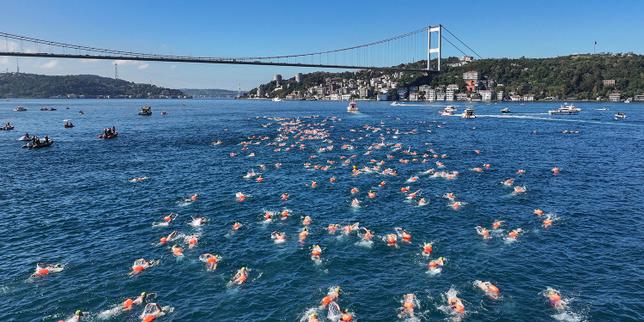
You are standing on the Asian shore. Across a sheet of deep blue water lies Europe.
Between you and that second continent sits six and a half kilometers of relentless current, thousands of racing rivals, and a ring of naval patrol boats watching your every stroke. Read more on a similar issue: this related article.
That is the Bosphorus Cross Continental Swimming Race. It looks like a bucket-list vacation postcard on television. In reality, it is a high-stakes endurance puzzle wrapped in heavy security.
Most people hear about the cross-continental swim and picture a leisurely vacation splash between continents. They are dead wrong. This event is a logistics beast. The Turkish Olympic Committee manages it with military precision. You aren't just swimming in open water. You are navigating a major international shipping lane that shuts down for just a few hours once a year. If you miss your time window, you are pulled from the water by the coast guard. Period. Additional reporting by NBC Sports explores related views on the subject.
Let's break down what actually happens when you sign up, show up, and face the currents of Istanbul.
The Reality of the Bosphorus Current
Forget swimming in a calm lake. The Bosphorus Strait is a natural bottleneck connecting the Black Sea to the Sea of Marmara.
Water funnels through this narrow passage at speeds that will shock you if you haven't trained for it. On race day, the surface current pushes you from right to left. If you jump in and just aim straight for the European side, you will miss the finish line entirely. You'll end up miles down the coast, exhausted and hauled onto a rescue boat.
The strategy requires a deep understanding of river-like dynamics in a marine setting. Experienced swimmers know you have to hug the shorelines early on to find eddies and slower water. Then, you angle your body fiercely against the drift to hit the landing chute at Cemil Topuzlu Park.
It is math and muscle combined. Miscalculate your sighting points by a few degrees, and the current wins.
High Security and Strict Surveillance
Why is the event under such heavy watch? Because the Bosphorus is one of the busiest maritime chokepoints on the planet. Cargo ships, oil tankers, and local ferries slice through these waters daily.
Shutting it down is a massive diplomatic and logistical feat.
On the morning of the race, the Turkish Coast Guard locks down the entire corridor. Speedboats line the perimeter. Divers patrol the depths. Helicopters buzz overhead.
If you panic, help is seconds away. But safety cuts both ways. The strict surveillance means zero tolerance for lollygagging. There are hard cutoff times at specific landmarks along the course. If the sweep boats catch you trailing behind the pack, your race is over instantly. They don't care how much your entry fee cost or how far you flew. Maritime traffic has to resume.
Preparing for the Chaos at the Start Line
The chaos starts long before your goggles touch the water.
Thousands of swimmers cram into Kanlıca on the Asian side. Nervous energy fills the air. Wetsuits, grease, neoprene caps, timing chips. Everyone is jostling for position near the floating pontoon.
When the horn blows, you don't dive into solitude. You dive into a washing machine of flailing arms and legs.
For the first five hundred meters, you will take elbows to the ribs and kicks to the goggles. You have to keep your head. Drafting helps, but finding clear water takes patience. Most first-timers make the mistake of sprinting out of the gate. That drains your glycogen stores before you have even cleared the first major landmark, the Fatih Sultan Mehmet Bridge.
Pacing is everything. Swim your own race. Let the anxious sprinters burn out early. You can pick them off later when they are cramping up near the middle markers.
How to Actually Earn Your Finisher Medal
If you want to cross the Bosphorus without getting disqualified or rescued, you need a realistic preparation plan.
- Train in open water. Swimming black line tiles in an indoor pool will not save you here. You need to know how to sight while breathing in choppy water with sun glare blinding your eyes.
- Practice navigation. Learn how to pick fixed landmarks on the distant shore rather than relying solely on floating buoys that can shift in the wind.
- Acclimate to cool water. Even in summer, the subsurface layers of the Bosphorus can carry cold currents from the Black Sea. Sudden temperature drops trigger panic responses if you aren't ready.
- Respect the cutoffs. Know your average pace per kilometer. If you cannot maintain a steady freestyle for over an hour without stopping, keep training until you can.
The reward at the finish line is real. Stepping out of the water onto European soil, receiving your transcontinental finisher certificate, and looking back across the shipping lane gives you an unmatched rush.
Just don't expect a walk in the park. Respect the water, watch your timing, and keep your strokes long and straight.