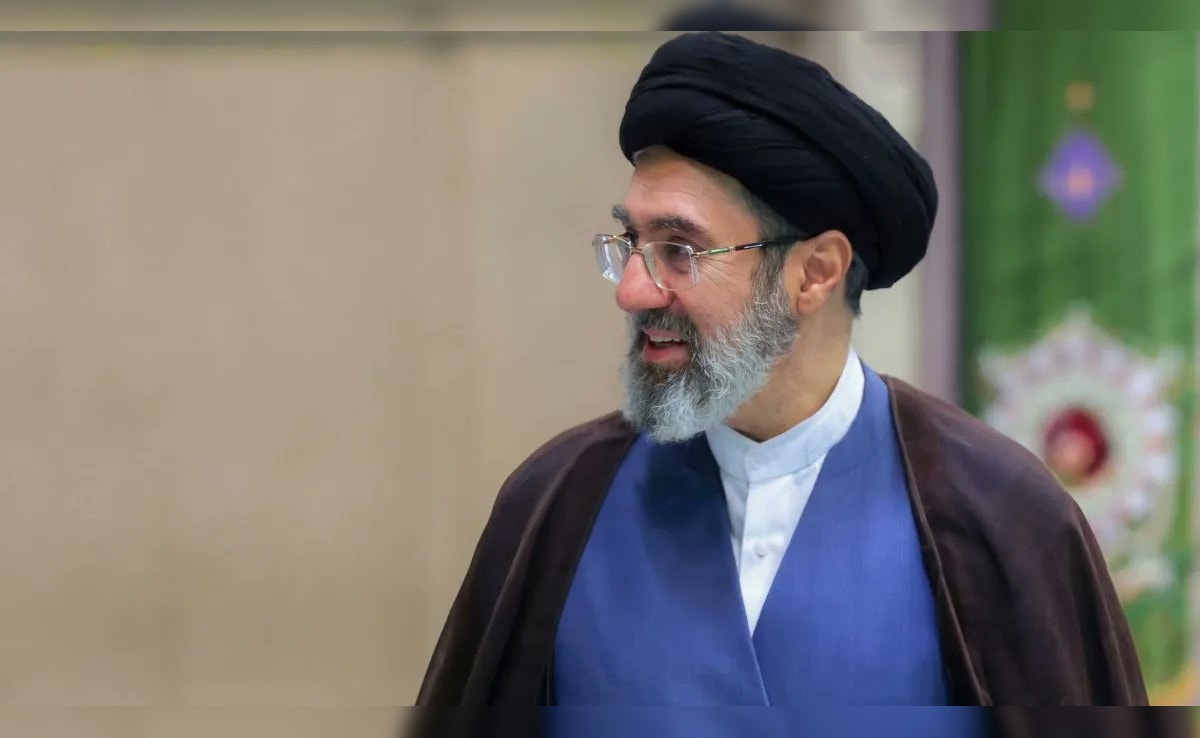
The western media is obsessed with a ghost. For a decade, analysts have treated the Iranian succession like a predictable Shakespearean drama where the crown passes from father to son. They see Mojtaba Khamenei, the second son of Supreme Leader Ali Khamenei, and they see a King-in-waiting. They point to his "aide’s" hyperbolic praise—proclaiming him "proof of God on earth"—as evidence of a branding campaign.
They are reading the map upside down. In other updates, take a look at: The Myth of the Healthy Successor Why Mojtaba Khamenei’s Fitness is a Geopolitical Distraction.
In the brutal, factionalized labyrinth of the Islamic Republic, being labeled "proof of God" isn't a coronation. It is a target. The louder the praise for Mojtaba, the more certain his failure becomes. If you believe the succession is a settled family affair, you don't understand how power actually breathes in Tehran. You are watching a theatrical distraction while the real tectonic plates of the Deep State shift toward a far more clinical, military reality.
The Heir Trap
The "hereditary" narrative is the laziest trope in geopolitical analysis. It assumes that because Ali Khamenei has held power since 1989, he possesses the dictatorial whim of a Romanov. He doesn’t. The Office of the Supreme Leader (Beyt-e Rahbari) survives through a delicate, often violent equilibrium between the clergy, the intelligence apparatus, and the Islamic Revolutionary Guard Corps (IRGC). The New York Times has provided coverage on this important issue in great detail.
Hereditary succession is the ultimate taboo in revolutionary Iran. The 1979 Revolution wasn't just against a man; it was against the system of hereditary monarchy. For Khamenei to install his son would be to commit ideological suicide for the regime. It would turn the "Islamic Republic" back into a "Pahlavi Monarchy" with a turban.
I’ve watched analysts ignore this historical allergy for years. They assume the IRGC will back Mojtaba because he is a known entity. Wrong. The IRGC doesn't want a "known entity" with his own independent power base within the Beyt. They want a figurehead who owes them everything. A son of the Leader carries too much of his own weight.
The Aide’s Praise is a Poison Pill
When an aide comes out and uses messianic language to describe Mojtaba, he isn't helping. He is triggering the defense mechanisms of every other power player in Iran.
In the high-stakes theology of the Shi’a establishment in Qom, calling anyone "proof of God" (Hujjat al-Islam or higher) in a political context is a challenge to the existing hierarchy. It offends the Grand Ayatollahs who already view the Khamenei family’s grip on religious authority with skepticism.
- The Clerical Veto: The Assembly of Experts—the body that technically chooses the successor—is filled with elderly men who have spent their lives climbing a meritocratic religious ladder. They aren't going to rubber-stamp a 55-year-old whose religious credentials have been "fast-tracked" for political convenience.
- The Legitimacy Gap: Mojtaba lacks the revolutionary "street cred" of the first generation. He is a product of the shadows. In a crisis, the shadows offer no protection against a public that views the elite as a corrupt kleptocracy.
The IRGC Does Not Take Orders From Sons
The biggest misconception is that Mojtaba controls the IRGC. He doesn't. He manages relationships with them. There is a massive difference.
The Revolutionary Guard has evolved from a ragtag militia into a multi-billion dollar industrial-military complex. They control the ports, the telecommunications, the construction, and the black market. They are not looking for a strong, charismatic leader to tell them what to do. They are looking for a transition that preserves their balance sheet.
If the IRGC backs a successor, it won't be out of loyalty to the Khamenei bloodline. It will be a cold, calculated move to ensure their economic empire remains untouched. A "dynastic" transition creates a massive point of failure for the regime’s propaganda. Why would the Guard defend a "monarchy" when they can rule through a committee of gray, undistinguished clerics who will sign whatever budget is put in front of them?
The "Health Crisis" Fever Dream
Every time the Supreme Leader coughs, the "Mojtaba is Rising" articles get dusted off and republished. This obsession with Khamenei’s health ignores the institutional inertia of the Iranian state.
The regime has spent thirty years building a system that is designed to survive the death of the individual. They have contingency plans that don't involve a single "savior." They are more likely to move toward a leadership council—a collective of three to five individuals—than to risk everything on a controversial son.
By focusing on Mojtaba’s aide and his "divine" status, the media is missing the real story: the systematic pruning of any candidate with a real backbone. Look at what happened to the heavyweights of the past. Rafsanjani was sidelined. Larijani was disqualified. Raisi is gone. The field isn't being cleared for Mojtaba; the field is being cleared for a vacuum.
The Risk of the "Counter-Intuitive"
The contrarian truth is this: Mojtaba Khamenei is the most useful lightning rod in Iran.
As long as the world focuses on him as the "heir," the real kingmakers can operate in total silence. He absorbs the scrutiny. He absorbs the hatred of the protest movements. He is the perfect distraction.
If you are betting on a Mojtaba presidency or Supreme Leadership, you are betting on a regime that is willing to discard its own founding myth of "anti-monarchy." That is a losing bet. The IRGC is far more likely to pivot toward a "Secular-Military" hybrid model where the Supreme Leader becomes a ceremonial post and the generals run the store.
Stop Asking Who Is Next
The question "Who will succeed Khamenei?" is flawed. It assumes the office will hold the same power in 2027 as it did in 1989. It won't.
Power in Tehran is decentralizing. It is moving away from the pulpit and toward the barracks. The next "Leader" could be a nobody—a placeholder cleric from a mid-tier province—precisely because the people with the guns don't want another strongman.
Mojtaba’s biggest weakness isn't his lack of charisma or his father’s health. It is his name. In the modern history of Iran, a name is a liability.
The aide who called him "Proof of God" just handed his enemies the nails for his political coffin. In the Islamic Republic, once they start calling you a saint before you’ve even got the job, it’s because they’re getting ready to bury your ambitions.
The crown is a circle of fire, and Mojtaba is standing way too close to the heat to survive the burn.


