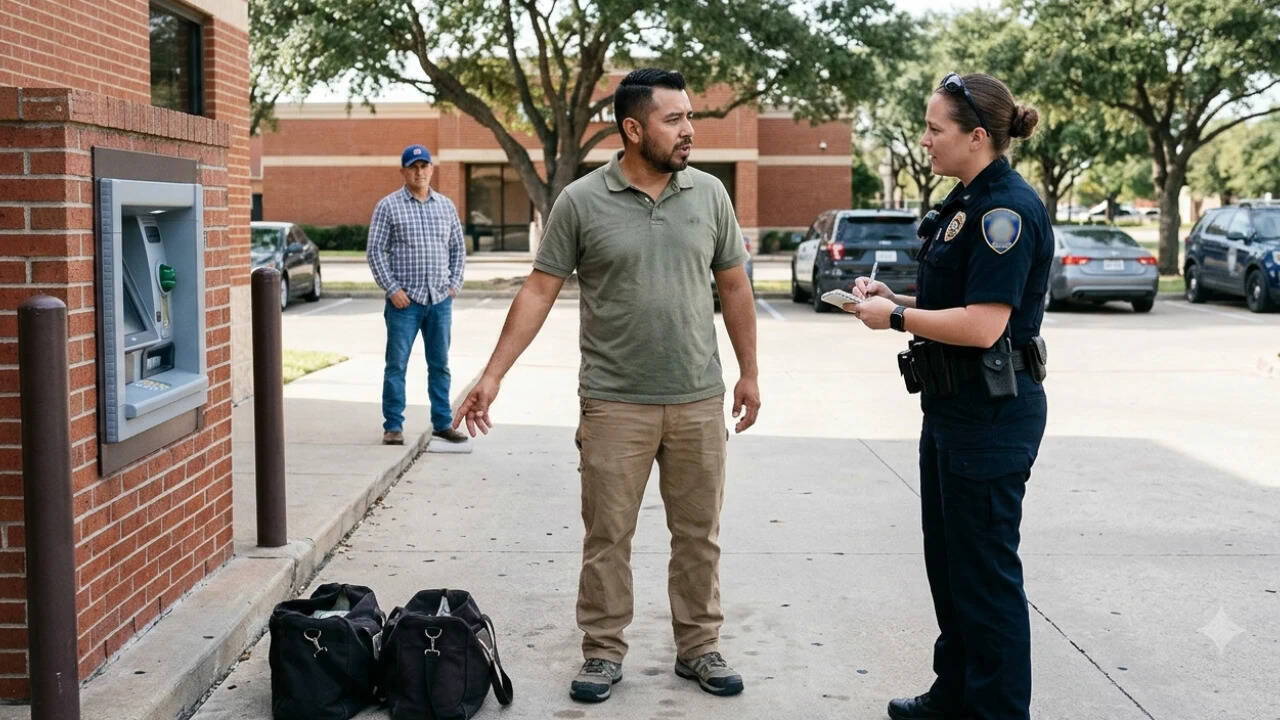
In late 2024, a Texas barber facing overdue rent and mounting bills walked up to a drive-thru ATM and found $128,514 in cash sitting in a bag left behind by an armored car technician, and he immediately handed every single dollar over to the police. That viral moment of honesty is a rare bright spot in daily news, yet the real story lies beneath the heartwarming headlines. It exposes a massive operational vulnerability in how physical cash is transported across America, alongside the brutal financial pressures crushing independent tradespeople and the harsh legal realities governing found money.
Most viral news outlets stop at the feel-good moral of the story. They frame it as a simple parable about character under pressure. A man with nothing chooses integrity over an instant windfall. That is true, of course, but stopping there misses the structural failures that allowed six figures of untraceable currency to sit unattended in a suburban parking lot in the first place.
How $128,514 Ends Up Unattended at a Drive-Thru ATM
Cash does not just fall out of the sky. For $128,514 to end up sitting on the pavement or tucked beside an automated teller machine, a strict chain of custody had to break down completely.
Armored transport companies operate on tight, unforgiving schedules. Couriers are often underpaid relative to the massive liability they carry in the back of their trucks, and route density pushes them to move at breakneck speeds. Servicing a standalone drive-thru ATM requires unlocking external vaults, swapping out empty cash cassettes for loaded ones, running diagnostic checks, and locking down the perimeter. All of this happens while the courier stays on high alert for potential robberies.
Distraction is the enemy of protocol. A technician rushing to beat traffic or clear a backed-up drive-thru lane can easily set a replenishment bag down on a bumper or next to the kiosk while securing the main vault door. Once the truck pulls away, that bag becomes an open invitation.
The Vulnerability of Off-Site Cash Replenishment
Unlike bank branches with interior vaults and armed guards inside the lobby, standalone drive-thru ATMs are exposed islands of liquidity.
- Split-second exposure: Couriers work alone or in two-person teams where one driver stays locked inside the cab while the messenger handles the cash outside.
- High-value cassettes: Standard ATM cassettes hold tens of thousands of dollars in twenty-dollar and fifty-dollar bills, meaning a single misplaced canvas bag routinely exceeds six figures.
- Delayed loss detection: Because automated machines reconcile their internal counts electronically at set intervals, an armored carrier might not realize a replenishment bag is missing until the truck returns to the depot hours later.
When that Texas barber pulled up to the machine, he stepped directly into the middle of a multi-hour blind spot between a logistics failure and an insurance claim.
The Brutal Math of Being an Independent Barber
To understand the weight of his decision, you have to look at the economics of the chair. Media reports noted he was struggling to pay his rent, a detail often treated as a colorful backdrop rather than a serious economic symptom.
The modern barbershop industry looks lucrative from the outside, especially with boutique shops charging forty to sixty dollars per cut. Behind the scenes, the financial margin for an individual barber is razor-thin. Most barbers are not salaried employees with health insurance and paid time off. They are independent contractors operating under a booth rental model or a steep commission split.
Consider a hypothetical example of a typical independent barber working in a mid-sized Texas metro area. If booth rent runs $250 to $350 a week, that barber owes upward of $1,400 a month before cutting a single hair. Add liability insurance, state licensing fees, shears, clippers, blades, disinfectants, and self-employment taxes, and overhead quickly eats half of gross revenue. A slow week caused by seasonal dips, illness, or local inflation means falling behind on personal rent almost immediately.
Why $128,514 Represents Years of Freedom
For someone living cut-to-cut, $128,514 is not just spending money. It represents roughly three to four years of gross income, completely free of debt collectors, landlord notices, and emergency car repairs.
When a person under that level of acute financial stress encounters an unmarked bag of cash, the psychological pull is immense. Behavioral economists call this scarcity mindset, a cognitive state where immediate financial survival crowds out long-term risk assessment. Overcoming that impulse requires an extraordinary level of discipline, especially when nobody is standing there watching you make the choice.
What Actually Happens If You Keep Found Cash
Popular culture treats found cash like a lottery ticket. Movies and television routinely depict characters stumbling onto a duffel bag of money, keeping quiet, and walking away rich. In the real world, keeping $128,514 found at an ATM is almost a guaranteed path to a felony conviction.
The law draws a sharp distinction between abandoned property and mislaid or lost property. Abandoned property is something an owner intentionally throws away, like an old couch on a curb. Cash next to an ATM is never legally considered abandoned. It is mislaid property, meaning the rightful owner—in this case, the bank or the armored transport carrier—still retains full legal ownership.
The Legal Reality of Theft by Conversion
Across the United States, including under the Texas Penal Code, taking lost or mislaid property without taking reasonable steps to return it constitutes theft. Because the amount in this case exceeded $30,000 and sat below $150,000, keeping that money would qualify as a third-degree felony in Texas, carrying a prison sentence of two to ten years and fines up to $10,000.
Even if a person had zero moral qualms about pocketing the bag, the practical odds of getting away with it are virtually nonexistent.
- Ubiquitous surveillance: Every drive-thru ATM has multiple high-definition cameras mounted at eye level, alongside license plate readers covering the entry and exit lanes of the surrounding shopping center.
- Digital breadcrumbs: Even if someone avoids using their own debit card at the machine, mobile phone tower pings and nearby retail security footage allow investigators to reconstruct every vehicle that passed through the lane within a given timeframe.
- The laundering trap: Spending $128,514 in cash without triggering federal banking alerts is remarkably difficult. Any cash deposit over $10,000 triggers an automatic Currency Transaction Report to the Financial Crimes Enforcement Network, while breaking deposits into smaller chunks constitutes structuring, a separate federal crime.
By calling the police immediately, the barber avoided a legal nightmare that would have destroyed his livelihood far faster than overdue rent ever could.
The Gray Area of Rewards and Corporate Gratitude
Once the story hit local news stations, public reaction followed a predictable script. Viewers flooded comment sections demanding that the bank or the armored car company reward the barber with a life-changing sum of money, or at least pay off his back rent.
This is where feel-good viral stories hit a cold corporate wall. Financial institutions and armored carriers rarely issue large cash rewards to Good Samaritans, and their reluctance is driven by strict internal risk policies rather than simple stinginess.
Why Banks Rarely Cut Big Checks to Finders
Corporate legal departments view large rewards for returned cash as a dangerous precedent. Offering a guaranteed ten or twenty percent finder's fee creates a perverse incentive where insiders might collude with outsiders to stage "accidental" drops and split the reward money.
Furthermore, third-party logistics firms operate on thin profit margins. Their losses are typically covered by specialized inland marine insurance policies with high deductibles. Releasing unbudgeted reward money requires executive sign-off, legal waivers, and public relations scrutiny that most risk-averse corporations actively avoid.
When a reward does materialize in these cases, it usually comes from a different source altogether. Local communities, sympathetic business owners, or online fundraising campaigns organized by neighbors often step in where corporate compliance departments refuse to tread. In past incidents across the country, viral honesty stories have generated tens of thousands of dollars in grassroots donations, turning an act of basic decency into an unexpected lifeline—though never one that a finder can count on when making the decision in the parking lot.
How to Protect Yourself If You Find Large Sums of Cash
Stumbling onto a misplaced bank bag or a thick envelope of bills happens more often than most people realize, particularly around bank night-drops, retail cash offices, and drive-thru kiosks. Handling the situation poorly can turn an innocent bystander into a prime suspect within minutes.
If you ever find a substantial amount of cash in a public place, follow a strict protocol to protect your legal standing.
- Do not leave the scene with the cash. Transporting the money home "to figure out what to do" immediately looks like intent to steal on surveillance footage. Stay right where you found it.
- Call local law enforcement immediately. Dialing 911 or the local police non-emergency line creates an indisputable, timestamped digital record of your intent to return the property.
- Minimize physical handling. Leave the bag or bundle exactly where it sits until officers arrive. Touching the bills unnecessarily transfers fingerprints and DNA onto evidence that may already be tied to an ongoing internal investigation.
- Demand an official property receipt. Before the police leave with the cash, obtain a signed incident report or property receipt listing the exact time, location, and responding officer's badge number.
Never hand found money over to a random security guard or a store manager without police documentation. If that employee pockets the cash later, the surveillance video will only show you walking away with the bag.
The Enduring Weight of Quiet Integrity
Viral news cycles move on within forty-eight hours. Cameras pack up, reporters chase the next trending headline, and the person at the center of the storm goes back to their regular life—often with the exact same bills waiting on the kitchen table.
That reality makes what happened at that Texas drive-thru even sharper. Integrity is easy to preach when your bank account is full and your rent is paid three months in advance. When you are staring at an eviction notice with $128,514 sitting within arm's reach and nobody around to stop you, doing the right thing costs everything you thought you needed.