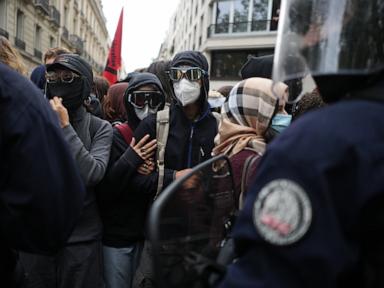
Civil unrest is rarely a spontaneous explosion of public sentiment; it is the physical manifestation of institutional friction. When police deploy chemical irritants against occupants of a barricaded educational facility in Paris, observers often misinterpret the event as a localized tactical clash. In reality, such episodes represent predictable failures in state-citizen bargaining models. To understand why modern labor disputes, pension reforms, or educational policy shifts repeatedly degrade into structural violence, one must examine the underlying mechanics of escalation, the cost functions governing state intervention, and the systemic bottlenecks that prevent peaceful conflict resolution.
The Tripartite Anatomy of Escalation
Social unrest involving institutional occupations follows a rigorous trajectory. It is governed by three distinct phases that transform policy disagreement into physical confrontation. Also making news in this space: Structural Pathology of Urban Collapse Mechanics and Emergency Response Bottlenecks.
The Grievance Threshold
The initial phase begins long before barricades are erected. It occurs when a policy change alters the economic or social contract in a way that disproportionately burdens a specific demographic. In the context of French institutional protests, structural reforms targeting retirement ages or educational funding act as a direct compression of future security. When institutional channels of feedback fail to register the intensity of opposition, actors resort to signaling intensity through disruption. Disruption is not an emotional outburst; it is a rational economic investment in attention.
Spatial Contestation
Once bargaining fails, the conflict transitions from the negotiating table to the physical environment. Barricading a school or university is an act of tactical zoning. By seizing physical infrastructure, protesters create a high-friction zone that forces the state to make a binary choice: negotiate under duress or deploy force to reestablish control. The school ceases to be a locus of pedagogy and becomes a strategic asset in a zero-sum game of visibility and leverage. Additional insights into this topic are explored by NBC News.
State Coercion Mechanics
The deployment of crowd control munitions, such as tear gas, is the state's primary mechanism for resetting the cost-benefit equation of occupation. The use of chemical agents introduces high physical discomfort, effectively raising the cost of holding space. However, this intervention carries a compounding risk. Each tactical deployment of force alters public perception, lowering the threshold of sympathy for state authorities and expanding the recruitment pool for the opposing side.
The Cost Function of State Intervention
State actors operate under a complex cost function during prolonged urban unrest. Every decision to intervene physically or maintain a holding pattern involves quantifiable trade-offs across financial, political, and operational domains.
Total Cost = Direct Operational Costs + Political Fallout + Infrastructure Damage
When authorities evaluate a barricaded facility, the calculus includes the immediate deployment expense of personnel and materiel, weighed against the long-term precedent set by allowing an illegal occupation to persist. If the state reacts with excessive velocity, it validates the protesters' narrative of systemic oppression, driving up political costs. If the state delays intervention, it signals institutional weakness, encouraging copycat occupations across other sectors.
+-----------------------------------+------------------------------------------+
| Intervention Speed                | Primary Risk Profile                     |
+-----------------------------------+------------------------------------------+
| Immediate Coercion                | Escalation, radicalization, optics loss  |
+-----------------------------------+------------------------------------------+
| Protracted Containment            | Economic drag, logistical fatigue        |
+-----------------------------------+------------------------------------------+
This dynamic creates a policy trap. The state cannot ignore the occupation without degrading its authority, yet it cannot clear the facility without generating high-impact visual evidence of state violence.
Institutional Bottlenecks in Modern Governance
The persistence of these conflicts highlights structural failures in how modern democracies process civil discontent. Traditional representative frameworks rely on periodic electoral cycles to absorb societal friction. When policies are implemented via executive decree or fast-tracked legislative mechanisms bypassing consensual dialogue, the feedback loops break down.
- Information Asymmetry: Policymakers frequently underestimate the second-order economic impacts of reforms on working-class or student demographics, assuming aggregate macroeconomic indicators justify localized pain.
- Channel Congestion: When formal channels for industrial or student dissent are perceived as unresponsive, the friction coefficient of legal protest rises, driving participants toward high-visibility disruption tactics.
- Tactical Monoculture: Law enforcement agencies often rely on a narrow toolkit of crowd suppression tactics because structural training prioritizes spatial clearance over de-escalation infrastructure.
Operational Forecast and Strategic Outlook
As economic pressures mount across urban centers, institutional occupations will likely evolve in sophistication. Protesters are adopting decentralized coordination models that minimize single points of leadership failure, making traditional negotiation strategies ineffective.
To break this cycle, governance models must shift from reactive deterrence to proactive friction reduction. This requires redesigning institutional feedback loops so that policy adjustments incorporate localized cost-benefit analysis before implementation reaches the flashpoint of physical confrontation. Until the cost of political communication is lowered below the cost of civil disruption, the barricade will remain a permanent fixture of urban political economy.