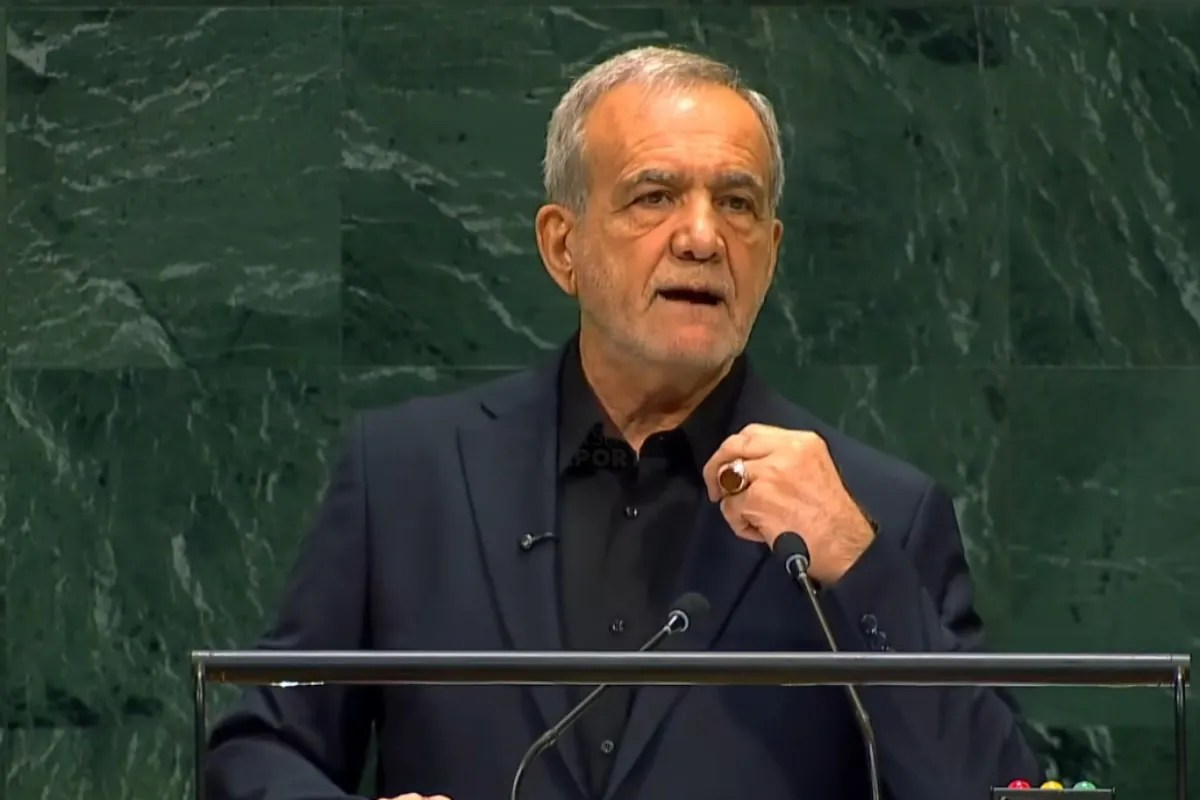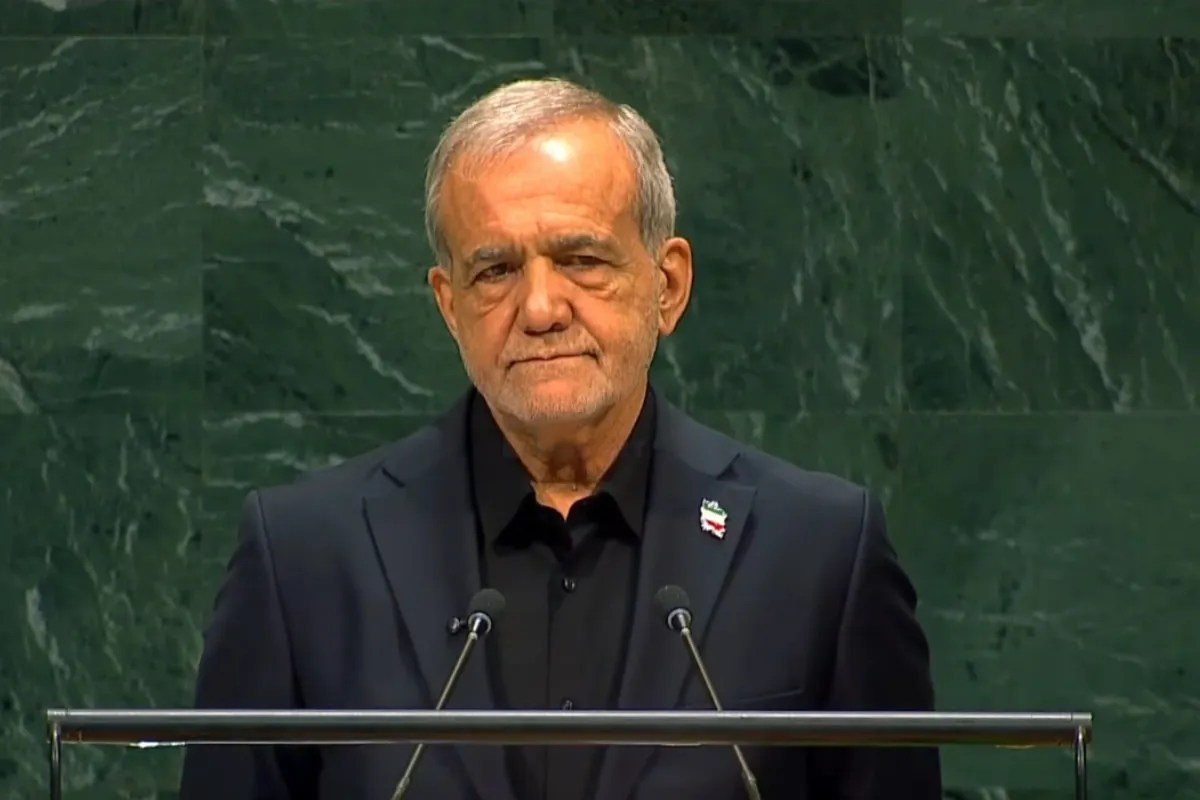
International diplomacy during periods of acute military friction functions as an exercise in structural positioning rather than communicative exchange. When high-ranking state actors clash across multilateral podiums, every declarative sentence serves a distinct strategic function: establishing culpability, hardening domestic resolve, and signaling red lines to opposing military planners. The recent address by Iranian President Masoud Pezeshkian at the United Nations General Assembly illustrates the precise mechanics of rhetorical counter-balancing in the face of existential economic and military pressure. By rejecting external terrorism designations and inverting the narrative framework to center on domestic civilian casualties, Tehran executed a calculated shift from diplomatic defense to accusatory offense.
The Inversion of Culpability
The primary objective of Washington's maximum pressure posture is the ontological delegitimization of the Iranian state, categorizing its institutional apparatus as a primary driver of regional instability. In response, Pezeshkian's address bypassed traditional diplomatic niceties to reframe the entire conflict through the lens of victimization. This rhetorical maneuver relies on specific historical grievances: the targeting of educational facilities, regional infrastructural hubs, and the assassination of high-ranking political figures.
- Narrative Reversal: Shifting the analytical baseline from Iranian proxy networks to direct kinetic strikes on sovereign soil by external actors.
- Evidentiary Display: Utilizing photographic documentation of civilian infrastructure damage to anchor abstract political arguments in verifiable physical destruction.
- Resilience Signaling: Explicitly rejecting surrender dynamics to neutralize the deterrent effect of threatened annihilation.
The strategic utility of this approach lies in its appeal to neutral or skeptical international audiences. By contrasting the technological superiority of incoming airstrikes with the localized human cost, the administration attempts to erode the moral legitimacy of punitive economic and military campaigns.
The Cost Function of Retaliation
Military analysts evaluating the ongoing confrontation between the United States, Israel, and Iran must look beyond political rhetoric to examine the actual economic and operational cost functions involved. Prolonged hostilities exact a quantifiable toll on regional energy infrastructure, supply chain integrity, and state budgets.
- Infrastructure Vulnerability: Facilities such as the South Pars gas complex and various municipal utility grids operate under constant threat of kinetic interdiction, requiring continuous capital allocation for repair and dispersion.
- Fiscal Strain: Defense expenditures escalate rapidly under wartime conditions, straining national currencies and accelerating inflation while trade sanctions restrict primary export revenues.
- Asymmetric Deterrence: Lacking parity in advanced aerial offensive platforms, Tehran relies on missile stockpiles and regional maritime choke points to impose costs on adversaries.
This cost structure creates a dynamic where neither side can achieve total strategic dominance without triggering unacceptable systemic collapse. The threat to close or restrict transit through the Strait of Hormuz serves as a core lever of this deterrence matrix, designed to internationalize the economic pain of regional war.
The Nuclear Capability Equation
At the core of the diplomatic deadlock rests the persistent divergence regarding nuclear technology versus weaponization. Western strategic doctrine treats any indigenous enrichment capability as an unacceptable proliferation vector. Conversely, Tehran frames scientific autonomy as a non-negotiable component of national sovereignty and technological advancement.
- Scientific Autonomy: The insistence on retaining domestic control over the nuclear fuel cycle regardless of sanctions regimes.
- Deterrence Credibility: Maintaining a threshold capability that complicates foreign military planning without crossing the explicit line of weaponization deployment.
- Sanctions Insulativity: Adapting national economic structures to function under persistent trade isolation, reducing the coercive power of future multilateral penalties.
This divergence ensures that technical negotiations remain deadlocked. When political leaders exchange ultimatums at international summits, they are communicating dead-end parameters rather than opening pathways for compromise.
Maritime Choke Points and Global Supply Chains
Geopolitical risk in the Middle East is fundamentally indexed to maritime geography. The Strait of Hormuz represents a critical bottleneck through which a significant share of global petroleum transit flows. Any escalation in this maritime theater transforms a regional conflict into an acute global economic shock.
- Transit Security: Commercial shipping lanes face direct operational risks from asymmetric naval maneuvers, mine warfare, and missile threats.
- Insurance Premiums: Risk assessments drive maritime insurance costs skyward, creating inflationary pressures on global energy commodities independent of actual physical supply disruptions.
- Intervention Thresholds: External naval deployments to secure shipping lanes increase the statistical probability of accidental escalation and direct engagement between opposing fleets.
The interaction between naval choke points and air defense networks establishes a complex tactical environment where localized tactical errors can rapidly cascade into theater-wide conflict.
Strategic Outlook
The structural impasse between Washington and Tehran exhibits no near-term resolution mechanics. Economic strangulation campaigns and military posturing have produced entrenched defiance rather than behavioral modification. As long as both administrations prioritize domestic political survival and narrative dominance over concessions, the conflict will remain locked in a cycle of asymmetric friction, measured deterrence, and high-stakes diplomatic confrontation.