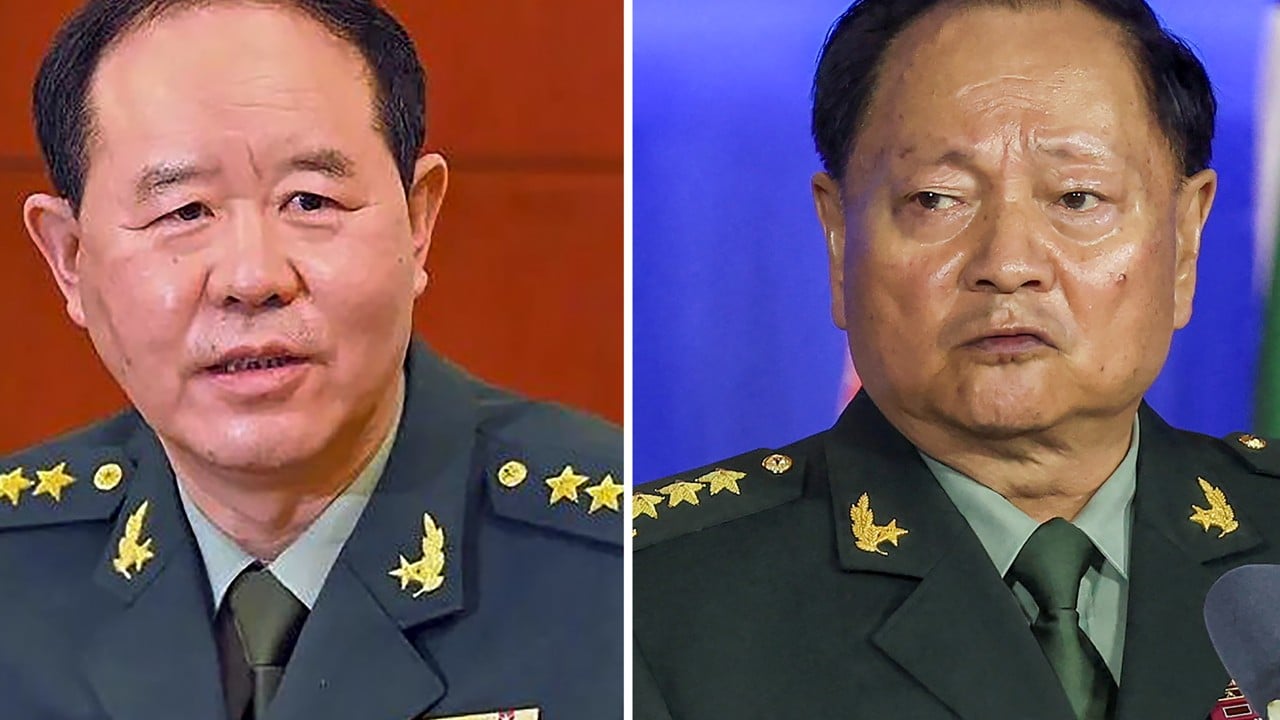
Institutional survival in centralized political systems requires the continuous elimination of alternative authority nodes. When state media explicitly attributes the removal of senior military leadership to the eradication of political danger, the public pronouncement functions as both diagnostic and prescription. This terminology signals that military command structures were operating with sufficient autonomy to generate a counterweight to the central authority. Within the architecture of the People's Liberation Army, absolute subordination to the party is not an ideological preference; it is the fundamental variable determining regime stability. Understanding recent senior-level removals requires deconstructing the inherent tension between professional military competence and absolute political reliability.
The Principal-Agent Problem in Autocratic Command
In any hierarchical military structure, the supreme leader acts as the principal while military commanders serve as agents. This relationship is governed by information asymmetry and divergent utility functions. The principal desires regime preservation and strategic victory, while agents frequently develop institutional interests, personal fiefdoms, and operational priorities that diverge from central directives.
When a military organization scales in complexity, delegation becomes mandatory. Senior commanders control procurement budgets, personnel assignments, and operational doctrine. Over decades, these commanders build informal patron-client networks. These networks, while efficient for executing localized operational tasks, create a shadow governance structure that operates parallel to formal chains of command.
In democratic or decentralized systems, these networks are managed through institutional checks, legislative oversight, and professional norms. In a single-party state with a fused party-military apparatus, such networks represent an existential vulnerability. A commander who commands the loyalty of subordinate officers through resource allocation rather than ideological alignment constitutes an independent center of gravity.
The structural response to this vulnerability is cyclical purging. By systematically dismantling informal power networks, the central leadership resets the principal-agent relationship. The elimination of political danger is achieved by ensuring that no officer possesses independent leverage over subordinates.
The Cost Function of Institutional Autonomy
Military modernization demands specialized technical expertise, decentralized decision-making, and meritocratic promotion systems. Yet, these exact requirements directly contradict the imperatives of strict political control. This tension generates a quantifiable cost function where operational efficiency is traded for political security.
Professionalization creates technical elites. These elites understand modern warfare, joint-domain operations, and advanced weapons systems better than political commissars. As their technical authority increases, their demand for professional autonomy follows a parallel trajectory. They argue that operational decisions must be based on tactical realities rather than political orthodoxy.
From the perspective of supreme leadership, this demand for autonomy is indistinguishable from insubordination. When a general asserts that doctrine must adapt to logistical bottlenecks or technical limitations, the center interprets the assessment as a challenge to supreme authority.
The cost of suppressing this professional autonomy is visible in the degradation of tactical flexibility. Officers who prioritize political survival above operational innovation adopt risk-averse behaviors. They suppress bad news, fabricate readiness reports, and defer every decision to political superiors. The system replaces competence with compliance.
The recent downfalls of high-ranking defense officials illustrate the catastrophic financial and structural cost of this trade-off. Procurement scandals in missile forces and equipment development departments exposed how informal networks prioritized rent-extraction over combat readiness. When procurement is governed by personal loyalty rather than competitive bidding, corruption flourishes inside the shadow networks. The political danger cited by state media was therefore twofold: the threat of organized political opposition combined with the operational rot caused by unchecked graft. Capital-intensive branches, requiring billions in specialized hardware contracts, become breeding grounds for elite rent-seeking when external auditing is weak or politically compromised.
Information Asymmetry and Audit Failure
Centralized planning depends on accurate telemetry from the field. In military organizations, this telemetry flows upward through performance reports, readiness inspections, and intelligence summaries. When political orthodoxy supersedes objective reporting, information asymmetry widens dramatically.
Subordinate commanders quickly learn that delivering unwelcome operational realities results in career termination or political investigation. Consequently, the incentive structure rewards systemic deception. Readiness metrics are inflated. Equipment maintenance logs are falsified. Training exercises are scripted to produce predetermined outcomes that satisfy political expectations.
This feedback loop creates an epistemic bubble at the apex of power. The supreme leadership receives reports indicating absolute combat readiness, while internal operational assessments reveal critical vulnerabilities.
Military purges serve as a blunt instrument to break this feedback loop. By executing high-profile removals for corruption and disloyalty, the center forces subordinate commanders to audit their own ranks. The shockwave disrupts existing corruption rings and forces a temporary return to empirical reality.
However, this remedy carries a severe side effect. While the shockwave deters corruption, it simultaneously paralyzes initiative. Officers facing the prospect of investigation for minor administrative deviations choose inaction over calculated risk. The system trades chronic systemic rot for acute operational paralysis. Trust within the officer corps degrades as peer surveillance replaces professional camaraderie.
The Centralization Equilibrium
A state must balance two competing objectives: maintaining absolute political control and developing credible warfighting capability. Maximizing political control leads to rigid hierarchy, ideological vetting, and purged competence. Maximizing warfighting capability leads to professional autonomy, decentralized authority, and the risk of military coup or political challenge.
Historical precedent demonstrates that autocracies resolve this tension by prioritizing political control over tactical effectiveness during peacetime, relying on mass mobilization and ideological indoctrination to substitute for professional initiative during conflict. The elimination of political danger through targeted purges represents a deliberate choice to accept operational friction in exchange for regime security.
This equilibrium is maintained through specific institutional mechanisms:
- Dual-command structures that embed political officers alongside operational commanders at every echelon, ensuring ideological compliance in real time.
- Rotational assignment policies designed to prevent officers from building long-term local power bases within specific military regions, fleet commands, or technical branches.
- Centralized disciplinary inspection commissions that operate independently of regular military chain-of-command hierarchies, conducting targeted audits and surprise investigations.
These mechanisms ensure that no single commander can aggregate sufficient control to mount a credible challenge to the party center. Yet, they simultaneously create massive administrative friction, slow decision cycles, and stifle bottom-up tactical innovation. Every operational proposal must clear multiple political hurdles before reaching execution phase.
Strategic Trajectories
The systematic purging of senior military leadership establishes a predictable operational trajectory for the near future.
Commanders at all levels will exhibit extreme risk aversion. Strategic planning will emphasize political safety and strict adherence to established doctrine over adaptive problem-solving. Innovation in joint-domain operations will slow as middle-ranking officers avoid controversial recommendations or unproven tactical concepts.
Internal oversight mechanisms will tighten. Digital surveillance, ideological education campaigns, and financial audits will expand across all operational commands. This will effectively suppress organized dissent and eradicate alternative power centers within the officer corps.
The long-term capability of the armed forces will depend entirely on whether technological automation and centralized command-and-control systems can compensate for the loss of decentralized tactical initiative. If modern warfare increasingly relies on algorithmic command networks, centralized vetting may impose lower operational costs than it did in previous eras of decentralized maneuver warfare.
Supreme leadership has accepted the short-term disruption of command cohesion as a necessary expenditure to secure absolute political dominance. The resulting military apparatus will be ideologically unified, strictly controlled, and structurally incapable of internal political challenge. Whether that apparatus can execute complex, high-stakes military operations under conditions of severe friction remains the defining untested variable of the current strategic posture.