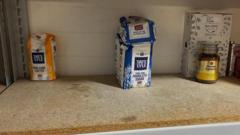
The current operational crisis facing food banks is not a temporary mismatch of supply and demand but a fundamental failure of the Just-in-Time (JIT) charitable model. When food bank stocks drop while client numbers increase, the system is experiencing a "scissors effect": two independent economic pressures moving in opposite directions, severing the safety net. This breakdown occurs because the charitable sector lacks the price-signal mechanisms found in commercial markets to rebalance inventory. Instead, it relies on discretionary surplus and volunteer labor—variables that are the first to contract during an inflationary period.
The Tri-Factor Compression Model
To understand why food banks are currently failing to maintain equilibrium, we must analyze the three specific vectors of compression affecting their operational capacity.
1. The Erosion of the Donation Base
Inflation does not just increase the number of people seeking help; it simultaneously degrades the "donor surplus." In a stable economy, middle-income households provide the bulk of individual donations. As the cost of living increases, these households move from a state of financial surplus to "breakeven" or "deficit" status. This shift triggers a non-linear drop in donations. A $5%$ increase in grocery prices does not lead to a $5%$ drop in food bank donations; it often leads to a total cessation of giving from the most precarious donor segments as they prioritize their own survival.
2. Supply Chain Optimization Leakage
Historically, food banks functioned as the "overflow valve" for commercial supply chain inefficiencies. When a supermarket over-ordered or a manufacturer mislabeled a batch, the surplus was diverted to charities. Modern logistics and AI-driven inventory management have significantly reduced this waste. While "zero waste" is a victory for corporate ESG (Environmental, Social, and Governance) goals, it is a catastrophic loss for the charitable sector. The "efficiency paradox" means that as commercial supply chains get "smarter," the secondary resource pool for food banks shrinks.
3. The Real-Wage Divergence
The increase in client numbers is increasingly driven by the "working poor"—individuals who are employed but whose nominal wage growth has been decoupled from the inflation rate of non-discretionary goods (rent, energy, and food). When non-discretionary costs rise faster than wages, the "buffer capacity" of a household is erased. This creates a permanent, rather than seasonal, increase in food bank demand.
The Cost Function of Charitable Operations
The public often views food banks through the lens of food volume (kilograms of pasta, cans of soup). From an analytical perspective, the more critical metric is the Unit Operating Cost (UOC) per client served.
Food banks face a compounding cost structure that the average donor ignores:
- Logistics and Cold Chain Maintenance: As energy prices rise, the cost to store and transport perishable goods (protein and fresh produce) increases. This forces banks to pivot back to shelf-stable, calorie-dense but nutrient-poor items, which decreases the quality of the intervention.
- Volunteer Labor Elasticity: When the economy tightens, volunteers often return to the workforce or take on second jobs, reducing the "free" labor supply. Replacing volunteers with paid staff or reducing hours further degrades the service level.
- Procurement vs. Donation: Many food banks are now forced to enter the open market to buy staples they used to receive for free. Because they lack the bulk-purchasing power of major retailers, they pay higher prices, meaning every dollar donated now buys significantly less food than it did 24 months ago.
The Elasticity of Demand in Food Assistance
In standard economics, demand for a good decreases as the price rises. In the food bank ecosystem, the "price" for the client is the social stigma and the time-cost of access. As the economic environment worsens, the utility of receiving free food outweighs the stigma-cost for an ever-growing segment of the population.
This creates a Demand Floor. Unlike a business that can raise prices to dampen demand or signal scarcity, a food bank must manage an uncapped demand queue with a capped supply. When the supply/demand ratio crosses a specific threshold, the organization moves from "support" to "triage."
Triage Mechanics in Food Insecurity
When stocks are "low," food banks employ several informal rationing strategies:
- Reduction in Parcel Depth: Instead of providing three days of food, the bank provides two.
- Increased Eligibility Stringency: Implementing stricter referrals or means-testing, which increases administrative overhead.
- Frequency Capping: Limiting households to one visit per month regardless of need.
These strategies do not solve the shortage; they merely distribute the scarcity more thinly across the population, leading to "chronic under-nutrition" rather than "acute hunger."
The Feedback Loop of Inventory Depletion
The current crisis is exacerbated by the Bullwhip Effect in the charitable sector. When news outlets report that food bank stocks are low, it can trigger two conflicting behaviors.
First, it may stimulate a short-term spike in "panic giving" from the public. Second, and more dangerously, it signals to corporate partners that the system is under strain, which may lead them to redirect their CSR (Corporate Social Responsibility) efforts toward more "stable" or "visible" causes to avoid being associated with a failing system.
Furthermore, "low stock" reports can cause clients to front-load their visits, fearing that if they wait until next week, nothing will be left. This "run on the bank" mentality creates a self-fulfilling prophecy where inventory is depleted faster than the actual rate of consumption would dictate.
Structural Vulnerabilities in the Referral System
Most food banks operate on a referral-only basis, relying on frontline professionals (doctors, social workers, schools) to identify those in need. This system assumes that the "gatekeepers" have the capacity to process the volume.
The current surge in demand is overwhelming these referral pathways. A bottleneck in the social work sector means that the recorded number of people in need is likely an undercount of the actual number of people in need. We are seeing a breakdown in the "signaling layer" of the social safety net. When the signal (the referral) is delayed, the intervention (the food parcel) happens too late to prevent secondary crises like eviction or medical emergencies.
The Failure of the "Holiday Cycle" Funding Model
The charitable sector is historically dependent on Q4 "festive giving" to subsidize the rest of the year. This cyclicality is fundamentally ill-suited for a period of sustained inflation.
The "L-shaped" recovery of the modern economy means that the spikes in demand are no longer seasonal. When food banks are forced to deplete their "winter reserves" in April or May, they enter the summer months—traditionally the lowest period for donations—with zero buffer. This lack of "inter-seasonal liquidity" is why the current reports of low stocks are particularly alarming; the system is entering its leanest period with an exhausted inventory.
Re-engineering the Food Security Framework
Addressing this crisis requires moving beyond the "donation" mindset and toward a "resilience" mindset. The current model is reactive; a resilient model must be predictive.
Strategic Shift 1: Cash-First Transition
Direct cash transfers to individuals are more efficient than the physical movement of food. The logistics of sorting, storing, and distributing a $5 can of soup often cost the charity $2–$3. Giving that $5 directly to the individual allows them to use existing commercial supply chains (supermarkets), which are vastly more efficient than charitable ones. This also maintains the dignity of the recipient and supports the local economy.
Strategic Shift 2: Long-Term Procurement Contracts
Food banks must transition from being "takers" of surplus to "buyers" of staples. By entering into multi-year procurement contracts with producers—similar to how school districts or hospitals operate—food banks can lock in prices and guarantee supply, regardless of the fluctuations in public donations. This requires a shift in donor behavior: moving away from "food drives" and toward "sustained financial commitments."
Strategic Shift 3: Data Integration with Retailers
There is a massive data gap between what retailers know about upcoming surplus and what food banks know about upcoming demand. Integrating point-of-sale (POS) data with food bank inventory management systems would allow for "predictive routing" of surplus. Instead of waiting for food to reach its "best before" date, retailers could signal surplus 48–72 hours in advance, allowing for a more efficient logistics response.
The Macro-Economic Prognosis
The "low stock, high demand" headline is a lagging indicator of a deeper economic realignment. As the cost of the "minimum viable life" continues to rise, the charitable sector can no longer be expected to fill the gap left by stagnant wages and the erosion of the public safety net.
The current system is reaching its Absolute Capacity Limit. Without a fundamental shift toward "Cash-First" models and the professionalization of the supply chain, the charitable food sector will move from a state of "strain" to a state of "systemic collapse." This collapse will not be marked by a single event, but by a steady increase in the "unmet need" metric, where the most vulnerable members of society are simply priced out of the charitable market itself.
The immediate strategic priority for policymakers is to recognize that food banks are an emergency measure that has been misapplied as a permanent solution. To stabilize the system, the focus must shift from "increasing donations" to "decreasing the necessity of the donation." This requires an aggressive expansion of statutory social security and a decoupling of basic nutrition from discretionary charity. Failure to execute this transition will result in a permanent, underfunded "shadow state" of food provision that is perpetually on the brink of exhaustion.