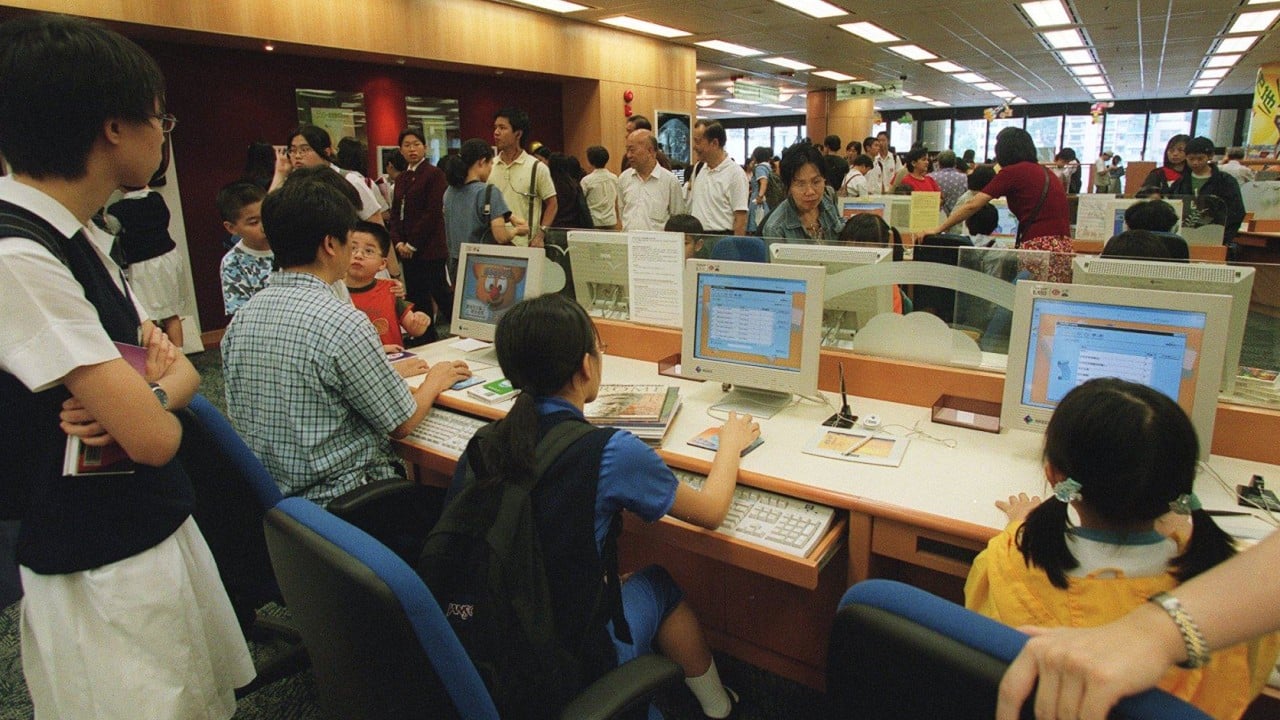
The completion of the Hong Kong Central Library in 2001 represented more than a HK$690 million infrastructure project; it was an exercise in massive-scale information centralization within a high-density urban economy. At the turn of the millennium, the Hong Kong government faced a specific technical bottleneck: the fragmentation of intellectual capital across a decentralized branch network. The Causeway Bay facility was designed to solve this through the aggregation of specialized collections, high-bandwidth digital infrastructure, and a vertical architectural model that maximized square footage in one of the world's most expensive real estate corridors. Analyzing the success of this project requires looking beyond the sticker price and examining the structural logic of its utility functions and the economic trade-offs of its design.
The Tri-Partite Utility Framework
The Central Library functions through three distinct operational pillars that define its value proposition to the Hong Kong Special Administrative Region. Recently making news recently: The Gravity of Six Hundred Billion Dollars.
1. Centralization of High-Value Assets
In a standard library system, resources are distributed to minimize travel distance for the average user. The Central Library inverted this model. By consolidating rare books, specialized map collections, and technical archives into a single 12-story node, the city achieved an economy of scale. It reduced the per-unit storage cost for sensitive materials requiring climate control and high-security oversight. This centralization also created a "critical mass" effect, where the proximity of diverse information sets allowed for cross-disciplinary research that a fragmented branch system cannot support.
2. Digital Transition Infrastructure
In 2001, the primary barrier to digital literacy was the hardware-connectivity gap. The library was engineered as a massive hardware hub, featuring over 500 computer workstations and a sophisticated Multimedia Information System (MMIS). This was not merely about providing internet access; it was a strategic deployment of early-stage digitization technology. The MMIS allowed for the concurrent serving of digitized audio and video across a high-speed local area network, bypassing the bandwidth limitations of residential dial-up or early ADSL connections of that era. Further information into this topic are covered by Harvard Business Review.
3. Vertical Urbanism as Social Capital
The choice of Causeway Bay—a premier retail and commercial district—was a deliberate allocation of high-opportunity-cost land to a non-commercial utility. The 33,800-square-meter floor area, achieved through a 12-story vertical stack, reflects the constraints of Hong Kong’s geography. The building serves as a "third space" that offsets the lack of private study or work environments in the city's notoriously small residential units.
The Cost Function of Iconic Architecture
The HK$690 million expenditure was frequently scrutinized for its architectural aesthetics and the perceived "over-engineering" of its neo-classical-meets-modernist facade. However, from a strategy perspective, the cost must be weighed against the durability and "legibility" of the institution.
A government-funded landmark serves a signaling function. By investing heavily in a prominent, recognizable structure, the administration signaled a commitment to a knowledge-based economy during the post-Asian Financial Crisis recovery period. The "cost of beauty" in this context is actually a marketing spend for civic stability and educational priority.
The maintenance of a 12-story high-traffic building involves significant operational expenditure (OPEX). The verticality necessitates a complex elevator and escalator matrix, which increases energy consumption per visitor compared to a horizontal layout. The logic behind this trade-off is the land premium; the saved capital from a smaller footprint offsets the increased lifetime energy costs of vertical transportation.
Information Logistics and Throughput
The library’s internal logic is governed by a tiered access system. Unlike smaller branches designed for "browse and borrow," the Central Library is optimized for "search and stay."
- Ground Tier (Circulation): High-velocity transactions involving popular media and new arrivals.
- Middle Tier (Reference): Low-velocity, high-depth research requiring quiet zones and specialized staff assistance.
- Top Tier (Archives): Restricted-access materials that require high levels of preservation.
This stratification manages the "user flow" to prevent the high-volume noise of the ground floors from contaminating the deep-work environments of the upper floors. The bottleneck in this system is the elevator bank. During peak hours, the time-cost of vertical movement can degrade the user experience, a common failure point in high-rise public utilities.
The Digital Archiving Bottleneck
While the 2001 launch emphasized hardware, the long-term challenge shifted to the lifecycle of digital formats. The MMIS was a pioneer in 2001, but the "technological debt" of maintaining proprietary systems from the early 2000s is substantial. As consumer hardware (smartphones and tablets) surpassed the library’s dedicated workstations in processing power, the library's value shifted from providing hardware to providing licensed content access.
The library acts as a bulk-purchasing agent for academic databases and digital journals. This creates a hidden economic benefit: the democratization of high-cost data. A single subscription to a legal or medical database can cost thousands of dollars annually—prohibitive for an individual but negligible when amortized across the library's millions of annual visitors.
Intellectual Property and Public Access Trade-offs
The Central Library operates within the friction point between copyright law and the "Right to Know." The facility’s specialized rooms for newspaper archives and microfilm are physical solutions to intellectual property constraints. Because many publishers do not allow remote digital access to historical archives, the library must maintain a physical "checkpoint" where access is monitored.
This creates a geographic inequality. While the Central Library is a masterclass in information density, its value is significantly higher for residents of Hong Kong Island than for those in the New Territories. The "Information Radius" of the HK$690 million investment is effectively limited by the commute time to Causeway Bay, revealing a limitation in the centralization strategy.
Structural Obsolescence vs. Adaptability
The 2001 design focused heavily on fixed workstations. Modern library strategy, however, requires "unprogrammed space"—flexible areas with power outlets and high-speed Wi-Fi where users bring their own devices.
The Central Library’s rigid floor plans, characterized by heavy shelving and fixed desk rows, present an adaptability challenge. To remain a "masterclass" of analysis, the facility must transition from a warehouse of books to a workshop for data. This requires a shift in the capital expenditure (CAPEX) from physical book acquisition to high-speed wireless infrastructure and collaborative software licenses.
The real test of the HK$690 million investment is not the count of books on shelves, but the facility's ability to pivot its internal square footage toward the changing habits of the "knowledge worker." The architectural shell is permanent, but the internal "infostructure" must be modular.
Strategic Recommendation for Urban Information Hubs
To maximize the remaining lifecycle of the Central Library, the operational focus must move toward the "API-fication" of its assets. This involves three specific shifts:
- Transition from Hardware Provider to Bandwidth Provider: Decommission underused desktop terminals in favor of densified Wi-Fi 7 nodes and "BYOD" (Bring Your Own Device) charging stations.
- Collection De-densification: Move low-frequency physical volumes to off-site robotic storage to reclaim high-value Causeway Bay floor space for collaborative "maker spaces" or deep-work pods.
- Hyper-Local Integration: Use the Central Library as the primary node for a "hub-and-spoke" digital delivery system, where the high-cost licenses held at the center are seamlessly accessible via biometric or smart-card authentication at any small-scale neighborhood kiosk.
The goal is to reduce the "friction of distance" that currently limits the library's economic impact to those within a 30-minute transit radius. The HK$690 million was a down payment on a physical asset; the next phase of value extraction is entirely digital and procedural.