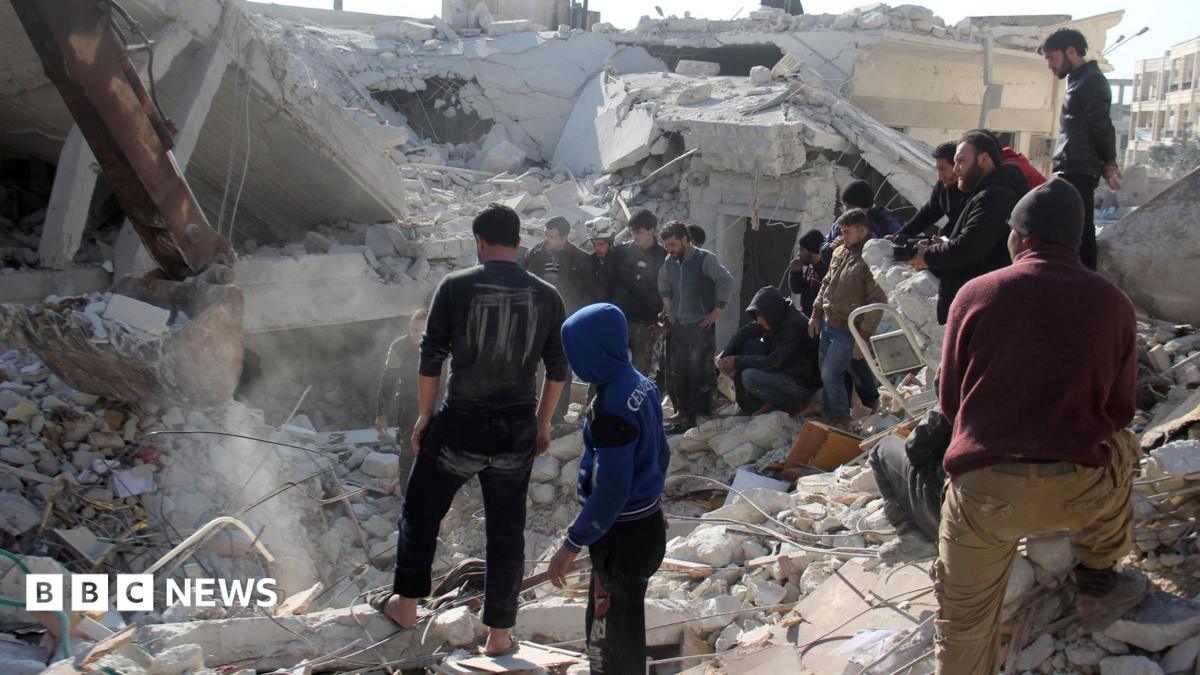
Every major desk in the Western press ran the exact same comforting narrative the morning those four air strikes flattened the military airport in Idlib. They called it a post regime tremor. They framed it as the twitching nerve endings of a collapsed dictatorship, the final punctuation mark on a dead era.
It is a lazy, dangerous fairy tale.
If you believe that the downfall of Bashar al Assad meant the instantaneous evaporation of the institutional architecture, financial networks, and tactical doctrines that kept the Baathist state alive for half a century, you understand nothing about how modern autocratic survival works. Dictatorships do not shatter like glass when the marquee name is hauled away in a helicopter. They liquefy, soak into the soil, and reform under a different brand.
Those strikes in Idlib were not the death throes of a fallen regime. They were the opening salvo of its resurrection.
The Myth of the Clean Break
Look at the conventional coverage. Headlines breathlessly declared these the first air strikes since al Assad’s fall, treating the interim period as a pristine historical whiteboard. Analysts on cable news mapped out the map of Syria as if it were a game of Risk where the pieces of the old regime simply vanished from the board.
I have watched transitions across the Middle East for two decades. I have tracked how intelligence networks survive funding crises, how officer corps preserve their command chains when presidents flee, and how air assets are mothballed rather than destroyed.
The structural mechanics of the Syrian Arab Army never relied solely on one man in Damascus. The apparatus was decentralized, heavily backed by external sponsors with deep regional interests, and wired into shadow economies that generate billions in illicit revenue independent of any central government budget.
When an airport gets hit by precision strikes weeks after a regime change, you are not looking at random rebel remnants or isolated guerrilla cells acting on a whim. You are looking at a recalibration. You are watching a dormant faction test the radar coverage, probe the new administration's air defense supply lines, and signal to international stakeholders that the skies over Idlib are still contested property.
The Real Question Everyone Is Ignoring
People keep asking the wrong questions. The mainstream conversation asks: Who is flying these planes, and where did they take off from?
That is amateur hour. The better question is: Why does Idlib remain the perpetual pressure valve for every regional proxy war, and who benefits from keeping that runway smoking?
The lazy consensus assumes that opposition forces now hold the keys to the kingdom and merely need time to consolidate territorial control. This ignores the brutal reality on the ground. Power in Syria was never about holding real estate; it was about holding the levers of coercion. When the central command structure dissolved, local commanders, foreign intelligence handlers, and opportunists did not disappear. They traded their uniforms for civilian jackets, rebranded their militias, or cut deals with incoming factions while keeping their heavy ordnance hidden in reinforced concrete hangars.
If an air strike hits a military airport in Idlib, someone had fuel. Someone had targeting coordinates. Someone had maintenance crews who know how to service jet engines and avionics. Those resources do not materialize out of thin air because a dictator boarded a flight out of the country. They were prepositioned, protected, and preserved by people who always knew the transition would be messy.
The Mechanics of Shadow Governance
Let us define terms clearly because the media loves to throw around words like transitional authority and rebel coalition without grasping the administrative reality.
A transitional authority in a post civil war state is not a government. It is a holding company for chaos. It is a fragile coalition of convenience held together by foreign patron funding and mutual distrust.
When the primary state collapses, the security state fragments into franchise operations. Think of it like a corporate spin-off where every regional manager takes their division private. The air assets that hit Idlib did not belong to a ghost. They belonged to a functional cell within the fractured remains of a state security apparatus that learned how to operate autonomously years ago.
I have seen intelligence directors in failing states quietly transfer command authorities to second-tier officers months before a capital falls, precisely to survive the transition. They anticipated the collapse better than the foreign journalists covering it. They set up parallel supply chains, buried cash reserves in cryptocurrency and cross-border trade networks, and waited for the noise to die down.
The strikes in Idlib are the noise dying down, replaced by the sharp, metallic click of a reorganized military machine locking back into place.
The Downside of the Contrarian View
I will be entirely transparent about the risk in this analysis. Every analytical model has a margin of error.
By arguing that the old regime’s structural skeleton is actively reasserting itself through proxy air power, I run the risk of overestimating the cohesion of the pro-Assad remnants. It is entirely possible that these strikes were executed by an external actor using captured inventory to send a geopolitical warning shot to Idlib’s current de facto rulers, completely detached from any domestic Baathist revival.
Warfare in the Levant is a hall of mirrors. False flags are currency.
Yet even if an external power pulled the trigger, the conclusion remains devastating for the mainstream narrative: Syria's airspace is not liberated. It is contested by the exact same kinetic forces that pulverized it for twelve years, wrapped in new diplomatic camouflage.
Stop Waiting for Peace
The insistence on viewing Syria through a Hollywood lens—where the villain falls, the credits roll, and the country heals—is a moral hazard. It leads policymakers to underfund stability operations, encourages naive investment in fragile local administrations, and blinds observers to the reality of protracted low-intensity insurgency.
The Idlib airport strikes are not a historical footnote. They are a flashing red light.
The war did not end when the palace emptied. The war just changed its management team. Stop looking for a new dawn in a country where the night never actually ended.