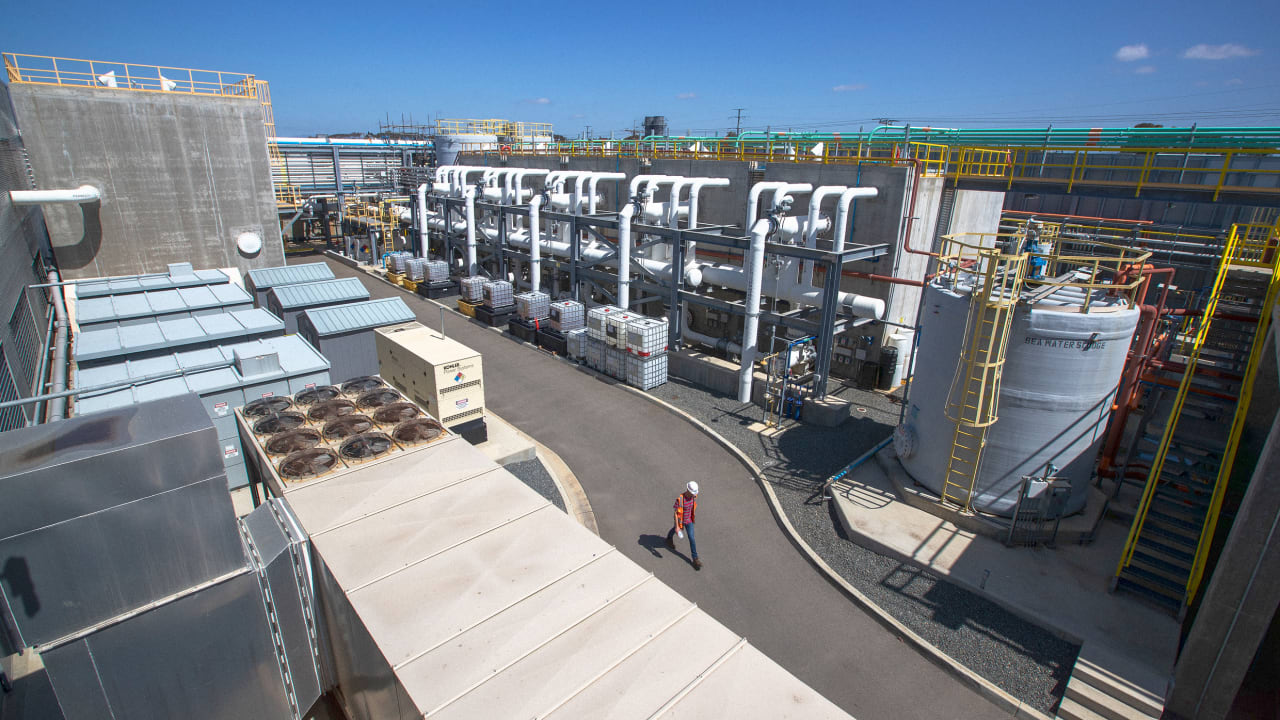
The security of the Persian Gulf is traditionally viewed through the lens of hydrocarbon transit, yet the region’s most critical vulnerability is not the flow of oil outward, but the flow of potable water inward. For the Gulf Cooperation Council (GCC) states, desalination provides between 70% and 90% of all municipal water requirements. This dependence transforms industrial water infrastructure into a high-leverage target in any kinetic escalation involving Iran. The operational reality of these facilities creates a structural asymmetry: while an aggressor can disrupt a nation’s entire survival matrix with a few well-placed strikes, the target nation possesses almost no margin for error or recovery time.
The Mechanized Hydrological Trap
The Persian Gulf is a shallow, semi-enclosed sea with high evaporation rates and limited freshwater inflow. This creates a high-salinity environment that complicates the desalination process. Modern plants primarily utilize two technologies: Multi-Stage Flash (MSF) distillation and Sea Water Reverse Osmosis (SWRO). Each possesses a distinct vulnerability profile during wartime.
MSF plants rely on thermal energy, often co-located with power generation. These are massive, identifiable heat signatures that are difficult to harden against precision-guided munitions. SWRO plants are more energy-efficient but rely on sensitive membrane technology. In a conflict scenario, the "weaponization of the environment"—such as intentional oil spills or chemical releases—can clog these membranes instantly, rendering the plant useless without a single shot being fired directly at the facility.
The fragility of this system is defined by the Time-to-Failure Constant. Most GCC states maintain only 3 to 5 days of strategic water reserves in storage tanks or aquifers. If a coordinated strike disables the primary desalination hubs in Jubail (Saudi Arabia) or Jebel Ali (UAE), the countdown to a humanitarian and administrative collapse begins within 72 hours.
Asymmetric Escalation and the Geography of Risk
Iran’s strategic depth and geography provide it with a "first-mover" advantage in water-sector warfare. Most of the major desalination plants on the Arabian Peninsula are situated on the coast, within range of short-to-medium-range ballistic missiles (SRBMs), cruise missiles, and unmanned aerial vehicles (UAVs) launched from Iranian territory or by proxy actors in Yemen and Iraq.
The Targeting Hierarchy for an adversary seeking to paralyze a Gulf state follows a specific logical sequence:
- Intake Infrastructure: Destroying the massive submerged pipes that draw in seawater is the most efficient way to halt production with minimal explosive force.
- Brine Discharge Control: Disrupting the outflow systems causes localized salinity spikes that can trigger automatic plant shutdowns to prevent hardware erosion.
- Power Interdependency: Since desalination is energy-intensive, targeting the electrical grid or the dedicated gas turbines at co-generation plants achieves the same result as hitting the water units themselves.
This creates a scenario where defensive systems, such as Patriot or THAAD batteries, must maintain a near-perfect interception rate. In a saturation attack, the probability of a single "leaker" hitting a critical valve or pump house is statistically high. The cost of a single interceptor missile (approximately $3 million to $4 million) compared to the cost of a suicide drone ($20,000 to $50,000) creates an unsustainable economic attrition model for the defender.
The Economic Cost Function of Water Disruption
A disruption in water supply does not merely affect residential consumption; it halts the entire industrial and service economy. The Cascading Failure Model illustrates how water scarcity translates into immediate economic contraction:
- Industrial Cooling: Petrochemical and manufacturing sectors rely on water for cooling. Without it, these plants must flare off or shut down, causing billions in lost revenue.
- Logistics and Labor: A city without water becomes uninhabitable within days. Mass exodus of the expatriate workforce—which makes up the majority of the private sector in several Gulf states—would lead to a total cessation of commercial activity.
- Desalination Recovery Lag: Unlike a power line that can be repaired in hours, a thermal desalination unit damaged by fire or explosion requires specialized components and months of lead time for reconstruction.
The structural dependence on these plants means that "Water Security" is synonymous with "Regime Stability." An adversary does not need to invade or occupy territory; they only need to sustain a blockade or a series of intermittent strikes on water infrastructure to force a total diplomatic capitulation.
Mitigation Limitations and Strategic Realities
Efforts to de-risk this infrastructure face significant engineering and geological hurdles. While many states are investing in solar-powered desalination and large-scale aquifer storage and recovery (ASR), these are long-term projects with current capacities that cannot yet replace the daily output of the mega-plants.
The second limitation is the Salinity Feedback Loop. In the event of an oil spill—whether accidental or intentional—the chemical composition of the Gulf changes. Conventional pre-treatment systems in desalination plants are not designed to handle heavy hydrocarbons at scale. A massive spill in the Strait of Hormuz would not only stop tankers; it would effectively "poison the well" for every desalination plant downstream, creating a self-sustaining ecological weapon.
The Strategic Shift to Decentralized Resilience
To counter this vulnerability, the operational doctrine must shift from Massive Centralization to Modular Redundancy.
- Distributed SWRO Units: Instead of a single plant producing 500 million gallons per day, states must deploy dozens of smaller, geographically dispersed units. This forces an adversary to spread their munitions across more targets, reducing the impact of any single successful strike.
- Hardened Sub-Surface Intakes: Moving seawater intakes beneath the seabed provides a natural filter against oil spills and protects the infrastructure from surface-level sabotage or kinetic impact.
- Cross-Border Water Grids: The development of a unified GCC water grid would allow states to "wheel" water to a stricken neighbor, much like electrical power. However, the sheer volume of water required for modern cities makes the physical transport of water via pipeline over long distances energetically and economically expensive.
The geopolitical tension between Iran and the GCC has moved past the era where "closing the Strait" was the only credible threat. The new flashpoint is the chemical and physical integrity of the desalination process. Control over the region now rests on the ability to protect the industrial mechanisms that turn salt water into life.
The strategic play for Gulf nations is clear: aggressive investment in decentralized, membrane-based systems powered by off-grid renewable energy, coupled with a massive expansion of underground strategic reserves. Without at least 30 days of stored water capacity, any defense strategy remains a fragile gamble against the physics of a 72-hour survival window.