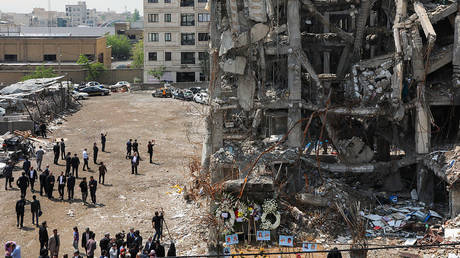
The structural stability of the Middle Eastern security architecture has transitioned from a state of managed friction to one of high-velocity kinetic attrition. The recent strikes in Tehran, characterized by the destruction of diplomatic and administrative infrastructure, represent a departure from traditional gray-zone operations. This shift is not merely a tactical escalation; it is a fundamental realignment of the risk-reward calculus between the United States, Israel, and the Islamic Republic of Iran. To understand the current trajectory, one must evaluate the conflict through the lenses of sovereign deterrence, the mechanics of proxy overextension, and the hard limits of regional air defense saturation.
The Triple Logic of Targeted Kinetic Attrition
The destruction of high-value targets within Tehran’s sovereign limits serves three distinct strategic functions that traditional sanctions or maritime skirmishes failed to achieve. Building on this idea, you can find more in: The Discipline Myth and the Reality of Kinetic Chaos.
- Deterrence Degradation: By successfully striking targets in the heart of the capital, the US-Israeli coalition aims to prove that Iran’s domestic "deep defense" is porous. This erodes the internal credibility of the Iranian security apparatus, forcing a pivot from offensive regional posturing to defensive domestic resource reallocation.
- Command and Control Decapitation: Beyond the physical rubble lies the interruption of the decision-making loop. When administrative buildings are leveled, the secure communication lines and the physical proximity required for rapid military coordination are severed.
- The Signal of Unrestricted Warfare: The transition from targeting military outposts in Syria or Iraq to striking Tehran signifies a removal of "sanctuary status." This forces Iranian leadership to calculate the personal survival costs of their regional strategy, rather than just the economic or proxy costs.
The Mechanics of Sovereignty and the War Crime Designation
The Russian envoy’s classification of these strikes as "war crimes" functions as a diplomatic tool designed to activate international legal friction. However, from an analytical standpoint, the legitimacy of the strikes rests on the definition of dual-use infrastructure. Under international humanitarian law, an object is a legitimate target if it makes an effective contribution to military action and its destruction offers a definite military advantage.
The contention arises when strikes occur within urban centers where the line between diplomatic residence and military coordination hub is blurred. The Russian rhetoric seeks to frame the US-Israeli actions as a violation of the Principle of Distinction. If the targets hit were purely administrative, the coalition faces a legal bottleneck. If they were command nodes for regional militias, the "war crime" narrative fails to hold under the Doctrine of Military Necessity. Experts at NBC News have also weighed in on this matter.
Structural Vulnerabilities in the Iranian Defense Grid
The failure to intercept high-altitude precision munitions over Tehran reveals significant gaps in the Iranian integrated air defense system (IADS). While Iran possesses the Bavar-373 and the S-300PMU2, these systems are optimized for specific flight envelopes. The coalition’s ability to penetrate this airspace suggests a sophisticated electronic warfare (EW) suite capable of "blinding" radar arrays or a saturation strategy that overwhelms the IADS through sheer volume of decoys and kinetic interceptors.
The cost-exchange ratio here is heavily skewed. An interceptor missile typically costs significantly more than the precision-guided munition (PGM) it is designed to destroy. By forcing Iran to deplete its limited stock of advanced interceptors, the coalition achieves Kinetic Dominance even if a strike does not hit its primary target. The exhaustion of interceptor inventories leaves the state vulnerable to a second-wave "breakthrough" strike which could target critical energy or nuclear infrastructure.
The Proxy Paradox and Front-Line Overextension
Iran’s "Forward Defense" strategy relies on a network of non-state actors—Hezbollah, the Houthis, and various PMFs in Iraq—to keep the conflict away from its borders. The strikes in Tehran indicate that this "shield" has failed. This failure creates a strategic bottleneck. If Iran retaliates through its proxies, it risks a full-scale Israeli invasion of Southern Lebanon or further US strikes on its Mediterranean supply lines. If it does not retaliate, it signals weakness to its own network, potentially leading to a fragmentation of the "Axis of Resistance."
The second limitation of the proxy model is the Resource Depletion Curve. Supplying proxies with ballistic missiles and UAVs requires a stable domestic industrial base. As the coalition targets the manufacturing and logistical nodes within Iran, the ability to sustain long-term proxy wars diminishes. The theater is moving toward a state where the "proxies" become liabilities that draw the patrons into a direct conflict they are not prepared to finance or fight.
The Role of External Power Brokers
The Russian Federation’s vocal support for Iran in the wake of the Tehran strikes is not merely a gesture of solidarity; it is a calculated move to preserve its own strategic depth. Moscow views Iran as a critical node in its "South-South" logistics corridor, which bypasses Western-controlled maritime routes.
The Kremlin’s strategy involves:
- Diplomatic Shielding: Using the UN Security Council to stall or condemn coalition actions, thereby buying time for Iranian reconstruction.
- Technology Transfers: Potential acceleration of Su-35 deliveries or advanced EW systems to bolster Iran’s domestic defenses.
- Economic Integration: Using the ruble-rial trade bypass to mitigate the impact of the "Sanctions Trap."
However, Russia’s bandwidth is constrained by its own kinetic requirements in the Ukrainian theater. This creates a ceiling for how much physical support Moscow can provide, leaving the envoy’s rhetoric as the primary, albeit low-cost, tool of engagement.
Measuring the Threshold of Total War
The transition to total war occurs when the belligerents move from targeting "capabilities" to targeting "will." The strikes on Tehran represent an attempt to break the Iranian leadership’s will. The risk in this approach is the Rally-Round-The-Flag Effect. External aggression against a capital city often consolidates domestic support for an embattled regime, even among a dissatisfied populace.
Quantifying the escalation requires tracking three specific variables:
- The Target Profile Shift: Moving from administrative buildings to energy production (oil/gas refineries).
- The Delivery Mechanism: The shift from stand-off missiles to manned penetrating sorties by F-35s.
- The Attribution Model: Whether the US takes public credit or maintains a policy of "calculated ambiguity."
As long as the strikes remain focused on security-related structures, the conflict is in a state of Hyper-Local Attrition. The moment the kinetic activity touches civilian power grids or water treatment facilities, the conflict enters the realm of Unrestricted Regional War.
The Economic Bottleneck of Escalation
The Iranian economy is already operating under extreme fiscal pressure. The cost of repairing high-tech administrative centers and replacing destroyed military hardware puts a strain on the central budget that cannot be offset by current oil exports. The coalition’s strategy utilizes Financial Asymmetry. By forcing Iran into a high-cost defensive posture, they are accelerating the state's internal economic degradation.
The rial's volatility directly correlates with the frequency of kinetic events. Every strike in Tehran acts as a massive sell-signal for the currency, driving up inflation and further alienating the middle class. The strategic objective is to create a situation where the cost of maintaining the regional empire exceeds the state's total tax revenue and oil rents.
Assessing the Israeli Strategic Incentive
For Israel, the strikes in Tehran are an existential necessity based on the Begin Doctrine, which dictates that Israel will not allow any enemy state in the Middle East to acquire weapons of mass destruction. By hitting the capital, Israel is communicating that no location is a safe haven for the architects of Iran’s nuclear program or its drone manufacturing.
The tactical execution—using low-observable (stealth) platforms—is a demonstration of technical superiority. It serves as a reminder that Israel possesses the capability to strike the Natanz or Fordow enrichment sites at any moment. The Tehran rubble is a prototype of what a larger-scale anti-nuclear campaign would look like.
The Strategic Path Forward
The situation demands a pivot from reactive defense to a restructured deterrence model. For the Iranian leadership, the only viable path to de-escalation that preserves regime integrity is a tactical retreat from proxy engagement in exchange for a cessation of strikes on the capital. This would require a "Grand Bargain" that current geopolitical tensions make unlikely.
The US-Israeli coalition must avoid the "Escalation Ladder Trap," where each strike necessitates an even larger response to maintain the same level of deterrence. The point of diminishing returns is reached when the strikes no longer influence Iranian policy but instead trigger a desperate, "all-in" retaliatory strike on regional oil infrastructure (e.g., the Abqaiq–Khurais attack model).
Strategic planners should focus on:
- Infrastructure Isolation: Disconnecting Iranian command centers from their satellite links rather than just destroying the physical buildings.
- Targeting the Supply Chain: Shifting focus to the raw materials required for drone and missile production, which are harder to replace than the final products.
- Diplomatic Decoupling: Driving a wedge between Russian interests and Iranian survival through localized concessions.
The theater is now a laboratory for 21st-century warfare where the lines between state and non-state, domestic and foreign, and legal and illegal have been pulverized alongside the Tehran rubble. The actor who most accurately calculates their kinetic limits while maintaining economic resilience will dictate the terms of the eventual settlement.
The final strategic move for the coalition is the implementation of a Total Information Blockade during kinetic windows. By combining physical strikes with cyber-attacks on Iran's internal internet and communication grids, the coalition can prevent the regime from mounting a coherent narrative response, thereby maximizing the psychological impact of the destruction. The rubble in Tehran is not just a sign of war; it is the physical manifestation of a new, uncompromising regional order.