The shift of Chinese orbital launch operations into the international waters of the South China Sea represents a calculated optimization of orbital mechanics, maritime logistics, and geopolitical posturing. This is not a symbolic gesture; it is a move to solve the persistent "drop zone" bottleneck of inland spaceports while maximizing payload capacity through latitude-dependent velocity gains. By utilizing mobile sea platforms, the China National Space Administration (CNSA) and private entities like Orienspace are transitioning from a fixed-infrastructure model to a dynamic, distributed launch network.
The Physics of Equatorial Advantage
The primary driver for sea-based launches is the Earth’s rotational velocity. A rocket’s efficiency is fundamentally tied to its launch latitude. At the equator, the Earth rotates at approximately 1,670 kilometers per hour. Launching from a platform at lower latitudes allows a vehicle to "borrow" this tangential velocity, directly reducing the Delta-v (change in velocity) required to reach orbit.
- Payload Maximization: For a Long March 11 or a Smart Dragon 3, moving the launch site from the Taiyuan Satellite Launch Center (38°N) to a platform at 5°N can increase the effective payload capacity to Low Earth Orbit (LEO) by 10% to 15% without altering the rocket’s propulsion system.
- Inclination Flexibility: Launching from international waters allows for a wider range of orbital inclinations. Fixed land sites are often restricted by "launch corridors" designed to avoid overflying populated areas or sensitive foreign territories. In the South China Sea, a mobile platform can be positioned to achieve polar, sun-synchronous, or equatorial orbits with minimal maneuvering after stage separation.
Solving the Inland Debris Constraint
China's legacy spaceports—Jiuquan, Taiyuan, and Xichang—are located deep inland for Cold War-era security reasons. This geography creates a severe operational hazard: spent rocket stages and fairings frequently fall near inhabited villages.
The transition to the South China Sea replaces terrestrial risk with maritime vastness. When a rocket is launched from a converted barge or a purpose-built launch vessel (like the Bo Run Jiu Zhou), the spent first stage and boosters fall into designated, uninhabited ocean zones. This eliminates the need for expensive and complex evacuation protocols for inland residents and reduces the liability profile of high-frequency commercial launches.
The Three Pillars of Sea Launch Infrastructure
Successful maritime orbital insertion relies on a triad of specialized components that must function in a synchronized, high-stakes environment.
1. The Mobile Launch Platform (MLP)
Unlike the decommissioned "Sea Launch" platform (Odyssey), which was a modified oil rig, the current Chinese strategy utilizes heavy-lift vessels and specialized flat-deck barges. These platforms must be engineered for:
- Acoustic Suppression: Managing the massive sound pressure levels (SPL) that reflect off the deck and can damage the satellite payload.
- Thermal Management: Dissipating the extreme heat of the engine exhaust to prevent deck warping.
- Dynamic Positioning: Utilizing GPS-linked thrusters to maintain a precise heading and coordinate, often within centimeters, despite wave action.
2. The Integrated Support Fleet
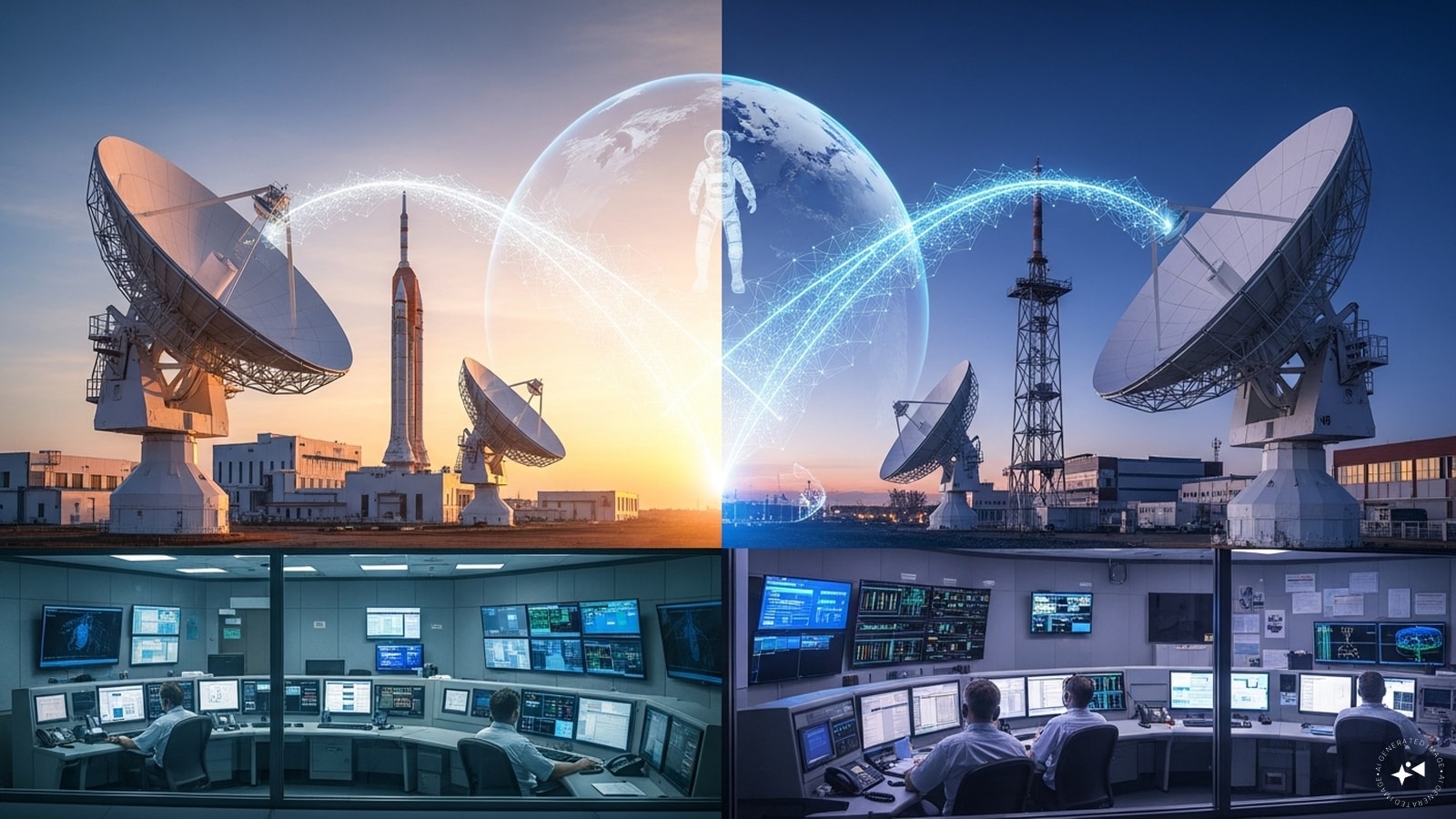
A sea launch is a naval operation. The MLP is supported by command-and-control vessels that handle telemetry, weather monitoring, and safety cordons. The communication latency between the platform and the mission control center in Haiyang (the "Eastern Aerospace Port") must be near-zero, necessitating dedicated satellite links to the Tianlian relay constellation.
3. Vertical Integration and Logistics
The rockets are often assembled in land-based "Space Cities" (like the one in Shandong Province) and rolled directly onto the ships. This "ship-to-space" pipeline reduces the vibration and environmental stress associated with long-distance rail transport to inland sites.
Strategic Cost Functions and Economic Logic
The economics of sea launches are governed by the trade-off between increased maritime operational costs and the reduction in land-based infrastructure maintenance and liability.
$C_{total} = C_{vessel} + C_{security} + C_{logistics} - (B_{payload} + L_{liability})$
In this equation:
- $C_{vessel}$ represents the high daily charter rate for specialized ships.
- $B_{payload}$ is the revenue gain from launching heavier satellites on the same vehicle.
- $L_{liability}$ is the saved cost of land-based debris mitigation.
The proliferation of "Mega-constellations" (similar to Starlink) requires a high cadence of launches. When the frequency exceeds 20 launches per year, the efficiency of sea-based operations begins to outperform fixed land sites. The South China Sea provides a unique environment where the water is deep enough for acoustic dampening but the logistics chain from coastal manufacturing hubs remains short.
Geopolitical Friction and Navigational Law
Launching from international waters introduces complex legal variables under the United Nations Convention on the Law of the Sea (UNCLOS). While the "Freedom of the Seas" doctrine allows for peaceful activities, the establishment of "Temporary Danger Areas" (TDAs) for rocket launches effectively closes off large swaths of international shipping lanes.
- The Cordon Conflict: By declaring a launch zone in contested waters, a nation can de facto control surface and air traffic under the guise of safety. This creates a "gray zone" where aerospace activity overlaps with maritime territorial claims.
- The Proximity Risk: International waters are populated by surveillance vessels and foreign navies. A sea-based launch platform is a vulnerable asset that requires a significant security perimeter, potentially leading to standoffs with vessels attempting to monitor the launch telemetry or recover sensitive debris.
Technical Bottlenecks and Failure Modes
The maritime environment is inherently hostile to precision aerospace hardware. Saltwater corrosion, high humidity, and the "pendulum effect" of sea swells create significant risk factors.
The most critical bottleneck is the "Launch Window Volatility." On land, weather constraints are primarily atmospheric (wind shear, lightning). At sea, the mission must also account for sea state (wave height and frequency). If the MLP tilts beyond a specific fraction of a degree during the ignition sequence, the guidance system may fail to compensate, leading to a catastrophic loss of the vehicle.
Furthermore, the recovery of reusable stages at sea—a goal China is actively pursuing with the Long March 10 and 8 variants—requires even more sophisticated sea-keeping capabilities. Landing a 50-meter-tall booster on a swaying deck in the South China Sea is an order of magnitude more difficult than a land-based touchdown.
Operational Forecast
The tactical move to the South China Sea is a precursor to a permanent, offshore launch capacity. Expect the deployment of semi-submersible platforms that can ballast down during a launch to increase stability, effectively mimicking a land-based pad while retaining mobility.
The logic of orbital mechanics dictates that as the global satellite market moves toward heavier, high-throughput satellites, the demand for low-latitude launches will become the dominant market force. China’s integration of its maritime industry with its aerospace sector suggests a move toward a "floating spaceport" model that can transit between the South China Sea for equatorial missions and the Yellow Sea for sun-synchronous orbits.
The strategic play is to decouple the space program from the geography of the Chinese mainland. By mastering sea launches, the CNSA gains a "sovereign-free" launch capability that can be positioned anywhere in the global commons, fundamentally altering the speed and scale of orbital deployment.