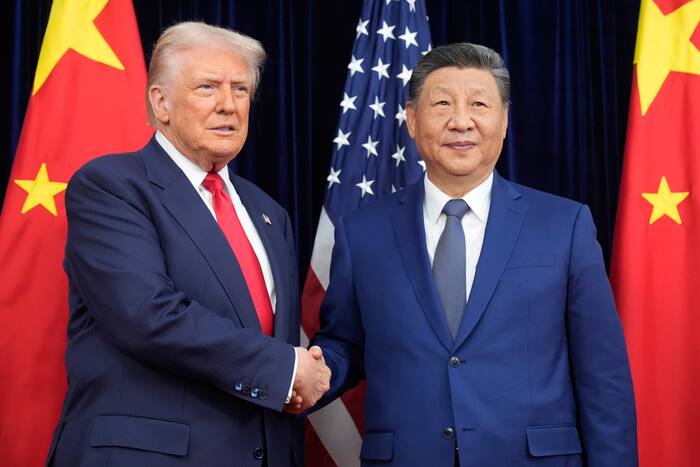
When Xi Jinping and Donald Trump meet for a third bilateral engagement at an Asia-Pacific Economic Cooperation (APEC) summit, Taiwan will not disappear from the strategic equation; rather, both leaders have structural incentives to subordinate it to immediate, transactional deliverables. Standard diplomatic commentary frames any omission or de-escalation of the Taiwan question as a concession or a shift in baseline policy. That reading misunderstands how great-power summitry functions under conditions of acute economic interdependence and domestic political pressure. In multilateral economic forums, bilateral leaders optimize for visible, near-term wins that satisfy domestic constituencies while deferring zero-sum territorial disputes that carry asymmetric escalation risks.
The Structural Constraints of APEC Summitry
An APEC leaders' meeting is fundamentally an economic forum, not a security alliance or a crisis-management mechanism. Its institutional architecture—built around trade facilitation, supply chain resilience, and regulatory alignment—dictates the agenda-setting calculus for participating heads of state. When Washington and Beijing prepare for a high-stakes bilateral on the margins of APEC, their diplomatic teams filter issues through a strict feasibility matrix.
- Forum Alignment: Issues tied to tariffs, market access, agricultural purchases, and industrial subsidies fit naturally within the APEC mandate. Raising kinetic security flashpoints disrupts the broader multilateral consensus that host nations work months to engineer.
- Time Compression: Bilateral pull-asides at multilateral summits rarely exceed two to three hours, inclusive of translation. Complex sovereignty disputes cannot be resolved in compressed timeframes; they can only be managed through pre-negotiated guardrails.
- Optics and Domestic Consumption: Both leaders require tangible takeaways for domestic audiences. Trade adjustments, fentanyl precursor enforcement metrics, or aviation route restorations offer measurable political capital. A deadlock over Taiwan produces only headlines of diplomatic friction.
This institutional design creates a natural selection bias. Topics capable of yielding incremental, verifiable progress rise to the top of the briefing book, while structural deadlocks are parked in lower-level working groups.
Asymmetric Cost Functions in Washington and Beijing
To understand why neither side benefits from making Taiwan the centerpiece of a third Xi-Trump summit, examine the distinct cost functions governing each administration.
Beijing's Economic Stabilization Imperative
China's leadership enters such engagements managing persistent structural headwinds: sluggish domestic consumption, local government debt overhangs, and overcapacity in manufacturing sectors seeking external absorption. For Xi Jinping, external stability with the United States is a prerequisite for executing internal economic restructuring.
- Tariff Exposure: Broad-based U.S. tariffs directly compress margins for Chinese exporters and accelerate supply chain diversification into Southeast Asia and Mexico.
- Technology Chokepoints: Export controls on advanced semiconductors and lithography equipment constrain Beijing's industrial upgrading timelines.
- Capital Flight Risk: Geopolitical escalation in the Taiwan Strait triggers immediate risk-off behavior among foreign institutional investors, complicating efforts to stabilize the renminbi and attract foreign direct investment.
Escalating rhetoric over Taiwan during a summit with Trump increases the probability of punitive economic countermeasures. Beijing's rational play is to reiterate its standard boilerplate on sovereignty—satisfying domestic nationalist expectations—without allowing the issue to derail negotiations over tariff relief or technology restrictions.
Washington's Transactional Leverage Model
Donald Trump's foreign policy operating system treats bilateral relationships primarily through the lens of trade balances, industrial reshoring, and deal-making leverage. Within this framework, security commitments are evaluated alongside economic reciprocity.
- The Trade Deficit Metric: Bilateral goods deficits remain the primary scorecard for evaluating U.S.-China relations. Securing binding commitments on energy, agriculture, or manufacturing investment provides an immediate, quantifiable victory.
- Allied Burden-Sharing: Trump has consistently signaled that regional partners, including Taipei, must assume greater financial responsibility for their own defense. This posture reduces the incentive to expend unilateral diplomatic capital on Taiwan during a leader-level meeting focused on U.S. commercial interests.
- Escalation Control: Provoking a crisis over Taiwan carries severe supply chain consequences for the U.S. technology sector, given Taiwan's dominance in sub-5-nanometer semiconductor fabrication. Avoiding an unforced confrontation preserves economic stability while negotiations over bilateral trade terms proceed.
The Three-Tier Agenda Hierarchy
When diplomatic sherpas construct the agenda for a third Xi-Trump meeting, issues sort into three operational tiers based on their probability of yielding an actionable agreement.
Tier One: Immediate Transactional Deliverables
These items involve reversible policy levers controlled directly by the executive branch. Examples include tariff rate adjustments, export license approvals, agricultural purchase quotas, and counternarcotics cooperation benchmarks. Both sides can verify compliance within quarters, making them ideal summit currency.
Tier Two: Guardrail and Crisis-Avoidance Mechanisms
This tier covers military-to-military communication channels, maritime incident protocols, and artificial intelligence safety dialogues. Neither side expects resolution of underlying strategic competition, but both recognize the mutual cost of accidental escalation. Agreement here consists of maintaining open hotlines rather than altering force postures.
Tier Three: Core Sovereignty and Ideological Disputes
Taiwan, South China Sea territorial claims, and human rights sit in this tier. Because Beijing views Taiwan as a non-negotiable core interest and Washington maintains strategic ambiguity backed by statutory commitments under the Taiwan Relations Act, no middle ground exists for a summit-level compromise. Any attempt to force movement in Tier Three immediately freezes progress in Tiers One and Two.
The Mechanism of Strategic Subordination
Subordinating Taiwan on the summit agenda does not equate to abandoning strategic objectives; it reflects a deliberate sequencing strategy. In game-theoretic terms, both leaders are playing a nested game where the bilateral economic track and the cross-strait security track interact asymmetrically.
If Washington pushes aggressively on Taiwan during the meeting, Beijing is forced by domestic political legitimacy requirements to respond with hardline counter-measures—suspending trade talks, halting counternarcotics cooperation, or initiating military exercises around the island. Conversely, if Washington keeps Taiwan within established diplomatic parameters—reaffirming existing policy without introducing new rhetorical provocations—it retains maximum leverage to extract economic concessions from Beijing.
Beijing executes the mirror image of this calculation. By refraining from demanding new U.S. concessions on Taiwan arms sales or diplomatic recognition as a precondition for economic dialogue, Xi preserves the negotiating space needed to address tariffs and sanctions. Taiwan is not ignored; it is held in reserve as a deterrence variable rather than deployed as a negotiating obstacle.
Limitations and Fragility of the Transactional Equilibrium
Relying on economic compartmentalization to manage a fundamental geopolitical rivalry carries inherent structural vulnerabilities. Analysts who mistake a quiet summit for a durable détente overlook three failure modes that can rapidly invert the agenda hierarchy.
- Exogenous Shocks in the Strait: A kinetic incident—such as a collision between coast guard vessels, an air defense identification zone incursion that triggers a defensive response, or domestic political shifts within Taiwan itself—can force the issue onto the table regardless of either leader's preference.
- Congressional and Institutional Pushback: In Washington, executive branch restraint on Taiwan frequently meets resistance from legislative hawks who control defense appropriations and arms sale notifications. Beijing often interprets congressional actions as coordinated executive policy, eroding the trust required to sustain Tier One trade deals.
- Asymmetric Compliance: Transactional agreements fail when one party perceives an imbalance in execution. If promised agricultural purchases stall or tariff relief is delayed, the aggrieved party may weaponize Tier Three issues to restore perceived leverage.
Operational Signals to Watch
To distinguish between substantive strategic realignment and temporary tactical restraint during the summit, observers should ignore boilerplate communiqués and track specific operational indicators:
- Joint Working Group Mandates: Look for the creation or elevation of deputy-level economic and financial working groups with fixed reporting timelines. Institutionalized follow-up indicates genuine prioritization of the economic track.
- Language on Cross-Strait Status: Compare the exact phrasing used in post-meeting readouts against prior bilateral statements. The absence of new red-line terminology from Beijing or new policy caveats from Washington confirms that both sides agreed to freeze the issue.
- Post-Summit Regulatory Actions: Watch for immediate, unilateral administrative moves within 30 days of the meeting—such as targeted tariff exclusions, adjustments to the Entity List, or changes in the cadence of Taiwan Strait transits by U.S. naval vessels.
The third meeting between Xi and Trump at APEC will function primarily as a bilateral clearinghouse for economic friction. Taiwan will remain the most dangerous structural fault line in the U.S.-China relationship, but precisely because its escalation costs are unacceptable to both economies, both leaders will treat it as a variable to be stabilized rather than a dispute to be litigated. Expect a disciplined focus on tariffs, market access, and commercial reciprocity, with the Taiwan question deliberately locked inside familiar diplomatic guardrails to ensure the economic deal-making proceeds uninterrupted.