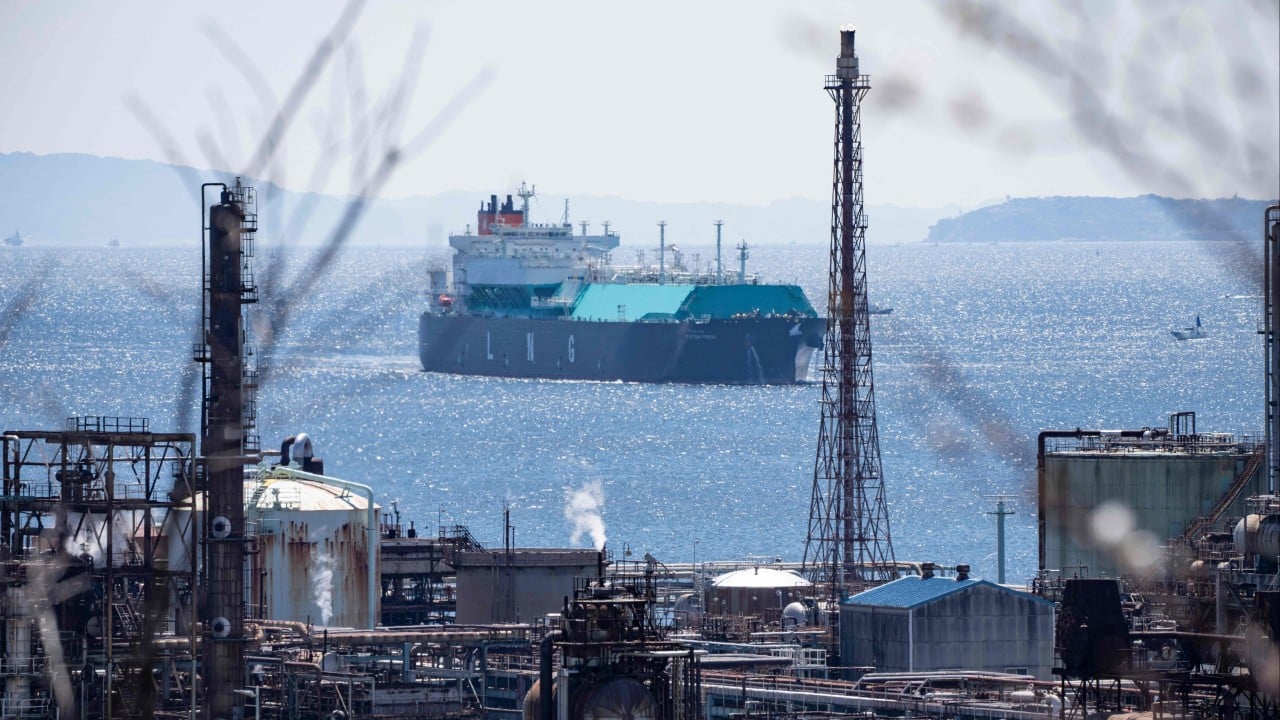
The global energy market is currently facing its most significant disruption since the 1973 oil embargo as the U.S. Navy enforces a blockade on the Strait of Hormuz. This narrow waterway, which carries roughly 21 million barrels of oil per day, is the primary artery for the world's most populous and industrial economies. China, India, Japan, and South Korea are now watching their strategic reserves dwindle while tankers remain idle under military escort. The immediate result is a decoupling of Asian industrial growth from the global energy supply chain, creating a crisis that goes far beyond simple price hikes at the pump.
The Physicality of the Chokepoint
Geopolitics often feels abstract until you look at a map of the Persian Gulf. The Strait is only 21 miles wide at its narrowest point. More importantly, the shipping lanes used by massive Very Large Crude Carriers (VLCCs) are only two miles wide in each direction. When the U.S. military decides to restrict traffic here, they aren't just making a political statement. They are physically turning off the faucet for roughly 20% of the world's total petroleum consumption.
For decades, the "Hormuz Dilemma" was a theoretical exercise for think tanks. Today, it is a logistical nightmare. Insurance premiums for maritime freight in the region have spiked by over 400% in a matter of weeks. Even if a tanker is cleared to pass, the cost of the voyage now exceeds the profit margin of the cargo for many independent refineries.
Why the Regional Alternatives are Failing
Many analysts point to pipelines across Saudi Arabia or the United Arab Emirates as the solution. This is a fundamental misunderstanding of the scale required to fuel the Asian continent. The East-West Pipeline in Saudi Arabia has a capacity of roughly 5 million barrels per day. The Abu Dhabi Crude Oil Pipeline adds another 1.5 million. Combined, these bypasses account for less than a third of what normally flows through the Strait.
They are buckets being used to empty a swimming pool. Furthermore, these pipelines terminate at ports that are themselves becoming bottlenecks. Red Sea terminals are already operating at 110% capacity, leading to week-long queues that further delay delivery to hungry markets in the East.
The Chinese Scramble for Inland Power
Beijing has spent the last decade preparing for this exact scenario, yet the speed of the blockade has caught them off guard. China's "String of Pearls" strategy and the Belt and Road Initiative were designed to create overland alternatives to maritime trade. The Power of Siberia 2 pipeline and Central Asian gas routes are operational, but they primarily move natural gas, not the heavy crude required for China’s massive petrochemical and manufacturing sectors.
Inland rail transport is the current fallback. We are seeing an unprecedented surge in crude-by-rail from Russian terminals and Kazakh fields. However, rail is notoriously inefficient compared to sea travel. One VLCC can carry 2 million barrels of oil. To move that same amount by train requires 2,000 tank cars. The sheer friction of this transition is causing massive inflationary pressure within the Chinese domestic market.
India and the Fragility of the Spot Market
India is perhaps in the most precarious position. Unlike China, India does not have a vast network of overland pipelines from friendly neighbors. New Delhi relies on the sea for nearly 85% of its oil needs. The Indian government has aggressively pursued discounted Russian oil over the past two years, but much of that oil is still transshipped through Western-controlled waters or requires passage through the very zones now under blockade.
The Indian manufacturing sector is already seeing power shedding in industrial hubs like Gujarat and Maharashtra. When the lights go out in a factory that produces 10% of the world's generic pharmaceuticals, the problem stops being an "energy crisis" and becomes a global supply chain collapse.
The Economic Ghost of 1973
History doesn't repeat, but it certainly rhymes. In 1973, the shift was about price. Today, the shift is about access. We are entering an era of "Energy Mercantilism." In this environment, the highest bidder doesn't always win. Instead, the winner is whoever has the military or diplomatic leverage to force a shipment through.
This has led to a bizarre secondary market. Dark fleets—tankers operating with transponders turned off and falsified registration—are attempting to run the blockade. These ships are often old, poorly maintained, and uninsured. The risk of a massive environmental disaster in the Gulf is at an all-time high, which would provide the justification for even stricter military intervention, a self-fulfilling prophecy of regional closure.
The Tech Sector’s Hidden Vulnerability
When we discuss oil, we often think of cars and heating. But the technology sector in Japan and South Korea is the silent victim of the Hormuz blockade. Semiconductor fabrication requires immense amounts of reliable, high-voltage power. The power grids in these nations are heavily dependent on Liquefied Natural Gas (LNG), much of which comes from Qatar through the Strait.
A "brownout" in a Samsung or TSMC facility isn't just a temporary pause. It can ruin entire batches of silicon wafers, leading to months of production delays. The blockade is effectively a tax on every smartphone, laptop, and EV battery produced in the next eighteen months.
A Systemic Failure of Globalism
The fundamental truth that this crisis reveals is the fragility of the "Just-in-Time" energy model. For thirty years, the world operated on the assumption that the seas would always be open and that a barrel of oil would always be available at a transparent market price. That era ended the moment the first carrier group took up a permanent blocking position.
What follows is a period of intense regionalization. Countries are no longer looking for the cheapest energy; they are looking for the energy they can physically protect. This means a massive, desperate pivot toward domestic coal in China and India, regardless of previous carbon-reduction commitments. It means Japan reconsidering its stance on nuclear power with a speed that seemed impossible five years ago.
The Strategic Miscalculation
The blockade was intended to exert pressure on specific regional actors, but the collateral damage is the entire Asian economic miracle. By cutting off the Strait, the U.S. is not just targeting its adversaries; it is strangling its own trading partners. The diplomatic rift between Washington and Tokyo or New Delhi is growing. These nations are beginning to realize that their economic survival is dependent on a security architecture they do not control and that does not necessarily prioritize their interests.
This realization is the catalyst for a new financial architecture. We are seeing a move away from the petrodollar in real-time. If the U.S. dollar is the currency of a system that blocks your energy supply, you find a new currency. China’s CIPS (Cross-Border Interbank Payment System) has seen a 30% increase in volume since the blockade began.
The Empty Tankers of the Future
If you stand on the shores of Oman today, you see a graveyard of trade. Hundreds of ships sit at anchor, their crews waiting for orders that may not come for months. The salt air corrodes the hulls while the global economy shifts beneath them. The blockade of the Strait of Hormuz is not a temporary flare-up. It is the definitive signal that the maritime-based global order is being replaced by a fragmented, fortified, and far more expensive reality.
The immediate action for any firm with exposure to Asian manufacturing is to price in a 25% increase in logistics costs for the next three fiscal quarters. This is not a volatility spike. It is the new floor. Supply chains that were built on the premise of free passage through the Middle East are now obsolete. Companies must identify tier-two and tier-three suppliers that operate outside this energy-dependent zone or prepare for a permanent reduction in output. The tap is closed, and the pressure is building toward a rupture that no amount of diplomacy can easily fix.