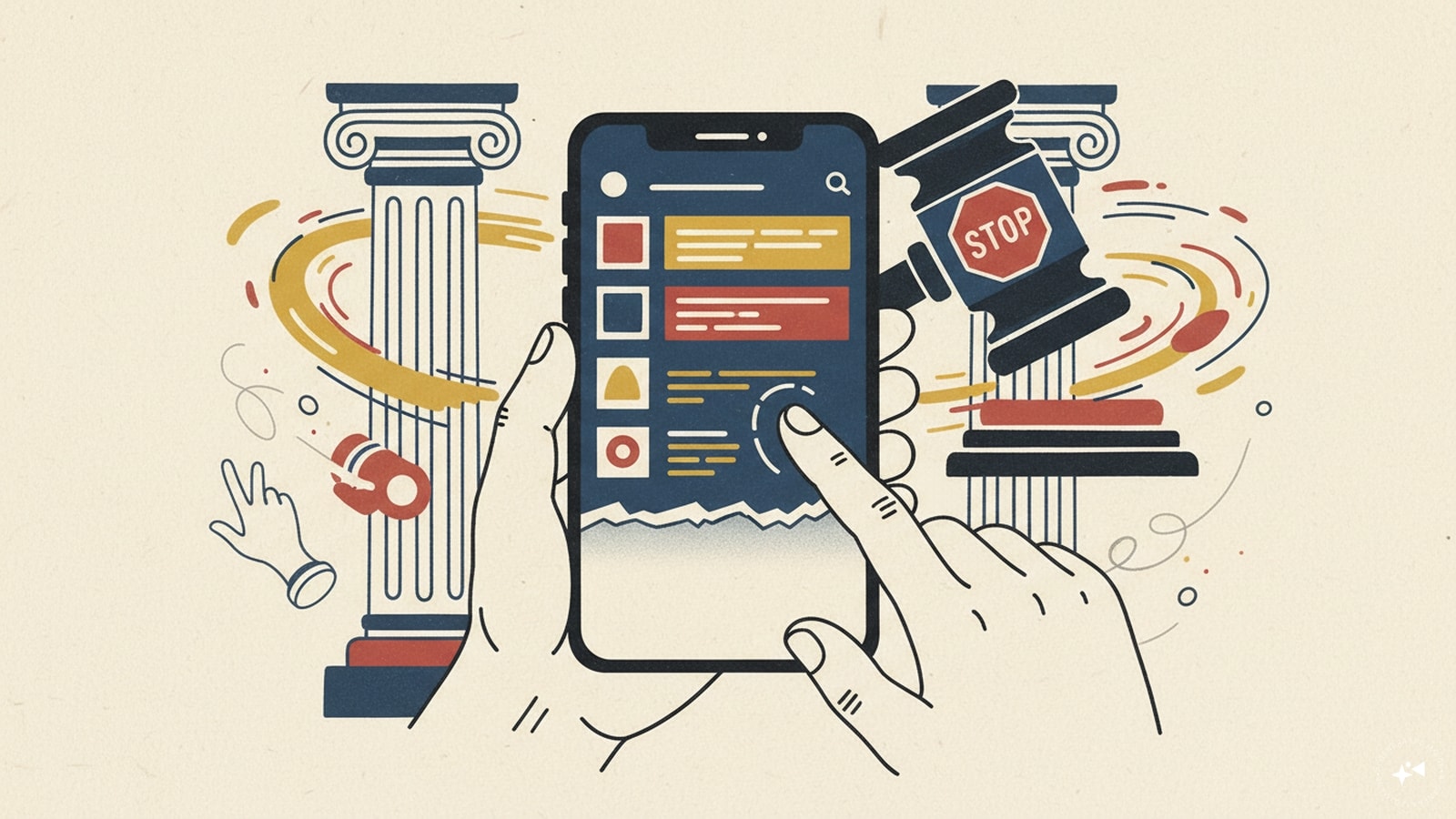
Every tech journalist in the country is currently hyperventilating over the sweeping litigation targeting Meta. The lazy consensus is predictable. Mainstream commentators treat every courtroom subpoena and state attorney general complaint as an existential reckoning that will rewrite how Instagram operates. They look at discovery documents, nod solemnly at allegations regarding youth mental health, and assume a judge is going to step in and surgically remove the features that keep billions of people hooked.
They are missing the plot entirely.
I have spent years watching executives panic over regulatory theater while the ground shifts beneath their feet. The lawsuits matter, sure. They generate headlines, rack up legal bills, and give politicians a stage. But treating courtroom drama as the primary threat to Instagram shows a fundamental misunderstanding of how platforms actually die. Regulation does not kill social media. Irrelevance does. And right now, Instagram is not being destroyed by a judge's gavel. It is being hollowed out from the inside by its own algorithmic desperation.
The Courtroom Distraction
Let us clear up the core delusion dominating the discourse. The premise behind the ongoing Meta litigation is that the platform is an irresistible, hyper-addictive trap that forces young users to scroll endlessly against their will, driven by predatory product design.
This argument relies on a deeply flawed view of human agency and product mechanics. Users do not stay on Instagram because Mark Zuckerberg installed a neurological override in their phones. They stay because, historically, that is where their friends posted photos.
Here is the dirty secret nobody in the legal briefs wants to admit. The addiction mechanics are already breaking down.
When I talk to founders and growth marketers who lived through the golden era of social acquisition, the mood is not fear. It is exhaustion. The public thinks Meta is an unstoppable monopoly holding users captive. I see a legacy utility desperately trying to mask the fact that organic reach for regular human beings hit zero years ago.
The lawsuits focus on what Instagram is. They should be focusing on what Instagram used to be and how far it has strayed. The platform is not a casino keeping people at the tables through brilliant engineering anymore. It is a broadcast network trying to masquerade as a community, spamming users with reels from strangers, sponsored posts, and AI-generated recommendations.
The Death of the Social Graph
To understand why the trial coverage is a massive waste of analytical bandwidth, you need to look at how the underlying architecture shifted.
Instagram used to run on a social graph. You followed your cousin, your college roommate, and your favorite indie coffee shop. What you saw was chronological. It was boring, human, and sticky.
Then TikTok happened.
Panicked by a competitor eating their lunch, Meta executives threw out the social graph and replaced it with an interest graph powered by a recommendation engine. They stopped showing you content from people you know and started showing you content an algorithm predicted would keep your eyeballs glued to the screen for four more seconds.
That single strategic pivot turned Instagram from a private photo album into an entertainment utility. But in doing so, they signed a death warrant for the core product.
When you prioritize engagement over connection, you invite every bot, growth hacker, and content farm on the planet to game your system. The feed is no longer a window into your social circle. It is a noisy digital billboard. Users figured this out long ago. Young demographics did not abandon Instagram because of a congressional hearing. They left because their parents joined, their feeds filled up with dropshipped junk, and sharing a photo of brunch felt like shouting into a shopping mall parking lot.
The courts are fighting yesterday's war. They are trying to regulate a social network that stopped being social half a decade ago.
Why the Remedies Will Backfire
Suppose the plaintiffs win. Imagine a scenario where a judge orders Meta to disable specific engagement loops, restrict infinite scroll, or alter how feeds are sorted for minors.
The tech press will pop champagne. Activists will declare victory.
And it will change absolutely nothing of substance, because the platform has already pivoted to survive. Meta has spent billions positioning itself for the artificial intelligence era. They are shifting infrastructure toward AI-generated feeds, messaging integration, and automated content creation. If traditional engagement metrics take a hit from a court order, they will simply accelerate their transition into an algorithmic utility powered by machine learning models rather than human-to-human sharing.
Furthermore, over-regulating the incumbent often secures its monopoly. Compliance costs are cheap for a trillion-dollar balance sheet. They are lethal to startups. Every heavy-handed mandate judges try to impose on Meta acts as a moat, raising the barrier to entry so high that no garage-born competitor can ever scale to challenge them.
When you cheer for sweeping legal interventions, you are not punishing the tech giant. You are helping them lock out future innovators who might actually build something better.
The Real Threat No One Is Discussing
If you want to know what actually threatens Instagram, stop reading legal analysis and look at user behavior.
The shift is toward dark social, private spaces, and intentional communication. People are retreating to group chats on WhatsApp, private channels on Discord, and closed communities where algorithms cannot track every micro-expression or monetize every second of attention. Public broadcasting of personal lives is deeply out of style.
Instagram's leadership knows this. That is why they tried to clone every feature from every competitor, transforming the app into a Frankenstein's monster of stories, short-form video, broadcast channels, and text updates. They are throwing products against the wall because they can no longer rely on the core engine of organic human connection.
The tragedy of the platform is not that it is too powerful. It is that it has become too corporate to care about what made it great in the first place.
What Comes After the Feed
We are witnessing the slow-motion collapse of the attention-extraction business model. When every platform uses the exact same recommendation engine to serve the exact same recycled video content, the product loses its identity.
The smart money is already looking past the current crop of centralized social media. Decentralized protocols, encrypted communities, and creator-owned platforms are quietly building the infrastructure for the next decade. They are not waiting for a federal judge to save them from Mark Zuckerberg. They are simply rendering him obsolete.
The trial is a spectacle. Let the lawyers argue about dopamine loops and algorithmic design. The real story is happening outside the courtroom, where users are quietly closing the app and logging off for good.
Delete your expectations of a regulatory savior. The market is already doing the job for them.

_1617603374686.jpg)