Brussels is sweating through another record-breaking summer, and the panic in the corridors of power has nothing to do with the thermostat. It has everything to do with the labels on the back of the millions of air conditioning units humming on windowsills from Berlin to Milan.
The mainstream press is flooded with hand-wringing commentary about how Europe’s sudden rush for Chinese cooling equipment exposes a dangerous flaw in the European Union’s trade policy. The current narrative insists that a surge in imports—up over 40 percent year-on-year—is a failure of "de-risking." Bureaucrats argue that Beijing is aggressively dumping underpriced appliances to suffocate local industry, and that Brussels must respond with a mix of punitive duties, stricter environmental mandates, and a rushed "Made in Europe" manufacturing campaign.
This analysis is completely wrong. It misinterprets a triumph of localized engineering and basic consumer survival as a regulatory oversight.
The run on Chinese air conditioners does not expose a gap in trade policy. It exposes the utter delusion of European economic strategy. Brussels thinks it can legislate an industrial base into existence via decree while actively choking its citizens with red tape, exorbitant energy costs, and protectionist walls.
You cannot fix structural industrial decay with a tariff. If European leaders attempt to block these imports under the guise of strategic autonomy, they will not build any new factories. They will simply give their own population heatstroke.
The Delusion of Regulatory Protectionism
For years, the European market was an afterthought for global cooling manufacturers. Mild summers, strict historical architectural preservation rules, and an administrative labyrinth made installing a traditional split-system air conditioner almost impossible for the average renter or homeowner.
To put a standard compressor on an exterior wall in France or Germany, a resident typically requires municipal approval, landlord permission, a certified technician to handle fluorinated gases, and structural guarantees that noise levels will stay below 35 decibels at night. For 80 percent of European households, the sheer friction of the process meant choosing to sweat.
Then came the climate shift. When consecutive heatwaves turned uninsulated European apartments into brick ovens, demand exploded. Local legacy brands, which had spent decades prioritizing shareholder dividends and stock buybacks over actual capital expenditure, had nothing to offer. They were still treating cooling as a niche luxury.
Chinese manufacturers did not win this market by undercutting European rivals on price alone. They won it because they actually bothered to understand the absurdity of European housing laws.
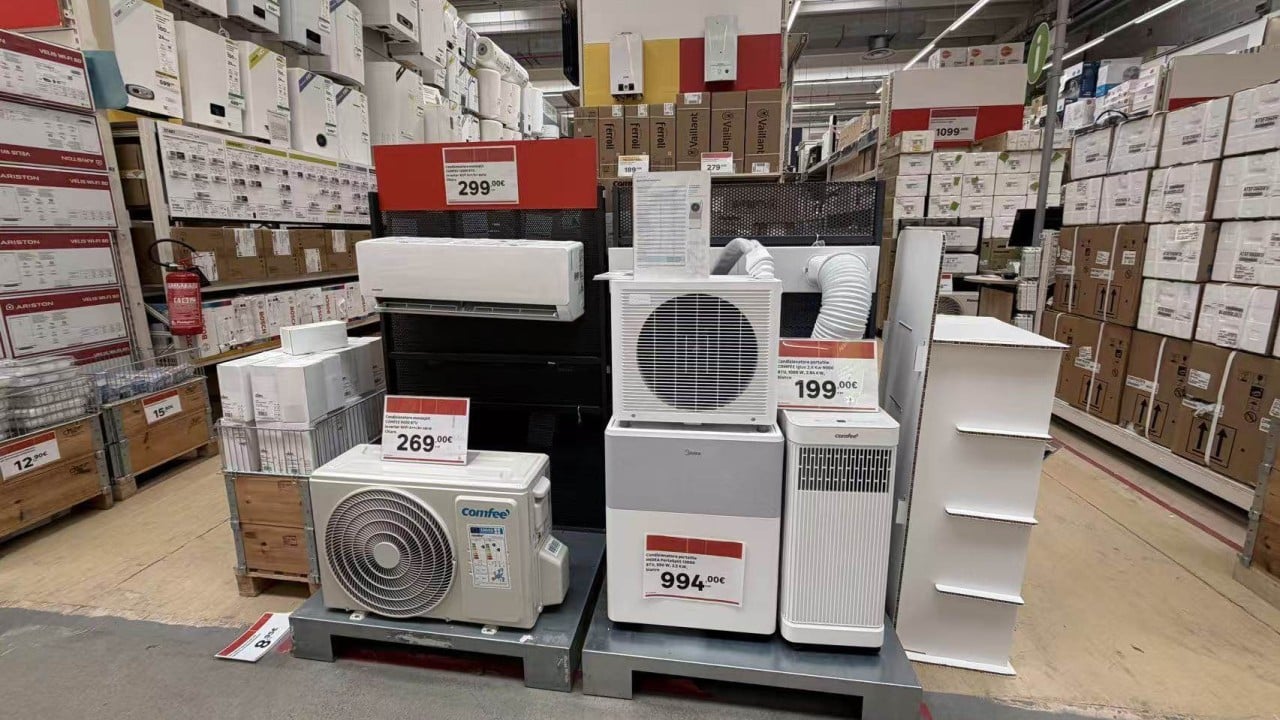
Consider the mechanics of recent product designs hitting the market, such as specialized portable split units that require zero wall drilling. Manufacturers engineered systems where the internal and external components connect via a flat ribbon cable thin enough to fit through a standard closed window frame. They precisely calibrated the weight to sit right under regulatory inspection thresholds, and limited the acoustic output to exactly match the stricter night-time noise caps enforced in Northern Europe.
This is not predatory pricing. It is hyper-targeted product development. I have watched European legacy industrial firms spend millions on corporate restructuring and lobbying seminars while foreign competitors spent that same capital on localized R&D centers in Stuttgart and Milan. The market did not get stolen; it was surrendered.
The F-Gas Regulation Trap
Instead of matching this industrial agility, Brussels is relying on its favorite weapon: the rulebook. The latest iteration of the EU’s Fluorinated Greenhouse Gas Regulation dictates that by next year, small air conditioning units and heat pumps must transition to refrigerants with a Global Warming Potential of less than 150.
On paper, this sounds like a victory for environmental stewardship. In reality, it is a desperate, thinly veiled trade barrier disguised as a green initiative. The vast majority of highly efficient, mass-produced cooling units currently keeping Europeans alive use R32 refrigerant, which possesses a much higher environmental footprint index. By abruptly moving the goalposts, European policymakers hope to lock out foreign supply chains and buy time for domestic companies to catch up.
This strategy will backfire catastrophically.
[Current Market Reality] -> High Demand + Affordability -> Chinese R32 Units
                                     │
                        (EU Regulatory Intervention)
                                     ▼
[2027 Ban Mandate]       -> Supply Collapse + 300% Secondary Market Premiums
When you ban the dominant product in a supply-constrained market without a viable domestic alternative, you do not stimulate local production. You stimulate a black market. In Germany, secondary markets have already seen portable cooling units resold at a 300 percent premium during peak heatwaves. Forcing an overnight upgrade to specialized, low-GWP refrigerants will double production costs across the board, pricing lower-income households out of climate relief entirely.
Furthermore, the domestic supply chain does not exist to support this transition at scale. European industrial planning operates under the bizarre assumption that if you pass a law outlawing an import, a factory will spontaneously materialize to fill the void. They forget that a factory requires stable, affordable industrial power, a trained technical workforce, and immediate access to raw materials—three things that European policy has spent the last decade systematically dismantling.
Capital Discipline Versus Financialized Sloth
The fundamental problem is not a trade imbalance; it is a capital allocation crisis. The "China Shock" narrative peddled by European industrial associations conveniently ignores where Western capital has actually gone over the last twenty years.
European legacy manufacturers chose financial financialization over industrial survival. They minimized labor costs, deferred factory automation, and treated engineering as an expense to be optimized rather than a core asset. Meanwhile, capital deployment across East Asia focused on establishing absolute dominance over the entire component ecosystem—from raw lithium and graphite processing to the compressors and automated assembly lines that build the final product.
Imagine a scenario where a European startup wants to build a competitive air conditioner completely within the bloc. They are immediately confronted with:
- Electricity costs that fluctuate wildly based on volatile spot-market trading.
- A severe shortage of vocational labor certified in automated manufacturing.
- Total dependence on imported critical minerals for the electronic components.
To think a 15 or 25 percent punitive tariff will magically erase these systemic disadvantages is pure economic illiteracy. Tariffs do not lower your energy bills. Tariffs do not train technicians. They merely subsidize inefficiency, allowing domestic executives to collect bonuses for maintaining stagnant market shares inside a shrinking, protected bubble.
Dismantling the Deficit Premise
People frequently ask: "How can Europe protect its industrial sovereignty if it relies on foreign powers for basic climate adaptation tools?"
The premise of the question is fundamentally flawed because it assumes isolation is an option. True industrial resilience does not come from total self-sufficiency; it comes from integration on your own terms.
Instead of freezing out foreign companies through regulatory trickery, the correct move is to draw their capital directly into the European continent. We are beginning to see the early stages of this trend with major automotive and appliance conglomerates setting up production hubs in Hungary, Spain, and Poland.
The European Union should stop obsessing over import metrics and start aggressively streamlining its own internal operating environment. This means:
- Accelerating permitting processes for new factories from years to weeks.
- Linking industrial zones directly to stable, baseload clean energy infrastructure.
- Establishing co-investment funds that mandate localized supply chain integration rather than superficial screwdriver assembly plants.
If Brussels continues down its current path of defensive protectionism, it will transform the continent into an industrial museum—highly regulated, incredibly expensive, and entirely uncompetitive. Trade policy cannot override the laws of supply and demand, nor can it lower the ambient temperature of a continent in the middle of a summer crisis. It is time to put away the tariff threat and start building.