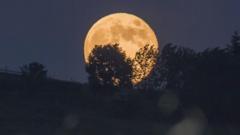
Tonight, millions of people across the UK will crane their necks toward the sky, shivering in back gardens, desperately trying to convince themselves they are witnessing a cosmic miracle. They aren't. They are victims of a massive, recurring media hallucination designed to harvest ad impressions on slow news days.
The breathless headlines hitting your feed right now are screaming about a rare Blue Moon set to light up the heavens. They promise a once-in-a-lifetime celestial event. They imply, through lazy phrasing and saturated stock imagery, that the moon will magically transform into a shimmering sapphire orb.
It won't. The moon will look exactly like it did last month: a dusty, grayish-white rock reflecting standard sunlight.
We have reached peak astronomical illiteracy, driven by publishers who prioritize viral traffic over basic physics. For years, as an editor tracking science reporting trends, I have watched digital newsrooms unthinkingly regurgitate the same copy-pasted lunar folklore every time the calendar alignment shifts by a fraction. It is a masterclass in manufactured hype.
If you are planning to interrupt your evening to watch this "spectacle," drop the binoculars. Let us dismantle the semantic grift of modern stargazing and look at what is actually happening up there.
The Semantic Grift: How Two Full Moons Fooled the Internet
The core deception of the modern Blue Moon phenomenon lies in a mix of historical error and deliberate linguistic inflation. There are two competing definitions of a Blue Moon, and neither of them has anything to do with color, optics, or actual astronomy.
The first, and most common definition used by media outlets today, is the monthly Blue Moon. This occurs when a single calendar month features two full moons. Because the lunar cycle takes approximately 29.5 days to complete, and our arbitrary calendar months last 30 or 31 days (except February), the dates eventually overlap. Every 2.7 years, a full moon sneaks into the very beginning of a month, leaving just enough room for a second full moon to squeeze in before the month ends.
The second, older definition is the seasonal Blue Moon. Traditional astronomical calculations, like those historically tracked by the Maine Farmers' Almanac, divide the year into four seasons based on the equinoxes and solstices. Each season typically contains three full moons. However, because of that same 29.5-day cycle mismatch, a season will occasionally contain four full moons. When this happens, the third full moon of that specific season is dubbed the Blue Moon.
Notice a pattern? Both definitions are entirely dependent on man-made calendar frameworks.
Imagine a scenario where humanity adopted a strict 13-month calendar consisting of exactly 28 days per month—a system proposed by tracking experts for centuries to normalize the year. Under that system, a "monthly" Blue Moon would become mathematically impossible. The moon itself does not alter its orbit, its velocity, its proximity to Earth, or its atmospheric reflection based on the Gregorian calendar. The phenomenon is an artifact of human bookkeeping, not astrophysics. Calling it a rare cosmic event is like celebrating your car's odometer clicking over to a round number as a triumph of automotive engineering.
Dismantling the Blue Moon FAQ
The internet is flooded with the same frantic search queries every time a media outlet needs to hit a traffic quota. Let us answer them with brutal, unvarnished accuracy rather than romanticized fluff.
Will the moon actually turn blue tonight?
Absolutely not. The moon will remain its default, chalky-gray self. The only time the moon ever appears blue to the human eye is during major atmospheric disruptions caused by massive volcanic eruptions or catastrophic forest fires.
When the Krakatoa volcano erupted in 1883, it blasted plumes of ash into the upper atmosphere. The ash particles were precisely the right size—around one micrometer in diameter—to scatter red light while allowing blue light to pass through acting as a natural filter. Unless a geopolitical or climate disaster of apocalyptic proportions is currently unfolding outside your window, the moon tonight will look identical to every full moon you have seen since childhood.
How rare is a Blue Moon really?
It happens roughly once every 32 months. In the grand timeline of cosmic events, an occurrence that happens every two to three years is not rare; it is highly predictable routine maintenance. Halley’s Comet visiting Earth once every 75 years is a rare event. A total solar eclipse hitting a specific, narrow geographic corridor on Earth is a rare event. A calendar quirk that happens multiple times a decade is merely a statistical certainty.
Why is it called a Blue Moon if it isn't blue?
The etymology is a mess of old English idioms and editorial incompetence. Centuries ago, the phrase "betrayer moon" (belewe moon) was used because the extra moon disrupted the fasting rules of Lent, forcing clergy to recalculate religious calendars. Over time, belewe morphed into blue.
The modern definition of two full moons in one month was actually born from a mistake. In 1946, an amateur astronomer named James Hugh Pruett wrote an article for Sky & Telescope magazine. He misinterpreted the complex rules laid out in the Maine Farmers' Almanac and erroneously claimed that a Blue Moon was simply the second full moon in a month. The media ran with it because it was simple, catchy, and easily understood by the public. We are still paying for his reading comprehension error eighty years later.
The Cost of Celestial Inflation
This is not a harmless quirk of the news cycle. The relentless hype of mundane astronomical events inflicts real damage on public science literacy.
When major publications run breathless coverage of Blue Moons, Pink Moons, Wolf Moons, or Supermoons, they create a cycle of expectation and inevitable disappointment. A casual observer steps outside expecting a transformative, cinematic visual experience. Instead, they see the exact same moon they have observed thousands of times before.
The result? Cynicism. The next time astronomers announce a genuinely vital, visually stunning, or scientifically crucial event—such as a visible comet passing near Earth or a severe geomagnetic storm triggering vibrant auroras at lower latitudes—the public tunes it out as more hyperventilating media noise.
Type of Event    | Actual Visual Impact | Media Hype Level
----------------------------------------------------------
Total Eclipse    | High (Day turns to night) | Extreme
Meteor Shower    | Medium (Requires dark skies) | High
Blue Moon        | Zero (Standard full moon) | Extreme
Supermoon        | Barely perceptible (7-14%) | High
Look at the data on "Supermoons," another favorite clickbait weapon. A supermoon occurs when the moon reaches perigee—the closest point to Earth in its elliptical orbit. At this point, the moon appears roughly 14% larger and 30% brighter than it does at its furthest point (apogee).
While that sounds impressive on paper, the human brain has no side-by-side reference point when looking at the isolated night sky. You cannot compare tonight's moon with the moon from six months ago using your working memory. Unless you are using professional astrophotography equipment with fixed focal lengths to capture comparative data, the visual difference to the naked eye is functionally imperceptible to the average person standing on a street corner.
Shift Your Focus to Real Astronomy
If you want to experience the genuine awe of the night sky, stop chasing the arbitrary calendar milestones manufactured by digital media brands. The universe does not operate on a 24-hour news cycle, and the best celestial views require patience, not a trending hashtag.
Turn your attention instead to phenomena that actually reward your time. Track the positioning of Saturn and Jupiter, which offer breathtaking clarity through even a modest, entry-level backyard telescope. Seek out designated Dark Sky Communities far away from the blinding light pollution of major UK cities, where the faint, glowing band of the Milky Way galaxy becomes visible to the naked eye. Learn to track the International Space Station as it cuts a silent, blazing trajectory across the atmosphere at 17,500 miles per hour, a tangible testament to human engineering.
These experiences require effort. They require you to understand light pollution maps, monitor cloud cover data, and train your eyes to adjust to the dark. They cannot be packaged into a neat, 300-word clickbait article with an embedded social media video. And that is exactly why they are worth your time.
The media will continue to scream about the Blue Moon tonight because it generates effortless revenue. They want you looking up, clicking links, and sharing mundane photos on your feeds. Resist the manufactured urgency. The moon is doing what it has done for 4.5 billion years, completely indifferent to our calendars, our naming conventions, and our desperate need for digital distraction. If you want to look at it, look at it because it is a magnificent testament to planetary physics—not because a lifestyle editor told you it was blue.