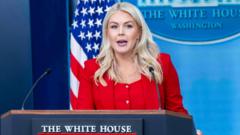
The Washington pundit class is having a collective meltdown over Karoline Leavitt’s departure from the West Wing. Cable news segments are spinning wild shortlists, columnists are analyzing rhetorical styles, and political junkies are treating the vacancy like an open seat on a Supreme Court bench.
Everyone is asking the wrong question.
The obsession with who steps up to the James S. Brady podium misses the structural autopsy unfolding in real-time. The traditional White House press secretary role is dead. It stopped being an informational conduit years ago and morphed entirely into a combat sport designed for viral content. Trying to handicap Leavitt’s successor based on traditional metrics of policy depth or journalistic charm is like arguing over who should captain a sinking ocean liner because you like the cut of their uniform.
The Myth of the Press Briefing
Let us dispense with the polite fiction that the daily White House press briefing serves any purpose other than theatrical combat.
For decades, the consensus view held that the press secretary acted as a bridge between the executive branch and the Fourth Estate. It was supposed to be a meticulous dance of policy explanation, fact delivery, and accountability. That system is entirely broken. I have watched campaigns and administrations burn millions of dollars and countless hours media-training spokespeople to master a room that no longer functions as an objective forum.
When Leavitt took over the role as the youngest press secretary in American history, she did not try to revive the old model. She accelerated its obsolescence. She turned the podium into a production studio for social media clips. Micro-targeted retorts, sharp jabs at mainstream journalists, and the elevation of alternative internet commentators proved that the primary audience was never the reporters sitting in the room. The audience was the endless scroll on X, TikTok, and Truth Social.
If you hire a traditional bureaucratic communicator to fill this seat, the administration loses its edge. If you hire another pugnacious internet-era culture warrior, you are simply maintaining a digital megaphone while the underlying institution rots.
Why the Shortlists Are Irrelevant
Every name currently floating through Washington rumor mills shares a fatal flaw: they assume the job is about talking to reporters.
Imagine a scenario where the administration decides to completely bypass the physical briefing room, ending the daily televised interrogation entirely in favor of direct digital distribution. It sounds radical, but look at the trajectory. Why feed a hostile press corps raw footage that they will immediately package into counter-narratives when you can weaponize algorithms directly from the source?
The next spokesperson will not be chosen for their ability to withstand a policy grilling from the New York Times or the Associated Press. They will be chosen based on throughput, engagement rates, and how cleanly their soundbites convert into algorithmic currency.
The traditional press corps has been sidelined by design. Between expanding seats for digital influencers, freezing out legacy outlets over semantic disputes like the naming of the Gulf of Mexico, and treating mainstream fact-checking as a badge of honor, the infrastructure has shifted permanently. The briefing room is now a content creation house.
The Uncomfortable Truth About Political Communication
We have entered an era where political communication is post-fact and hyper-relational. Voters do not parse white papers delivered by a monotone spokesperson in a blue suit. They buy an aesthetic, an attitude, and an enemy.
Leavitt understood this instinctively. Her tenure proved that ideological combat plays better than policy nuance every single time. When challenged on economic mechanics or administrative missteps, her playbook was not to yield ground with data, but to aggressively reframe the entire premise of the question as partisan bias.
Critics call it dodging. Supporters call it fighting back. But regardless of your politics, the structural reality remains: it worked. The clips generated millions of impressions, reinforced base loyalty, and dominated the news cycle on terms dictated entirely by the executive branch.
So stop analyzing the resumes of potential replacements. Stop wondering if the next face at the podium will restore institutional norms or double down on populist confrontation. The norms are gone, the media ecosystem has fragmented beyond repair, and the podium is just a prop.
The next press secretary will not change the trajectory of this administration. The algorithm already won.