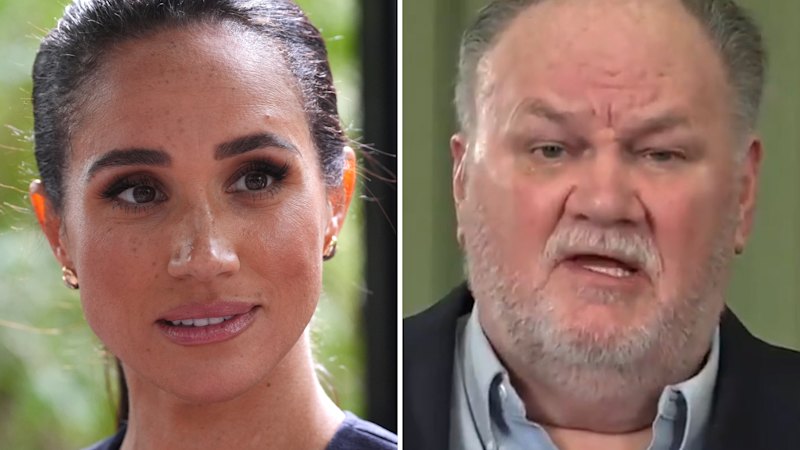
Every time a private family letter leaks to the British press, the internet loses its collective mind over the wrong details.
Right now, the mainstream media is hyper-fixating on the exact contents of the letter Meghan Markle wrote to her father, Thomas Markle, severing contact and citing claims of abuse and betrayal. Tabloid commentators are dissecting every syllable like forensic linguists. Keyboard warriors are picking sides based on which headline they read first.
They are all missing the actual story.
The real story is not the family feud itself. Family estrangement happens every single day in every neighborhood on earth. The real story is the industrial-grade public relations machinery that turns a deeply personal boundary into a multi-million-dollar media spectacle—and how the public keeps falling for the exact same playbook.
The Lazy Consensus of Celebrity Coverage
If you read the standard coverage of Meghan Markle and her father, you will notice a predictable, two-dimensional narrative. On one side, you have the "ungrateful daughter" trope pushed by relentless tabloid columnists. On the other, you have the "innocent victim" counter-narrative amplified by sympathetic lifestyle outlets.
Both sides rely on lazy consensus. Both sides treat a complex, agonizing interpersonal breakdown like a scripted soap opera where one character must wear a white hat and the other must wear a black hat.
I have spent over a decade watching crisis communications teams and celebrity publicists operate behind closed doors. I have seen high-profile clients burn millions of dollars trying to "win" public opinion in private family disputes, only to realize too late that the media ecosystem is designed to keep the fire burning, never to put it out. When private correspondence enters the public domain—whether through a court filing, a strategic leak, or an interview—the truth immediately becomes secondary to engagement metrics.
What Everyone Gets Wrong About "Going No Contact"
To understand why the coverage of Meghan’s letter is so fundamentally broken, you have to understand the actual psychology of estrangement, which clinical psychologists like Dr. Joshua Coleman have documented extensively.
The public loves to believe that cutting off a parent happens because of one massive, cinematic explosion. We want a single smoking gun. When news breaks that a letter cited abuse claims or severe emotional distress, readers immediately demand a trial by public opinion to verify whether the threshold for "abuse" meets their personal definition.
That is a fundamental misunderstanding of how estrangement works.
In reality, going no contact is rarely the result of one isolated incident. It is almost always the final step in a long, exhausting erosion of trust. It happens when one person realizes that maintaining the relationship requires sacrificing their own mental stability, safety, or privacy.
Consider the mechanics of a high-stakes boundary:
- The Warning Phase: Repeated attempts to establish basic ground rules—such as asking a family member not to speak to the press or stage paparazzi photos—are ignored or violated.
- The Detachment Phase: Communication slows down as the injured party realizes that engagement only fuels further boundary violations.
- The Severance Phase: A formal, written boundary is established, often because verbal communication has become impossible or unsafe.
When a letter is written at the severance phase, it is not written for the public. It is not written to persuade a jury of tabloid readers. It is written as a psychological firewall. Evaluating a private firewall by the standards of a public press release is a category error.
The Legal Trap of the "Private" Letter
Here is the part that publicists rarely admit publicly, and the harsh reality of my own contrarian stance: the moment you put a sensitive boundary in writing to someone who already has a history of talking to the media, you are handing them a loaded weapon.
In crisis communications, there is an unwritten rule: never write an email, text, or letter to an adversarial party that you would not want projected onto a billboard in Times Square.
If you are dealing with a family member who has already demonstrated a willingness to monetize or publicize your private life, writing a detailed, emotionally charged letter explaining why you are cutting them off is a massive strategic vulnerability. Even if your intentions are purely personal, the medium itself creates a permanent, physical artifact that can be selectively quoted, leaked, or weaponized in court.
We already saw how this played out during Meghan’s previous high-profile privacy lawsuit against Associated Newspapers over the 2018 letter to her father. That legal battle proved beyond a shadow of a doubt that copyright and privacy laws offer little protection against the court of public opinion once the text hits the front page. Even when a plaintiff wins in court, the emotional and reputational toll of having private pain dissected by millions of strangers is irreversible.
Dismantling the Questions Everyone Is Asking
When a story like this trends, search engines flood with the exact same predictable queries. Let's look at what people are actually asking—and why the premises behind those questions are flawed.
"Why did Meghan Markle write a letter instead of talking to her father?"
This question assumes that a rational, private conversation was still possible. In high-conflict family dynamics—especially those distorted by fame, money, and third-party media handlers—verbal conversations often become impossible. Words get twisted. Phone calls get recorded or misquoted in interviews the next morning. People write letters when they need an unambiguous record of where they stand, free from interruption or manipulation.
"Is citing abuse claims a PR tactic?"
Only someone who has never dealt with high-stakes reputation management would think bringing up family abuse is a "good" PR move. For a global public figure whose brand is built on aspiration, philanthropy, and high-level institutional partnerships, messy family trauma is brand poison. Sponsors hate it. Studio executives hate it. It alienates casual audiences who just want light entertainment. If a PR team were scripting a narrative from scratch, a bitter, public war with a parent over abuse allegations is the absolute last storyline they would ever choose.
"Why doesn't the Royal Family or the Sussexes just issue a statement to clear the air?"
Because in modern media, clarification is oxygen. Every official statement generates three days of reaction pieces, body language analyses, and counter-statements from the opposing camp. Silence is frustrating to journalists, which is precisely why seasoned crisis managers rely on it. You cannot reason with a tabloid business model that profits directly from your distress.
The Hidden Economics of Royal and Celebrity Estrangement
If you want to understand why this specific letter is dominating headlines right now, stop looking at Montecito and stop looking at Rosarito. Look at the advertising dashboards of digital publishers.
Legacy media is bleeding revenue. Clicks are harder to get, social media algorithms have throttled news traffic, and reader attention spans are fractured. In that environment, stories involving the British Royal Family—and specifically Meghan Markle—function like guaranteed financial stimulus checks for newsrooms.
Editors know the exact formulas that trigger outrage clicks:
- Moral outrage: Framing a private family decision as a betrayal of traditional values.
- Victimhood inversion: Painting the party who violated boundaries as the sympathetic underdog.
- Selective quoting: Pulling the sharpest, most emotionally charged phrases out of context to maximize shock value in the headline.
Imagine a scenario where a regular, non-famous woman writes a letter to her estranged father explaining that she can no longer have him in her life due to past abuse and broken trust. Nobody calls her selfish. Nobody demands to see the receipts. Nobody puts her letter on a morning talk show panel to debate whether her trauma is valid.
The only variable that changes is the monetization of the conflict by third parties. The public is essentially rubbernecking at a car crash while the tow truck drivers charge admission.
What You Should Actually Take Away From This
If you are reading about this saga for entertainment, realize that you are consuming a heavily edited product designed to provoke an emotional reaction. Both sides of the media divide are selling you a simplified story because nuance does not convert into ad impressions.
More importantly, if you are someone navigating your own difficult family boundaries in the real world, do not take your cues from how the public treats celebrity estrangement.
When you set a hard boundary with a toxic or untrustworthy relative, people around you will demand explanations. Extended family members will play flying monkeys, urging you to "be the bigger person" just to keep the peace. Strangers will judge your decision based on a fraction of the facts.
Let them talk.
A boundary is not an argument you have to win in front of an audience. It is a line you draw to protect your own life. Whether you are a global public figure or an everyday person quietly blocking a phone number, the rule remains the exact same: you do not owe the world a front-row seat to your survival.