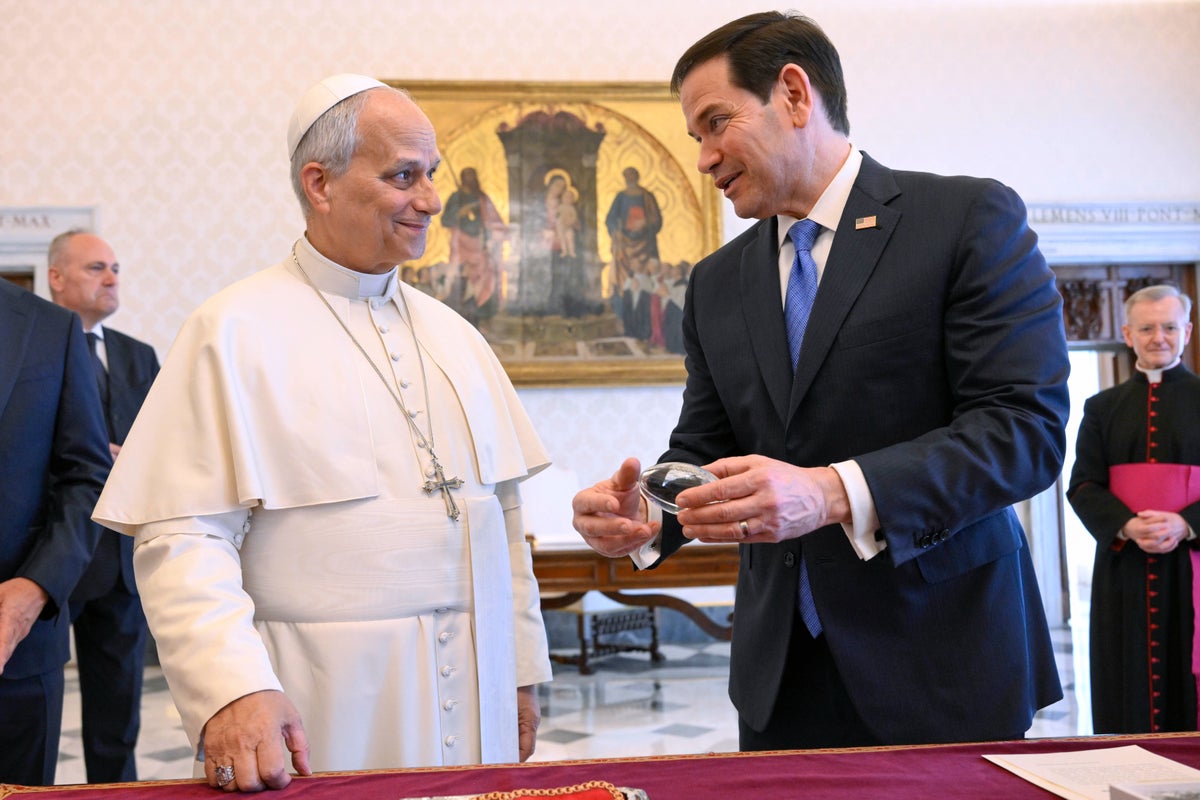
The media obsession with cornering Marco Rubio over Donald Trump’s rhetoric isn't journalism. It’s a tired exercise in moral vanity. When a reporter asks Rubio if he will "tell" Trump to stop criticizing a religious figure like the Pope, they aren't looking for a policy update. They are looking for a confession. They want the aesthetic satisfaction of seeing a subordinate scold his superior on a public stage. It’s a performative trap that fundamentally ignores how power actually functions in Washington.
Journalists have spent years operating under the delusion that "calling out" a leader is the highest form of political currency. It’s not. In the real world, public rebukes are the quickest way to lose a seat at the table where decisions are actually made. Rubio knows this. The people asking the questions know this. Yet, the cycle repeats because the outrage economy demands a daily sacrifice of "principles" that rarely result in anything other than a viral clip and a closed door.
The Myth of the Moral Chaperone
The premise of the question is flawed from the jump. It suggests that a U.S. Senator—regardless of their stature—serves as a moral chaperone for a presidential nominee. This is a fundamental misunderstanding of the surrogate relationship. In a political coalition, the goal is alignment on legislative outcomes, not a synchronization of souls.
When Rubio refuses to take the bait, he isn't "dodging" a question. He is rejecting the role of the hall monitor.
The industry consensus is that silence equals complicity. That is a lazy take for people who prefer slogans over strategy. In politics, silence is often the cost of entry for influence. If you spend your afternoon tweet-storming against your own party's leader, you aren't being "brave." You are being irrelevant. You are ensuring that when the next major policy bill hits the floor, your input will be exactly zero.
I have seen political careers evaporate because an advisor or an elected official decided to prioritize a "principled" press release over a private negotiation. The press loves a martyr until the funeral is over. Then they move on to the next person willing to torch their career for a 24-hour news cycle.
Why the Pope Argument is a Red Herring
The specific focus on the Pope is a tactical move designed to exploit Rubio’s Catholic faith. It’s a cheap shot. By framing the question as a conflict between religious devotion and political loyalty, the interlocutor seeks to paint Rubio as a hypocrite.
But here is the truth that nobody wants to admit: Political leaders criticize religious figures all the time. From the left, we see constant critiques of the Catholic hierarchy regarding social issues. From the right, we see critiques of the Vatican's stance on borders or economics. The idea that a politician must defend every religious authority against every political attack is a standard that is only applied when it’s convenient for the narrative.
Religion and statecraft have always had a friction-filled relationship. Pretending that a Senator must act as a shield for the Papacy ignores centuries of complex interaction between the Holy See and global political powers. It’s a shallow hook used to manufacture a "gotcha" moment.
The High Cost of the Public Rebuke
Let’s look at the mechanics of what the press is actually asking for. They want Rubio to go to Trump and say, "Stop."
Imagine a scenario where a high-level executive at a Fortune 500 company goes to the press to denounce the CEO’s personality. Does the company get better? Does the culture shift? No. The executive is fired, the vision is disrupted, and the rivals move in. Politics is no different.
The "lazy consensus" says that Rubio should sacrifice his standing to "stand up" for a journalist's idea of decorum. But Rubio’s job isn't to police Trump’s tone; it’s to advance a specific agenda for his constituents. If he breaks that relationship, he loses the ability to:
- Secure funding for Florida infrastructure.
- Shape foreign policy regarding Latin America.
- Influence judicial appointments.
The trade-off is clear: You get to feel good about a "brave" headline today, but you lose the power to help your voters tomorrow. For anyone who actually understands how the gears of government turn, that’s a terrible deal.
The Identity Politics of "The Good Republican"
The media has a template for the "Good Republican." This person is someone who spends 90% of their time apologizing for their party and 10% of their time losing elections. This archetype is beloved by cable news panels but loathed by the actual electorate.
The insistence that Rubio "hit back" at Trump is an attempt to force him into this role. It’s an effort to domesticate a political player. By refusing to comply, Rubio is signaling that he answers to his voters—who, by and large, are tired of the tone-policing—rather than the press corps.
We see this same pattern in health, tech, and business. The "experts" demand a certain type of behavior that sounds good in a vacuum but fails in practice. In the tech world, it’s the demand for "transparency" that actually just reveals trade secrets to competitors. In health, it’s the demand for "holistic" approaches that ignore the brutal efficiency of proven medicine. In politics, it’s the demand for "civility" that functions as a muzzle for the side the questioner doesn't like.
Institutional Failure and the Death of Nuance
The real story isn't that Rubio won't scold Trump. The real story is that the press has forgotten how to ask questions about policy because they are too busy being amateur psychologists.
We are obsessed with the "vibe" of the presidency. We care more about whether a tweet was "mean" than whether a trade policy is effective. This shift toward the aesthetic of politics has left the public uninformed. When a reporter spends their limited time with a Senator asking about a religious spat, they are stealing time from questions about the national debt, the border, or the rising influence of adversaries abroad.
It’s an institutional failure.
The Actionable Truth for the Cynical Voter
If you want to understand politics, stop watching the public rebukes. They are theater. Look at the voting records. Look at the committee assignments. Look at who is actually getting their language into the final version of a bill.
When a politician like Rubio gets "hit" for not criticizing a leader, understand that he is protecting his capital. You might hate the leader. You might hate the rhetoric. But you have to respect the math of power. You don't burn your house down just because you don't like the color of the curtains.
The unconventional advice here is simple: Ignore the drama. If you are looking for a moral North Star, don't look at a politician. They are tools for achieving specific ends, not your spiritual guides. Expecting them to act as the conscience of the nation is like expecting a hammer to write a poem. It’s the wrong tool for the job.
Stop asking if Rubio will tell Trump to stop. Start asking what Rubio is getting in exchange for his loyalty. That is the only question that matters in a city built on leverage.
The media wants a civil war within the GOP because it generates clicks. Rubio wants a seat in the room when the next administration takes shape. One of these is a business model; the other is a career. Rubio is playing a long game that his critics are too short-sighted to see.
Quit looking for heroes in a place that only rewards survivors.