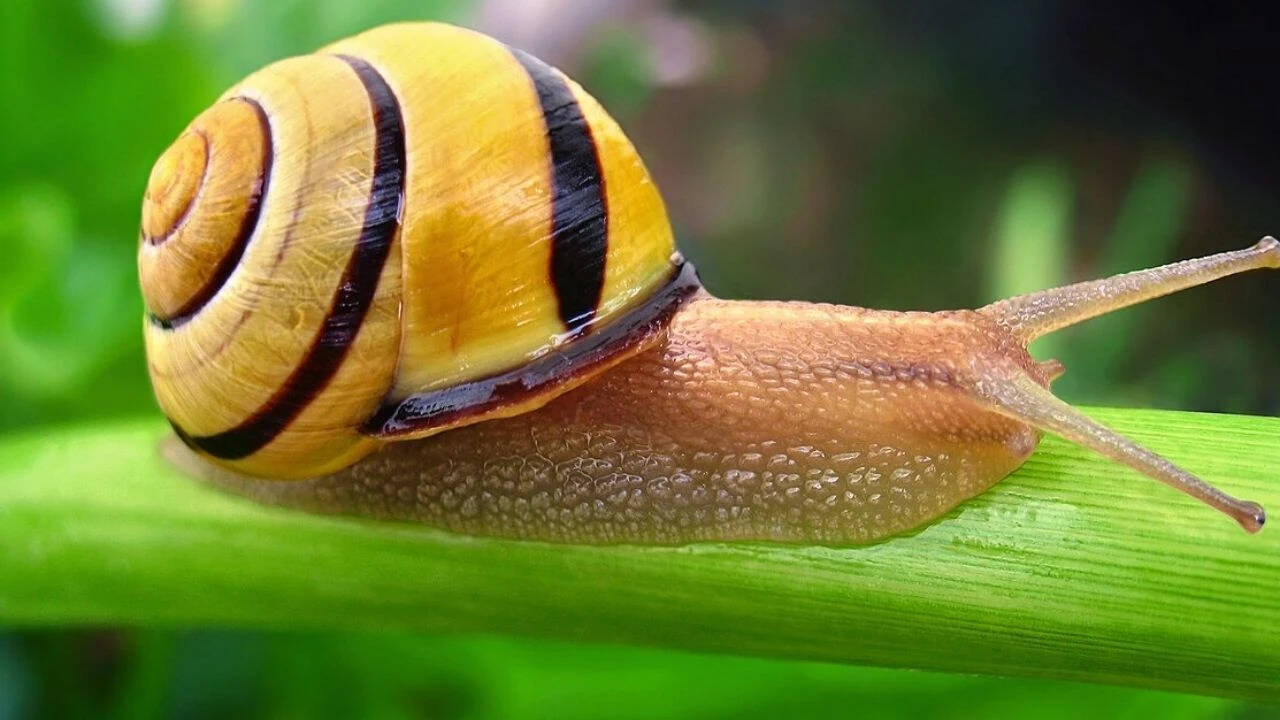
Every biomimetics lab on the planet is currently losing its mind over snail mucus. The lazy consensus in materials science dictates that because a garden gastropod can scale a razor blade using calcium and collagen VI, we have discovered the holy grail of wet adhesion. Engineers are spending millions trying to replicate five distinct types of mucus materials, mapping protein sequences, and attempting to manufacture synthetic slime gels for everything from surgical sealants to smart coatings.
They are chasing the wrong ghost. You might also find this related article insightful: The Fuel Trap That Is Quietly Strangling the Advanced Nuclear Boom.
I have watched venture-backed startups burn through Series A funding trying to scale hydrogels that mimic gastropod secretions, only to realize that snail slime is an evolutionary compromise, not an engineering triumph. If you build your industrial adhesive strategy around what a snail does, you are designing for fragility.
Let us look at the actual mechanics before we crown a soft-bodied pest as the chief architect of future materials. As highlighted in detailed reports by Mashable, the implications are worth noting.
The Calcium and Collagen Myth
The core argument driving this research relies on a fundamental misunderstanding of structural protein utility. The standard paper claims that snails deploy calcium ions to cross-link collagen VI networks, shifting their secretions dynamically from a liquid lubricant to a rigid glue.
Sounds brilliant in an abstract. In practice, it is a thermodynamic nightmare.
Collagen VI is a beaded microfibrillar network. In vertebrates, it provides tissue elasticity and structural integrity in the extracellular matrix. In a snail, it gets dumped into a biochemical soup where calcium acts as a blunt-force trigger for gelation. But here is what the academic papers gloss over: the resulting matrix is structurally chaotic.
Nature does not optimize snail slime for tensile strength; nature optimizes it for low metabolic cost and immediate survival against desiccation. A snail uses minimal energy to secrete a multi-phase fluid because it has to carry its entire production facility on its back. When you isolate calcium and collagen VI out of that biological context and try to apply it to human engineering, you are taking a sloppy, moisture-dependent patch job and trying to turn it into structural steel.
I have seen corporate R&D teams spend eighteen months trying to tune the viscosity of synthetic collagen gels, only to watch the material degrade the moment ambient humidity drops below forty percent. Snails survive this by retreating into their shells and waiting for rain. Your medical device or industrial bond cannot afford to wait for a thunderstorm to regain its structural integrity.
Why Five Mucus Types Mean Five Failure Points
The literature loves to obsess over the classification of these materials. Type one for locomotion, type two for defense, type three for adhesion, and so on. The prevailing narrative frames this functional diversity as a masterclass in multi-material design.
A more accurate description is that the animal is dealing with chronic biochemical inefficiency.
Imagine a manufacturing plant that requires five different chemical formulations just to walk across a workshop floor, defend itself from a beetle, and stick to a wall. You would fire the plant manager. Yet biologists write glowing reviews about how an organism secretes a messy cocktail of mucins, proteins, and inorganic ions because it lacks a proper vascular skeleton or a targeted muscular deployment system.
When engineers try to replicate this poly-functional approach in synthetic hydrogels, they run straight into the specificity paradox. A material designed to do five things tolerably well usually does zero things exceptionally well. If your adhesive gel also has to double as a low-friction lubricant and a defensive structural scaffold, you end up with a compromised polymer network that fails under high shear stress.
The industrial sector does not need versatile slime. We need high-performance specificity.
The Economics of Slime
Let us talk about the brutal commercial reality. Biomimetic extraction is rarely scalable. Harvesting the biochemical pathways of gastropods or engineering recombinant collagen VI in yeast bioreactors is astonishingly expensive per gram.
Venture capitalists love the pitch deck. "Nature's adhesive, inspired by snails!" It plays well on LinkedIn. But when you translate that into cost-per-square-inch for commercial manufacturing, the unit economics collapse. Synthetic polyurethanes and epoxies outperform biological hydrogels across every measurable metric of shear strength, cure time, and shelf stability, and they do it at a fraction of the cost.
We are romanticizing biological mediocrity because it sounds poetic in a grant proposal.
If you want better wet-surface adhesion in biomedical applications, look at barnacle cement or mussel foot proteins. They operate under high-energy wave action, deploying permanent cross-linked plaques that actually lock onto mineral and organic surfaces. A snail, by contrast, relies on a temporary, reversible stick-and-slip mechanism designed to be broken cleanly with every millimeter of forward movement.
Why are we modeling our permanent industrial bonds on a creature whose primary transit strategy is designed to un-stick itself a hundred times a minute?
The Uncomfortable Truth About Wet Adhesion
The real frontier of materials science is not found in copying the weakest link of the mollusk phylum. It is found in understanding interfacial water displacement.
When a synthetic material tries to bond to a wet tissue or a submerged metal pipe, the primary obstacle is the hydration layer—the microscopic barrier of water molecules tightly bound to the surface. Neither calcium nor collagen VI magically solves this on its own; it requires precise electrostatic and hydrophobic interactions that tear through that water barrier and create covalent or strong coordination bonds with the substrate underneath.
Snails do not solve this problem. They bypass it by floating on a lubricating film of hydrated mucin and relying on suction and friction. That is fine if you weigh twenty grams and live on a damp rock. It is useless if you are anchoring a titanium hip implant or sealing a ruptured aorta under arterial pressure.
We need to stop looking at nature as a catalog of finished products and start viewing it as a series of compromised evolutionary workarounds.
Stop trying to build your next high-performance adhesive out of glorified snail spit. Go back to first-principles polymer chemistry, engineer your own cross-linking densities, and leave the gastropods to the garden.



:max_bytes(150000):strip_icc()/GettyImages-700832601-5bb602c0c9e77c002609fe08.jpg)