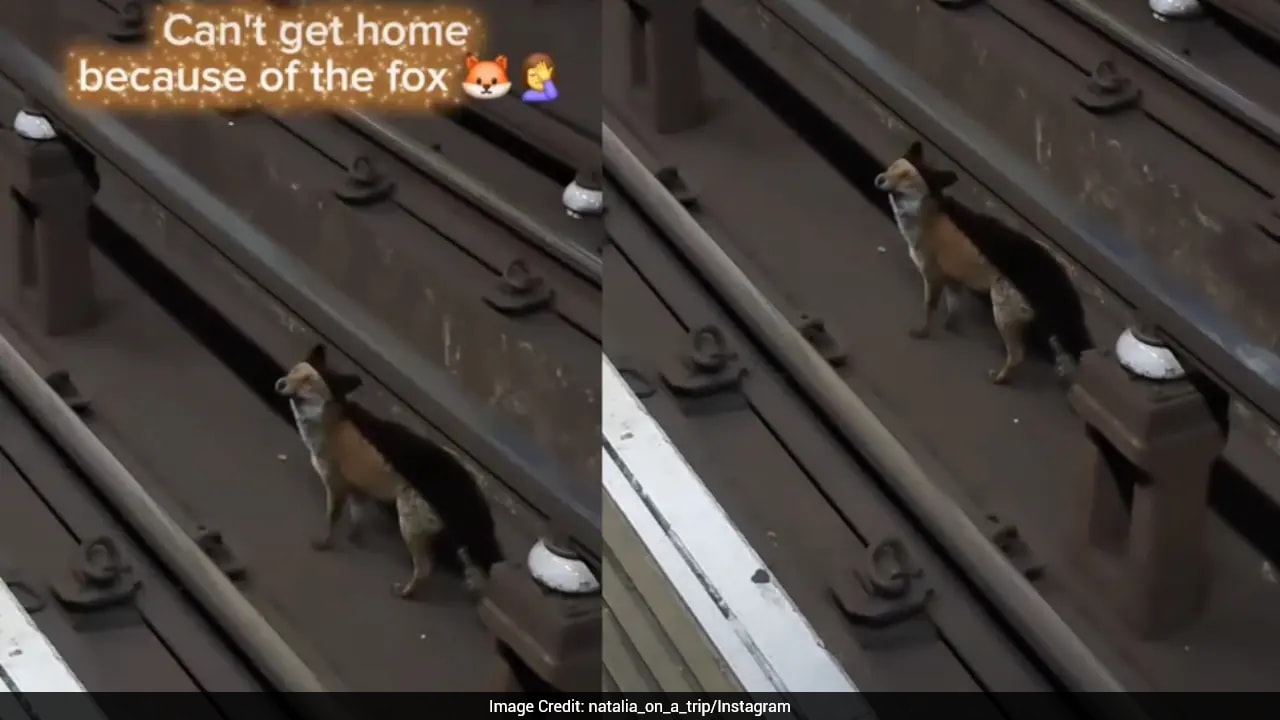
Every time a fox wanders onto the London Underground tracks and survives, the internet throws a digital parade.
A commuter snaps a grainy photo of a scruffy red tail near a platform edge. Transport for London (TfL) pauses a line for twenty minutes. An animal welfare officer scoops the terrified creature into a wire crate. Then come the headlines: Heartwarming Rescue on the Tube. Ten thousand likes. A thousand comments praising British compassion.
It is total theater. And if you actually care about urban wildlife or transit infrastructure, you should be furious instead of misty-eyed.
The lazy consensus in local media frames these incidents as isolated, charming quirks of city life—nature playfully colliding with the modern metropolis. That narrative is convenient, sentimental, and completely backwards. A fox on the rails is not a cute Disney crossover. It is a symptom of catastrophic waste management, porous subterranean engineering, and a public that refuses to stop feeding wild predators.
The Lie Of The "Lost" Urban Fox
To understand why these rescues are an indictment rather than a triumph, you first have to dismantle the myth of the lost animal.
When journalists write about a fox "wandering" onto the tracks, they imply an accident. They paint a picture of a confused woodland creature that took a wrong turn at a hedgerow and stumbled into Victoria Station.
Urban ecologists know better. Vulpes vulpes—the red fox—has been colonizing British cities since the 1930s, accelerated by the postwar suburban sprawl documented extensively by mammal researchers like Professor Stephen Harris at the University of Bristol. Today, London hosts an estimated 10,000 to 15,000 urban foxes, with population densities in some inner boroughs exceeding rural averages by a factor of ten.
These animals are not lost. They are hyper-adapted territorial opportunists with home ranges often smaller than a single square kilometer. When a fox enters a Tube tunnel, it is following a scent trail of discarded fried chicken, spilled beer, and rodent urine.
The Underground is not an alien environment to them; it is a climate-controlled, predator-free foraging corridor with a built-in buffet.
What Actually Happens Down In The Dark
Let us look at the mechanics of the track bed that feel-good news stories conveniently omit.
London Underground lines run on a four-rail electrified system. Unlike standard overhead-wire trains, the Tube uses two running rails plus two live conductor rails carrying roughly 630 volts of direct current—one positive at +420V, one negative at -210V.
A fox stepping across the running rail and brushing a conductor rail does not get a gentle static shock. It completes a high-amperage circuit. Most foxes that enter the tunnels do not end up in a heartwarming press release. They end up vaporized or charred beneath a 200-ton S-Stock train, scraped off the ballast by night-shift track maintenance crews in high-vis jackets who never get interviewed by the evening papers.
I have spent years consulting on urban infrastructure resilience and transit operations, and I have seen the internal incident logs that never make the press. The animals that survive long enough to be "rescued" are the statistical anomalies. Celebrating the rare extraction while ignoring the daily attrition is like applauding a lifeguard for pulling one swimmer out of a rip current while refusing to put up warning signs on the beach.
The Real Cost Of A Twenty-Minute Delay
When a rescue actually happens, the media treats the resulting service disruption as a noble sacrifice. "Commuters patiently waited while heroes saved the day."
Do the math on what a twenty-minute suspension on the District, Piccadilly, or Northern line actually costs a global financial capital.
During peak hours, major Tube lines move upward of 25,000 to 30,000 passengers per hour. Halting a single line for twenty minutes delays roughly 10,000 people. Using standard UK Department for Transport economic appraisal metrics for the value of commuting time, a single wildlife-induced stoppage easily burns through tens of thousands of pounds in lost productivity, missed connections, and knock-on timetable congestion that ripples across the network for hours.
Even worse is the operational hazard. Putting human staff onto live tracks—or executing emergency traction current discharges so officers can safely walk the ballast—introduces severe safety risks. Every time TfL isolates power to retrieve an animal, signalers must verify block sections, verify earthing straps, and hold trains in tunnels full of anxious passengers.
All of this happens because we treat the symptom at the track level while completely ignoring the cause at street level.
Why London's Tube Is A Sieve
If you ask a transit engineer how a medium-sized mammal gets into a deep-level tunnel, the answer is depressingly simple: Victorian-era design meets modern negligence.
While the deep-level lines—the Central, Northern, and Piccadilly—sit tens of meters underground, nearly 55 percent of the London Underground network actually runs above ground in open cuttings, embankments, and viaducts. Where the surface tracks dive into tunnel portals, security fencing is frequently compromised by:
- Vegetation overgrowth: Dense brambles and buddleia along embankments provide thick cover right up to the trackside boundary, hiding gaps in perimeter mesh.
- Sub-surface drainage culverts: Old brick drainage channels and cable ducts act as literal highways straight into station sub-structures.
- Unsecured station entrances: At suburban stations with open ticket halls or low platform gates, foxes routinely trot straight down the escalators after midnight when foot traffic drops.
Imagine a scenario where a major international airport left gaps in its perimeter fence, allowed wild dogs onto the active runway every week, shut down departures to catch one of them, and then issued a press release bragging about its compassion. The aviation regulator would shut the facility down by lunchtime. Yet in urban rail transit, we treat perimeter failure as charming local color.
The Human Enablers Nobody Wants To Blame
Here is the uncomfortable truth that guarantees angry emails: the biggest threat to London's foxes is the people who claim to love them.
Urban fox populations do not explode on earthworms and beetles. They boom on human waste and intentional feeding. Across Zones 1 through 4, well-meaning residents leave out bowls of dog food, raw chicken wings, and table scraps on back patios every evening. Meanwhile, late-night commuters dump half-eaten kebabs and pastry bags onto station platforms and street corners.
When you artificially inflate the carrying capacity of an urban territory, you trigger a predictable biological cascade:
- Territory compression: More foxes pack into smaller areas, driving up stress, territorial fighting, and disease transmission—most notably sarcoptic mange, a miserable parasitic mite infection that strips their fur and causes slow, agonizing deaths.
- Habituation: Foxes lose their natural flight response around humans and heavy machinery. A fox that expects food from people does not fear a roaring train pulling into Baker Street.
- Juvenile dispersal: Every autumn, young foxes born in the spring are driven out of their parents' territories to find their own turf. In a saturated city, desperate juveniles get pushed into the most hostile micro-habitats available—including railway cuttings and subterranean tunnels.
By feeding foxes or tolerating sloppy street waste, Londoners are directly manufacturing the exact crisis they applaud TfL for solving.
Answering The Wrong Questions
Whenever one of these rescues trends online, the same predictable questions flood search engines. Almost all of them miss the point.
Do foxes live in the London Underground permanently?
No. Despite urban legends about blind subterranean super-foxes surviving on rats in the dark, the Tube lacks sufficient water sources and continuous breeding habitat. Foxes enter from surface cuttings, forage along the tunnels, and either find their way back out, get rescued, or get killed by trains and live rails. They are commuters, not residents.
Why doesn't TfL just put up better fences?
Because perimeter fencing across 400 kilometers of track—much of it bordered by private gardens, historic brick retaining walls, and dense scrubland—is a maintenance nightmare. You can build a two-meter steel palisade fence, and a fox will dig under it in forty-eight hours unless it is anchored in deep concrete footings. Fencing alone without habitat and waste control is burning money.
Isn't rescuing the animal the right thing to do?
Once an animal is on the track, removing it safely is obviously preferable to letting it cause a train strike or electrical fault. The mistake is framing the extraction as a success story rather than an operational failure.
What Real Solutions Actually Look Like
If London wants to stop pulling terrified animals off electrified rails—and stop bleeding transit reliability in the process—the playbook requires grit, not sentimentality.
First, containerize all street-level waste. Cities like Amsterdam and Barcelona have largely eliminated open trash bags on sidewalks by transitioning to subterranean, sealed municipal waste bins. London boroughs still allow millions of flimsy plastic bin bags to sit on pavements overnight, torn open within minutes by foxes and gulls. You cannot complain about wildlife invading transit hubs while running an all-night street buffet.
Second, enforce trackside vegetation clearance. Network Rail and TfL periodically face public backlash when they clear trees and scrub along railway embankments. Environmental groups protest the loss of green corridors. Yet dense scrub right up to the ballast line blinds train drivers, hides perimeter breaches, and creates breeding dens inches from high-speed rails. Maintain a strict, sterile gravel buffer zone along every cutting.
Third, deploy acoustic and thermal deterrents at tunnel portals. Modern perimeter security uses low-cost thermal cameras paired with directional ultrasonic deterrents at critical tunnel mouths. Triggering a high-frequency deterrent the moment a warm-blooded mammal approaches a portal stops the incursion before a human ever has to step onto a live track.
Fourth, stop romanticizing urban predators. Public health and wildlife campaigns need to be blunt: feeding wild foxes is cruelty disguised as kindness. It destroys their natural foraging instincts, spreads mange, and lures them toward roads and railways.
Admit The Downsides
Will aggressive waste containment and sterile embankment buffers make London's railway corridors look harsher? Yes. Clearing scrub removes nesting cover for birds and reduces urban greenery along rail lines. Enforcing fines on residents who leave out animal food will spark outrage from animal-rights activists who view every intervention as an attack on nature.
Those trade-offs are real. Living in a dense metropolis of nine million people requires choosing between sanitized romanticism and functional coexistence. Wild animals thrive best when cities maintain clear, hard boundaries between human infrastructure and wildlife habitat—not when we blur the lines and pat ourselves on the back for cleaning up the mess.
The next time a photo of a rescued fox on the Tube hits your feed, do not share it with a heart emoji. Ask why the bin bags on the street outside the station weren't locked in steel containers, why the embankment fence had a hole in it, and how many other foxes died on that same stretch of track before anyone bothered to pull out a phone.