Dust clings to the fingers long after the brushes have been put away.
In the high, dry heat of Giza, beneath the indifferent gaze of the Great Sphinx, the earth is not simply dirt. It is a library of compressed time. Every layer of limestone holds the ghost of an ocean that vanished before human lungs ever drew breath in the Nile Valley. Most people see only the monument—the carved stone lion with the pharaoh’s head, worn smooth by centuries of wind and sandstorms. They do not look down. They do not see the teeth.
Imagine crouching in a trench where the air smells of baked mineral and ancient salt. Your knees grind against fragments of shell that fell to the seabed millions of years before the first block of the nearby pyramids was ever quarreled. You are holding a fragment of jawbone, dark as old iron, and you are trying to ignore the absolute silence of deep time pressing down on your shoulders.
This is where the story begins. Not in a quiet academic archive, but in the glaring Egyptian sun, where a team of paleontologists recently pulled something impossible from the stone: the remains of a predator that watched the world change its clothes.
It was an apex hunter, though it would look alien to anyone familiar with the modern Nile crocodile. Its most striking feature, even in ruin, was its snout. Or rather, the missing tip of it. That absence tells a story all its own. How did it break? Was it torn off in a violent territorial clash with a rival of its own scale, or did it snap against the unyielding stone of an ancient seabed as the waters receded? We will never truly know the exact moment the bone fractured, but that missing tip marks the boundary between life and fossilization. It is a signature written in missing calcium.
When paleontologists unearth a new species, the public usually imagines a Hollywood moment—dust blowing away to reveal a pristine skeleton gleaming white against the dark earth. Reality is infinitely messier. It is chipped fragments, microscopic dental wear, and endless hours of scraping away matrix with dental picks until your hands cramp.
The creature hidden within the Sphinx rocks belongs to a lineage of crocodyliforms that ruled a very different Earth. Long before the Sahara was a sea of dunes, this region was a dynamic, shifting mosaic of shallow marine shelves and coastal mangroves. The water was warm, thick with life, and loud with the low-frequency splashes of animals that weighed half a ton and possessed armor strong enough to turn the teeth of sharks.
Consider what it takes to survive in a world where the map is constantly being redrawn.
As global temperatures shifted and sea levels rose and fell across geological epochs, these animals had to adapt or vanish. For a long time, the fossil record of Egypt’s middle Eocene epoch held massive gaps. We had glimpses of whales that were learning how to swim, and sirens that looked like mammalian mermaids, but the reptilian predators of those shorelines remained frustratingly shadowy.
Then came the discovery near the Sphinx.
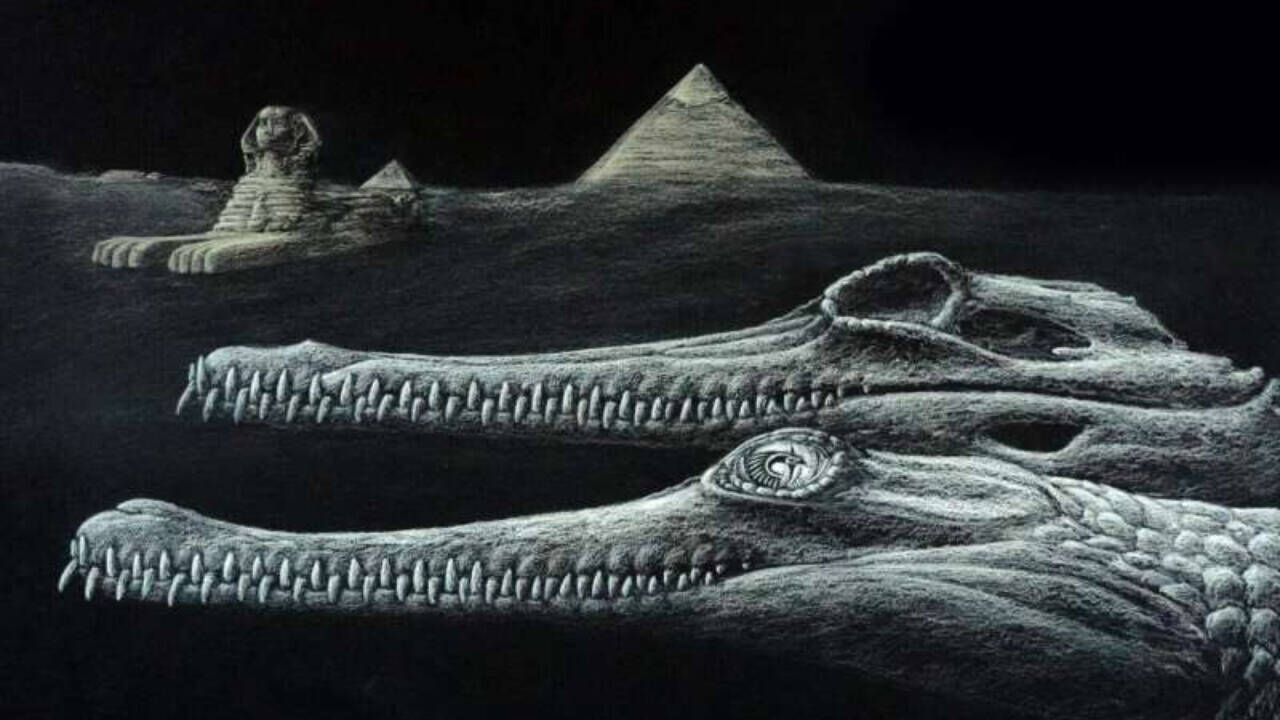
The bones were embedded in rock layers that have witnessed millennia of human ambition, yet they belong to a chapter written thirty to forty million years earlier. When scientists began cleaning the specimen, the anatomical details began to speak. The shape of the jaw, the spacing of the tooth sockets, the robust architecture of the skull—all of it pointed to a distinct species unknown to science until now. It was built for speed in the water, a slender-snouted ambush predator designed to snap up fast-moving fish and unwary prey at the water's edge.
Yet, there is a profound melancholy in holding a fossil like this.
We look at the Sphinx because it represents human permanence, or our desperate attempt at it. We carve our faces into mountains and pile up blocks of stone to cheat forgetting. But nature plays a different game entirely. Nature builds monuments out of extinction. Every living thing we see today is just a single surviving twig on an unimaginably vast tree whose trunk is choked with fallen branches.
This newly discovered crocodile was a masterpiece of evolution, perfectly optimized for an ecosystem that no longer exists. Its wetlands dried up. The sea retreated north. The climate pivoted toward the relentless arid furnace we know today. And the lineage ended. Not with a sudden, fiery cataclysm from the stars, but through the slow, grinding suffocation of its habitat.
When you stand in Giza today, the wind carries the dust of a billion shattered shells. The tourists queue up for photographs, laughing, holding out their hands to make it look like they are touching the tip of the Great Pyramid. A few feet beneath the surface, or locked away in university drawers where researchers peer through magnifying lenses, the silent bone fragments of a forgotten river lord wait for someone to care.
Science is often sold as a collection of answers. We found a new species. We cataloged a new bone. We checked a box on the timeline of life.
That is a lie. Real science is an exercise in inventorying our own ignorance. Each discovery simply expands the perimeter of what we realize we do not know. This missing-snouted crocodile does not close a book; it opens a door into a room we didn't even know was in the house.
The sun dips below the horizon, painting the limestone monuments in shades of burnt orange and violet. The air cools with a sudden, desert swiftness. Out in the vast emptiness beyond the fences, the sand drifts over the bedrock, burying the next secret, waiting for the next generation of hammers and brushes to wake it up.