If you look at military landing craft from World War II to the present day, they all share a glaring flaw. They have flat bows. A flat bow is great when you want to drop a ramp onto a sandy beach and roll tanks off, but it is a absolute nightmare when you have to transit thousands of miles of rough, open ocean. These flat fronts slam violently into waves, drastically slow the ship down, destroy fuel efficiency, and make the crew completely miserable.
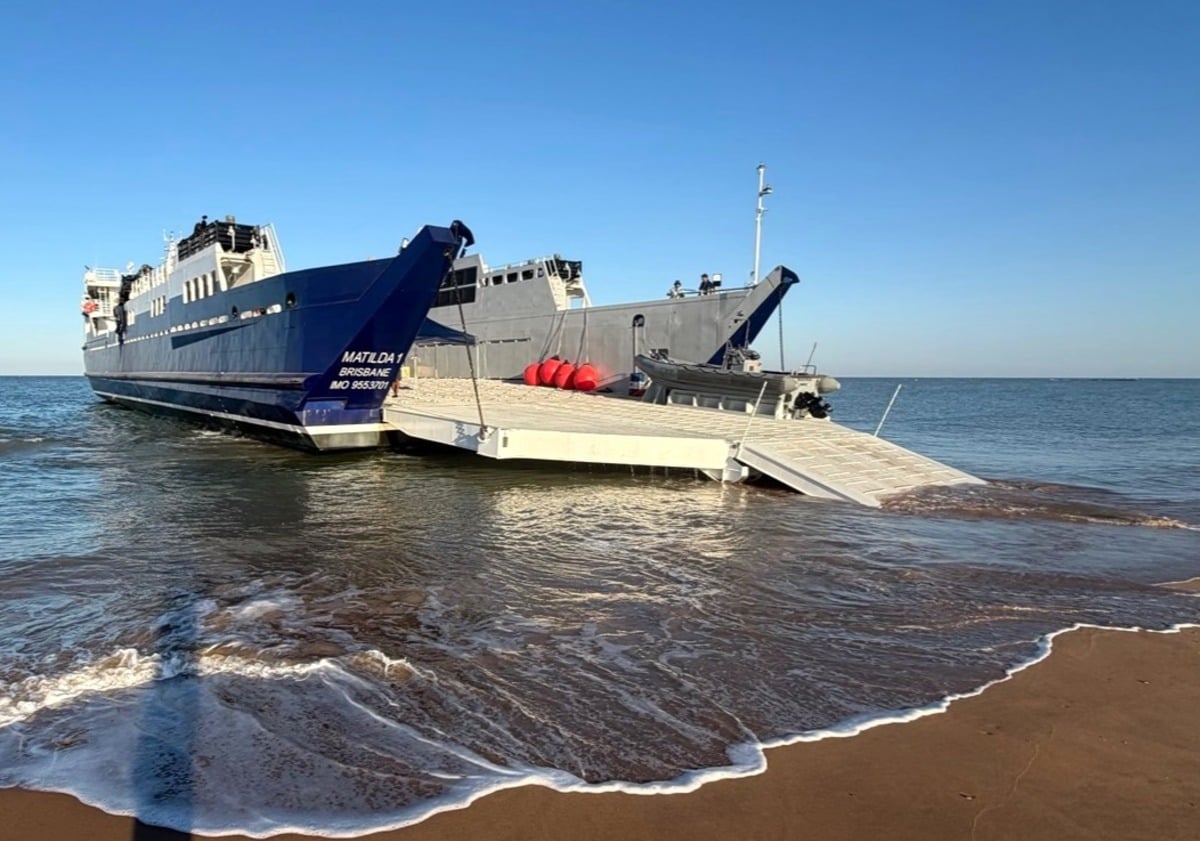
The US Marine Corps is finally acknowledging this fatal design limit. As the military shifts its focus to the vast distances of the Indo-Pacific, the old way of moving troops and supplies does not work anymore. The solution is not coming from a massive US defense prime. Instead, it is an Australian-designed ship called the Matilda 1 that is quietly rewriting the rules of amphibious logistics.
By flipping the entire concept of a landing craft backward—literally—this ship is showing how the military can transport heavy cargo across oceans without sacrificing beach access.
The Fatal Flaw of the Bow Ramp
For decades, amphibious warfare relied on a simple mechanism: sail forward, beach the bow, lower the ramp, and unload. While this worked for the beaches of Normandy or Iwo Jima, those operations happened with massive fleet support and short transit distances.
Modern conflict in the Pacific demands something entirely different. Small units of Marines need to scatter across remote islands, establish temporary outposts, fire anti-ship missiles, and quickly pack up before the enemy locates them. Doing this requires vessels that can travel thousands of miles on their own, often through rough seas, without needing a massive escort.
Traditional landing craft cannot do this. Their flat noses make blue-water transit incredibly inefficient.
- Severe wave slamming: Flat bows act like a wall against waves, forcing ships to slow down to a crawl in rough seas.
- Terrible fuel economy: Shoving a flat surface through water requires immense power, limiting the ship's operational range.
- High vulnerability: Landing craft are loud, slow, and easily tracked by modern surveillance systems.
If the Marines want to survive in a contested maritime environment, they need a vessel that behaves like a fast, efficient ocean-going ship during transit but still functions as a landing craft when it arrives.
How the Stern Landing Vessel Solves the Problem
The Australian naval architecture firm Seatransport came up with a beautifully simple solution: build a ship with a sharp, highly efficient bow for ocean travel, but put the landing ramp on the back.
This design is called a Stern Landing Vessel (SLV). When the Matilda 1 is traveling from port to port, it cuts through waves just like a standard commercial cargo ship or frigate. It handles rough seas with ease, maintains high speeds, and saves massive amounts of fuel.
When it comes time to deliver cargo to an unimproved beach, the captain simply turns the ship around and backs onto the shore.
Protected Propellers and Rudders
You might think backing a ship onto a beach would destroy the propellers and rudders. Seatransport solved this by housing the propulsion systems in twin skegs. These are heavy steel tunnels built under the hull that physically shield the propellers, shafts, and rudders from hitting the seabed. The ship can back into shallow water, discharge its cargo, and pull itself off the beach using its own power without damaging its vital components.
A Massively Wider Ramp
Traditional bow-landing craft have narrow ramps, usually restricted to five or six meters in width due to the structural limits of a ship's nose. Because the stern of a ship is naturally wider and structurally stronger, the Matilda 1 boasts a massive 12.7-meter-wide stern ramp. There are no height restrictions either. This means crews can load and unload heavy vehicles, shipping containers, and bulk cargo in a fraction of the time it takes on a traditional landing craft.
Inside the Matilda 1 Specs
The Matilda 1 is not just a concept on paper. Built by Karimun Anugrah Sejati in Batam, Indonesia, the 73-meter vessel has completed its contractor and end-user sea trials. It is now on a three-year charter with the US Marine Corps, operating primarily out of Darwin.
The real-world capabilities of this platform show exactly why the Pentagon is paying close attention:
- Cargo Capacity: The vessel can carry up to 550 tonnes of cargo. Its deck is configured to hold up to 84 TEU shipping containers, stowed either lengthwise or across the deck.
- Operational Range: It has a range of 4,000 nautical miles, allowing it to easily transit between remote Pacific islands without constant refueling.
- Rough Water Performance: Seatransport CEO Dr. Stuart Ballantyne noted that the ship can maintain 85 percent of its designed speed in head sea state five, a feat that would leave traditional landing craft battered and struggling to stay afloat.
- Propulsion: The vessel runs on an efficient quad-screw, diesel-electric propulsion system, offering high redundancy. If one engine fails, the ship keeps moving.
Lessons from Ukraine and Modern Drone Warfare
The conflict in Ukraine has highlighted the vulnerability of traditional landing ships. Black Sea fleet operations showed how explosive sea drones can easily target and sink large, slow amphibious vessels. A favorite target for these drone strikes has been the delicate hinge mechanism of bow-opening doors. If you damage the bow ramp, the ship cannot unload, and it often floods and sinks.
The Matilda 1 design actively addresses this modern threat. By moving the ramp to the stern, the most vulnerable opening on the ship is shielded from frontal drone attacks. The structural design of the stern ramp and the surrounding well deck are built to withstand heavy impacts and total swamping without losing stability.
If a drone does strike the ship from the rear, the quad-screw propulsion system offers enough redundancy to keep the ship maneuverable, while the water-tight integrity of the forward bow remains completely untouched.
Future-Proofing with Nuclear Power
While the Matilda 1 currently runs on a diesel-electric setup, its builders and designers are already looking at what comes next. Seatransport recently received approval in principle from the classification society Lloyd's Register for a hybrid propulsion system that is nuclear-ready.
The concept involves integrating micro modular reactors (MMRs) with the ship's existing electric grid. These small reactors, producing between 1.2 and 2.6 megawatts of power, would essentially grant the vessel unlimited range.
For the US military, this would solve the single biggest headache in Pacific logistics: fuel. A fleet of nuclear-powered stern landing vessels could run for years without ever needing to pull up to a diesel tanker, creating a self-sustaining supply chain across the entire ocean.
The Next Step for Defense Planners
Military planners need to stop thinking of amphibious operations as massive, coordinated beach assaults. The future of maritime conflict is distributed, fast, and light.
To adopt this new style of warfare, defense forces must move away from expensive, vulnerable 45,000-tonne amphibious assault ships and start building fleets of smaller, highly capable logistics vessels.
If you want to understand how the military will move supplies in a contested environment, watch how the US Marine Corps uses the Matilda 1 in Darwin over the next three years. The era of the flat-bow landing craft is officially over, and the future belongs to those who know how to back onto the beach.

:max_bytes(150000):strip_icc():focal(842x0:844x2)/twin-peaks-billy-zane-040425-70a37fe9a7cb4ffb9e7821106c80f296.jpg)

