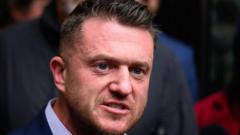
The British state just fell for the oldest trick in the digital outrage playbook. Again.
When the Metropolitan Police intercepted Stephen Yaxley-Lennon—better known by his stage name, Tommy Robinson—at Heathrow Airport, they thought they were exercising a clinical enforcement of border security. Instead, they handed a master class in martyrdom to a man who converts police scrutiny into cold, hard cash and millions of social media impressions. Expanding on this topic, you can find more in: Why the Sudden Chaos in Pakistan Occupied Kashmir Matters.
Mainstream media outlets ran the standard, boilerplate copy. They dryly noted that Robinson was detained for three hours under Schedule 3 of the Counter-Terrorism and Border Security Act 2019 following his return from Russia via Turkey. They dutifully printed the police statement about his seized communication devices. They framed it as a straightforward legal consequence for an activist who spent the preceding week stoking the fires of civil unrest in Belfast and Southampton.
This lazy consensus misses the entire mechanics of modern political theater. Observers at NPR have also weighed in on this matter.
The state thinks it is containing a threat. In reality, it is acting as the unpaid production crew for Robinson’s personal brand. By deploying sweeping counter-terrorism legislation against a professional provocateur, the government didn't suppress his message; they validated his entire worldview.
The Illusions of Schedule 3
Let’s be precise about what happened at Heathrow. Schedule 3 of the 2019 Act is an incredibly broad piece of legislation. It allows border officials to stop, search, and detain individuals to determine if they are engaged in "hostile activity" on behalf of a foreign state.
I have spent years watching the intersection of state power and digital activism. The standard assumption among legacy commentators is that these laws are effective deterrents. They are not. When applied to high-profile political figures, they operate as an accelerant.
The state’s logic is flawed from the outset. Consider the progression:
- Robinson travels to Moscow, meets Errol Musk, and returns via Turkey.
- He spends a week amplifying highly volatile footage of a stabbing in Belfast, driving a surge of anti-immigrant unrest.
- The police use specialized border powers to strip him of his iPhone and Samsung Galaxy.
The mainstream press views this as a robust defense of public order. But look at what happened the second Robinson was released. His team immediately hijacked his X account to blast out images of the official paperwork. The narrative was pre-written: The state is terrified of what I know. They want to uncover my sources. They are destroying free speech.
By using counter-terrorism laws rather than ordinary public order offenses, the authorities elevated Robinson from a localized rioter to an international political dissident. They implicitly told his two million followers that the state views his smartphone as a weapon of mass disruption.
The Economy of the Border Stop
The most naive premise of the current media coverage is that a police stop is a setback for a radical movement.
For Robinson, a border stop is a monetization event. Within minutes of his release, the call to action went live: "Please help kick off my legal fund for defence."
Imagine a scenario where a corporation gets hit with a regulatory fine, and that fine instantly triggers a massive spike in direct-to-consumer sales that quadruples their quarterly profit. You wouldn't call that regulatory enforcement; you'd call it a brilliant business model. That is the exact asymmetry of the modern populist grift.
Every minute Robinson spends in a holding room at Heathrow is worth thousands of pounds in micro-donations from an audience convinced he is fighting a lonely war against a tyrannical regime. The police think they are gathering intelligence by seizing his phones. Robinson has likely already backed up his critical data to secure servers, leaving the Met with a couple of pieces of hardware that served their primary purpose the moment they were confiscated: acting as props for his next fundraising campaign.
Dismantling the Premise of Free Speech
The defense mounted by Robinson’s camp is equally disingenuous, and the media’s failure to dissect it is embarrassing. His representatives claim this is "an attack on investigative journalism, nothing more nothing less."
Let’s correct the record immediately. Aggregating viral videos on X and adding inflammatory commentary during a riot is not investigative journalism. It requires no tradecraft, no verification, and no ethical standards. It is algorithmic amplification designed to maximize rage.
Yet, by using specialized counter-terrorism powers rather than standard criminal procedures, the state gives his legal team the perfect ammunition to argue precisely that. They have allowed him to cloak himself in the mantle of a persecuted reporter.
In July 2024, Robinson was cleared of a similar charge after refusing to give police his phone PIN at the Channel tunnel, precisely because a district judge concluded they couldn't be certain the stop was lawful. The state learned absolutely nothing from that failure. They ran the exact same script at Heathrow, expecting a different result.
The Real Cost of Symbiotic Hostility
The relationship between the Metropolitan Police and figures like Robinson isn’t adversarial; it’s symbiotic.
- The Police get to signal to the public that they are taking a hard line on the far-right actors driving violence in British and Irish cities.
- The Activist gets to signal to his base that the deep state is desperate to silence him.
The only loser in this equation is reality. The real mechanics of the unrest in Belfast—driven by complex socio-economic decay, post-conflict paramilitarism, and structural failures in local governance—are completely ignored. Instead, the narrative gets flattened into a binary psychodrama between a single influencer and the British border apparatus.
If the government genuinely wanted to neutralize the threat Robinson poses to public order, they would stop giving him the spotlight of high-stakes counter-terrorism theater. They would treat him like any other low-level public nuisance. They would let him clear customs in silence, stripping him of the one thing he cannot survive without: attention.
Instead, they gave him a three-hour interrogation, a dramatic phone seizure, and the perfect opening line for his next crowdfunding video: "I'm a terrorist again."
The Met didn't disrupt a network on Saturday night. They just funded its next three months of operations.